If you buy 6+ containers of exam paper a year, the gap between a direct exam table paper roll supplier and a regional medical distributor is no longer 5% — in 2026 it is 28–42% per landed case, plus 30 days of locked working capital.
Going direct to an exam table paper roll supplier in China saves clinic wholesalers 28–42% per landed case versus buying through a US or EU medical distributor — provided your annual volume is above one 20HQ container per quarter and you have the documentation discipline to import compliantly. Below that threshold, distributors win on convenience and credit terms. The decision is volume-driven and predictable; this guide gives you the exact crossover point.
What this guide answers
- The structural margin difference between supplier and distributor
- Landed-cost breakdown: factory FOB vs distributor invoice
- The volume crossover — when distributor still wins
- Hidden costs that often get missed
- Tracy’s experience from a recent clinic group conversion
- Risk profile by sourcing model
- FAQ for clinic wholesalers and private label brands
1. Why the Margin Gap Exists
A medical distributor’s business model is inventory plus access. They warehouse SKUs, extend net-30 or net-60 credit, and absorb small-order operational cost. Every one of those services has a cost, and that cost lives inside the unit price. An exam table paper roll supplier operating direct out of China sells you a manufacturer’s margin, not a distributor’s margin — but you pick up freight, customs, and stocking responsibility in return.
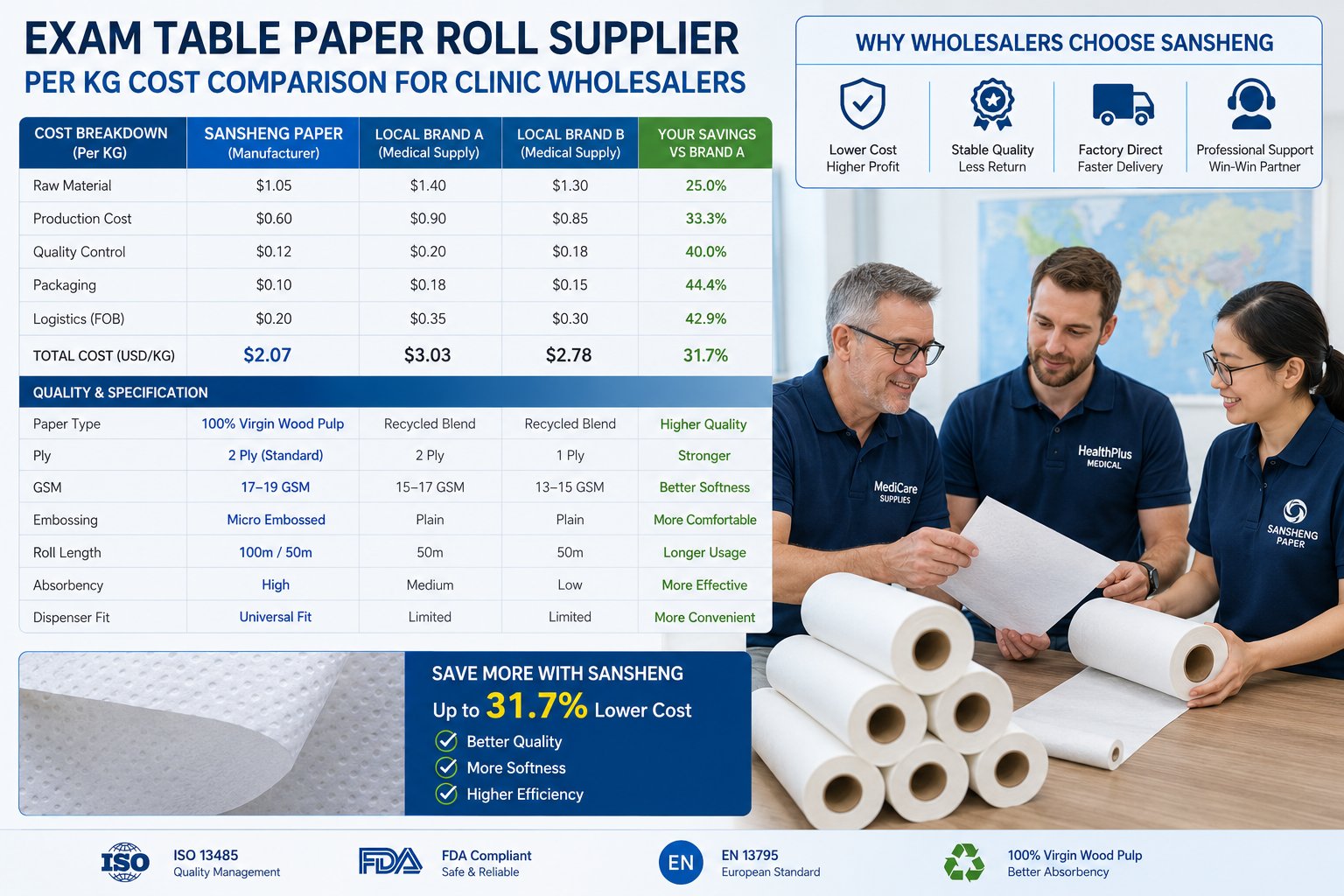
The structural difference for exam paper specifically: a Tier 1 China exam table paper roll supplier ships at $0.42–$0.68 per kg FOB depending on GSM and embossing. A US or EU medical distributor invoicing the same SKU sits at $1.05–$1.45 per kg delivered. Roughly half of that gap is real value (financing, warehousing, last-mile), and roughly half is margin defended by the distributor’s negotiation leverage with smaller buyers.
2. Landed Cost Breakdown — Per 40HQ Container
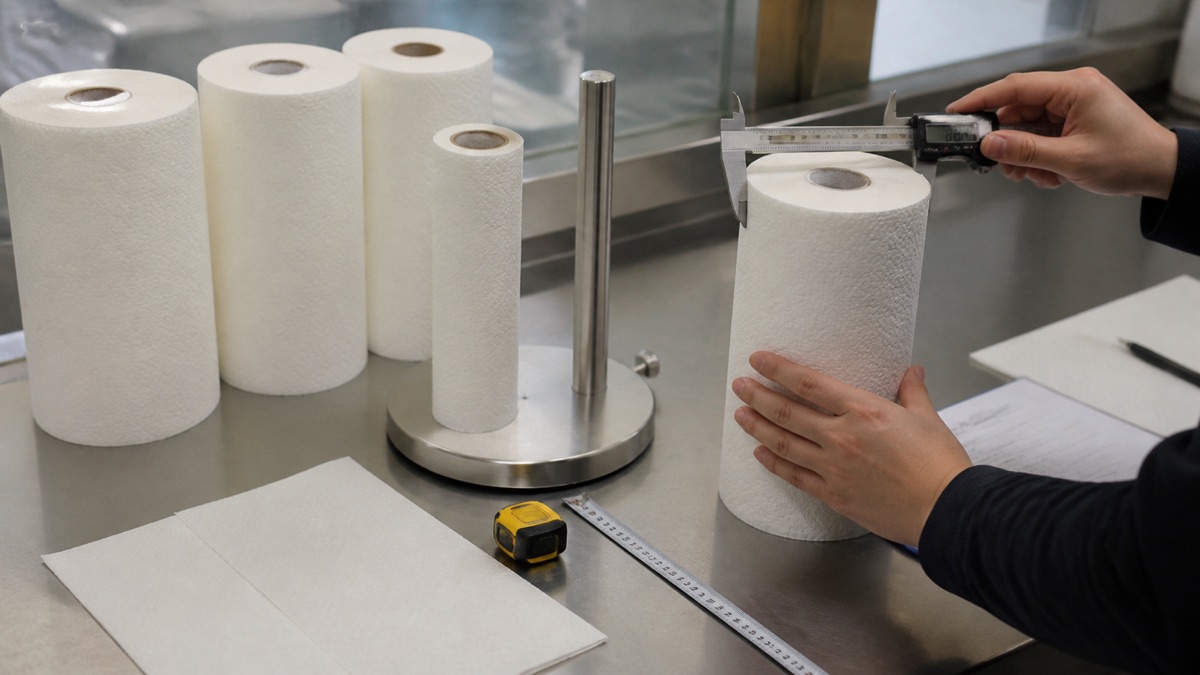
The honest comparison is total landed cost, not invoice line. Below is a representative 40HQ of 2-ply, 22 GSM, 50 cm × 60 m embossed couch rolls — a common SKU for European private clinics.
| Cost Line | Direct from Exam Table Paper Roll Supplier (China FOB) | Through Medical Distributor (EU Delivered) |
|---|---|---|
| Product (per kg) | $0.52 | $1.18 (already includes downstream costs) |
| FOB total (≈22 tonnes) | $11,440 | n/a |
| Sea freight FOB → main EU port | $1,800–$2,400 | included |
| Customs duty (HS 4818.90, EU MFN 0%) | $0 | included |
| VAT (recoverable for VAT-registered importers) | 22% (cash-flow only) | included |
| EU last-mile + warehousing | $1,200–$1,800 (if 3PL) | included |
| Total landed (one container) | ≈ $14,640 | ≈ $25,960 |
| Per-kg landed | $0.67 | $1.18 |
| Saving vs distributor | 43% | baseline |
The same arithmetic applied to a 20HQ on lighter SKUs (18 GSM US-spec exam paper) typically shows 28–34% savings — smaller, but still well outside distributor margin. For wholesalers running multiple paper categories, the same direct-supplier logic extends across airlaid napkins, paper towel, and facial tissue SKUs sourced from a single converted factory partner.
3. The Crossover Point — When a Distributor Still Wins
Direct sourcing is not free. The crossover for exam paper sits at roughly one 20HQ per quarter — below that volume, the distributor model often wins on net economics. Reasons:
- Working capital lock. Direct sourcing ties up $14k–$30k for 30–45 days (production + sea freight). Distributors typically extend net-30 or net-60, which means zero capital lock for the same SKU mix.
- Compliance overhead. An importer running their own documentation needs roughly 2–3 hours per shipment on certificate verification, customs paperwork, and lot reconciliation. At low volume that overhead is real cost.
- Stocking risk. One full container of a single SKU is too much inventory for many regional clinic distributors. Distributors absorb this risk; direct importers carry it.
- Lead time. Production-to-port runs 25–40 days from a competent exam table paper roll supplier. Distributor next-day delivery has its own working-capital value for emergency restocks.
Rule of thumb: if your annual exam paper spend is below $60k, distributors usually deliver better net economics. If it is above $100k, direct sourcing is almost always the dominant strategy — assuming the documentation infrastructure described in our examination paper rolls manufacturer page is in place.
4. Hidden Costs Most Buyers Forget to Model
- Demurrage and detention. A 3-day port delay on one 40HQ at a US west-coast terminal can run $1,200+. Build a 2-day buffer into landed cost when modeling direct sourcing.
- Currency exposure. FOB China is USD-quoted. EU and UK buyers carry FX risk between PO and payment — typically 1–3%.
- Insurance. Marine cargo insurance for a $14k container runs roughly 0.3–0.5% of invoice value. Often dropped from direct-sourcing models and shows up as a painful surprise after a single damaged shipment.
- Quality dispute cost. Direct sourcing means you negotiate quality claims with the factory; distributors absorb that friction. Budget for 1 SGS inspection per 4 containers as a hedge.
- Sample and tooling. First-order tooling for custom embossing or perforation can be $400–$1,500 and is typically rolled into the second order — not the first.
5. Tracy’s Experience — A Real Conversion
🏭 From Our Factory Floor
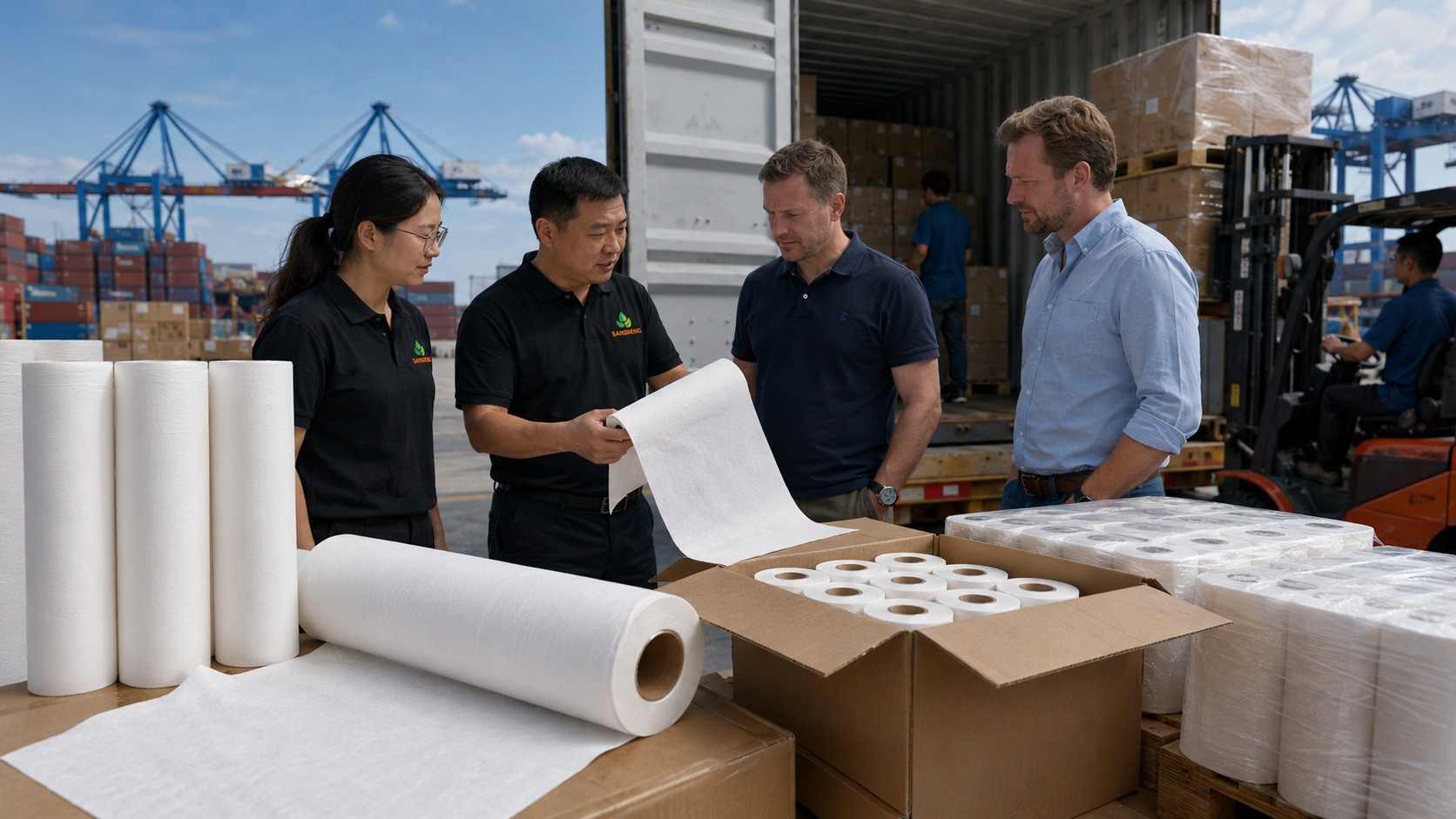
Real case (Q4 2025): A French regional clinic wholesaler with 28 clinic accounts was paying €1.34/kg through a Paris-area medical distributor for 22 GSM, 50 cm × 60 m couch rolls. Annual exam-paper spend ≈ €148,000 across 3 SKUs. We modeled their economics over a 90-day pilot: two 40HQs direct from Sansheng, FCL freight to Le Havre, 3PL last-mile to their 2 regional warehouses.
Result: Landed cost per kg dropped to €0.71 — a 47% saving on the dominant SKU. Annual gross saving ≈ €56,000. Offsets: €4,200 in 3PL warehousing they hadn’t paid before, €1,400 in pre-shipment SGS testing, and roughly 6 hours per month of additional admin time. Net Year-1 saving after offsets: €48,400. The wholesaler converted permanently in February 2026 and added paper towel and airlaid SKUs to the same supply line by April.
What we learned: The hardest part was not pricing — it was getting the buyer comfortable with 35-day lead time after years of next-day distributor service. The fix was a one-time strategic safety stock build (extra 30% on PO #1) plus an explicit reorder calendar. Once that operational pattern was in place, conversion was irreversible.
6. Risk Profile by Sourcing Model
| Risk Dimension | Direct from Exam Table Paper Roll Supplier | Through Medical Distributor |
|---|---|---|
| Quality drift between batches | Higher (verify with pre-shipment inspection) | Lower (distributor pre-qualifies) |
| Supply continuity (pulp shocks, freight) | Direct exposure | Buffered by distributor inventory |
| Working capital tie-up | 30–45 days per cycle | 0 (with credit terms) |
| Compliance liability | Importer’s responsibility | Distributor’s responsibility (until you re-sell) |
| Margin upside | Captured by you | Captured by distributor |
| Customization flexibility | High (custom GSM, width, embossing, print) | Limited to distributor’s SKU range |
The risk table is not a verdict — it is a budget. Direct sourcing trades distributor margin for managed risk. Buyers that internalize the operations win the margin; buyers that do not, give it right back through one bad container.
External context for tariff and trade risk: the USTR announced 2026 Section 301 review actions affecting several paper categories, and WTO data confirms exam paper HS 4818.90 retains 0% MFN duty in the EU. Direct importers should track those policy windows because they directly compress or expand the saving gap quantified in section 2.
7. FAQ for Clinic Wholesalers and Private Label Brands
What annual volume justifies switching from a medical distributor to a direct exam table paper roll supplier?
For exam paper specifically, $100k+ annual spend or 4+ × 20HQ-equivalent volume is the typical break point. Below that, the working-capital and compliance overhead usually offsets the unit-price gain. Above $200k, the case becomes overwhelming on math alone.
Can a China exam table paper roll supplier ship under our private label?
Yes. Standard offering covers private label printing on the carton and on the roll-end label, with typical lead time of 35–45 days from artwork approval. Custom-printed paper (logo embedded in the sheet) adds tooling cost and a 500 kg per SKU minimum.
How do I protect quality when buying direct, without a distributor’s pre-qualification?
Three-step protocol: (1) reference-sample first order, (2) pre-shipment third-party inspection for the first 3 containers, (3) ongoing random reel sampling on arrival. Combined cost is roughly 0.4% of invoice value — well below the saving captured.
What payment terms do credible exam table paper roll suppliers actually accept?
Standard for first orders: 30% T/T deposit, 70% against B/L copy. After 2–3 successful shipments, mature suppliers will extend to 30% / 70% against B/L copy with 30-day deferred final payment, or LC at sight. Net-60 is uncommon on direct China sourcing.
How do regional clinic wholesalers handle minimum order quantities below one container?
Two routes: (1) consolidate SKUs across product categories so one container mixes exam paper with a complementary line such as the jumbo roll tissue manufacturer supply, or (2) co-buy with a sister wholesaler to share a container. Both protect FOB economics without the inventory risk of a single-SKU container.
What’s the worst-case scenario in direct sourcing and how do I avoid it?
Worst case: arrival of an off-spec container with paperwork too thin to support a quality claim. Avoidance: contractually require batch traceability, pre-shipment lab report attached to BL, and a written QC protocol with photo evidence per pallet. Cost: zero to negotiate, irreplaceable if needed.
8. Final Take for the Wholesaler
For any clinic wholesaler running more than four containers of exam paper a year, an exam table paper roll supplier in China is not a “consider once” decision — it is the dominant strategy on math, with a manageable operational tax. The distributor model still wins below volume threshold, in markets where compliance liability sits with the seller, and in any account where credit terms are non-negotiable. Above that threshold, every quarter spent inside the distributor model is margin paid to a service you could buy cheaper, retail at higher contribution, and grow with the same buyer base.
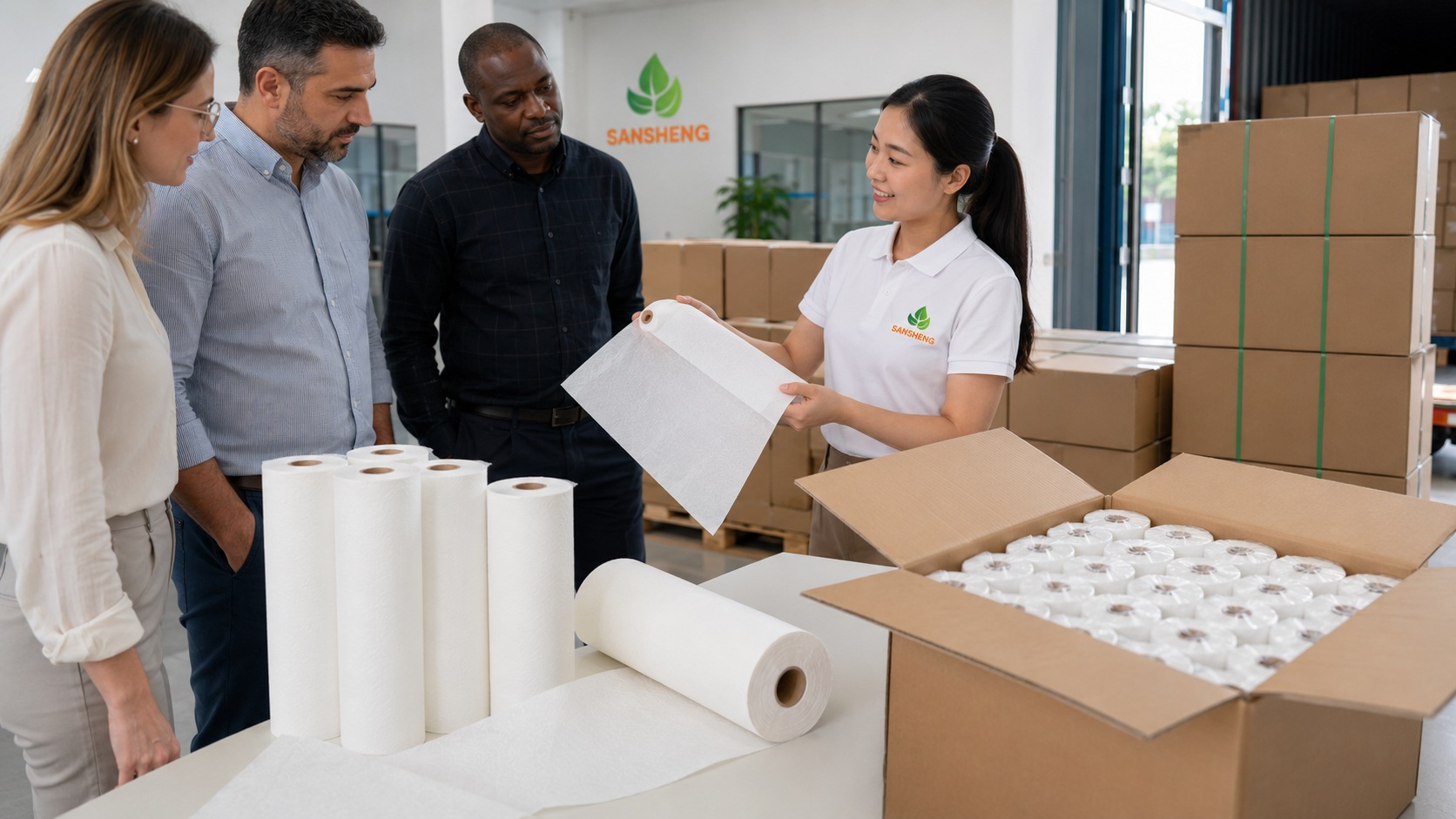
Run the numbers on your own exam paper spend
Send us your current SKU specs and annual volume. We’ll return a side-by-side landed-cost model versus your current distributor invoice — typically delivered within one business day, no obligation.
Tell us these 5 points to get a faster quote:
- Your country and target market
- Current SKU spec: GSM, width, length, ply, embossing
- Your name
Sales Manager at Sansheng Paper · 20+ years in tissue paper OEM & bulk export · LinkedIn