If you walk into Hall 10.1 without a script, you will leave with brochures and nothing else.
The Canton Fair Phase 3 runs May 1–5, 2026, and for any importer hunting a reliable toilet paper manufacturer, it is the single highest-density sourcing event of the year. Seven questions separate buyers who close a 40HQ trial order within 90 days from those who collect business cards and follow up to silence. Those questions cover production capacity proof, GSM and sheet-count verification, tariff mitigation documentation, OEM lead time, quality-rejection protocols, sustainable fibre sourcing, and payment terms flexibility. Ask all seven at the booth, and you compress weeks of email due-diligence into 20 minutes of face-to-face conversation. Sansheng Paper is exhibiting at Hall 10.1, Booth K43 — bring this guide and walk in ready.

In This Guide
- Why Phase 3 Is the Tissue Buyer’s Sweet Spot
- Q1: Can You Prove Your Monthly Output?
- Q2: How Do You Verify GSM Before I Leave the Booth?
- Q3: What Tariff Documentation Do You Provide?
- Q4: What Is Your OEM Lead Time for a First 40HQ?
- Q5: How Do You Handle a Rejected Shipment?
- Q6: Do You Hold FSC or ISO Certification?
- Q7: What Payment Terms Are Available for New Buyers?
- Booth Comparison Checklist
- Factory Floor Insight
- FAQ
Why Canton Fair Phase 3 Is the Tissue Buyer’s Sweet Spot
Canton Fair splits into three phases. Phase 1 covers heavy industrial goods; Phase 2 moves into electronics and gifts. Phase 3 (May 1–5) focuses on daily consumer goods — and paper products sit squarely in this window. That concentration matters: you can walk eight booths of toilet paper manufacturers in a single morning, compare samples side-by-side under the same light, and negotiate terms without the distracting noise of unrelated categories.
The global tissue market is valued at $23.2 billion in 2026, with B2B importers accounting for an outsized share of long-run contract volume. The effective US tariff on Chinese tissue — including the Section 301 layer — sits at roughly 57%, which means your sourcing conversation must now include a structured tariff discussion from minute one. Buyers who skip that conversation discover the cost problem six weeks into shipping negotiations.
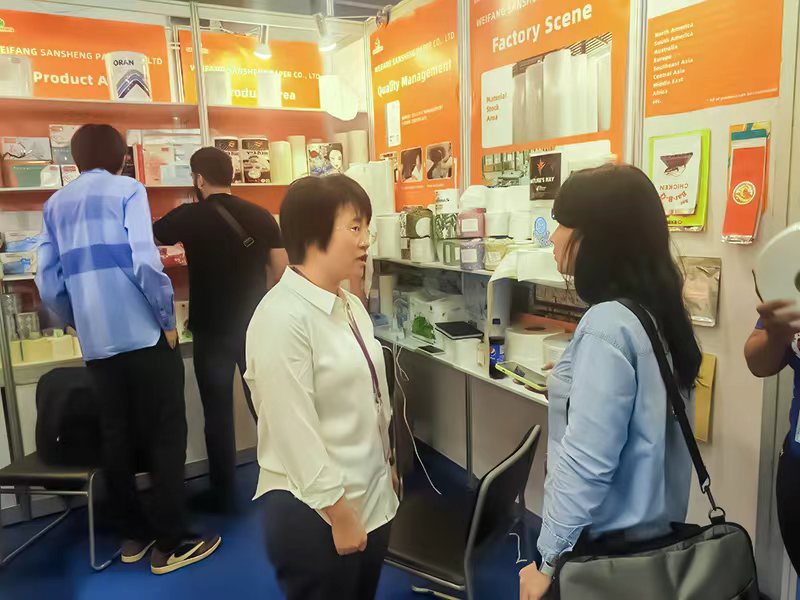
Sansheng Paper’s booth at Hall 10.1, Booth K43 stocks live samples, a product specification binder, and a dedicated English-speaking sales contact who can pull up production records on a tablet. The seven questions below are designed to be asked in order — each answer sets up the next.
Q1: “Can You Prove Your Monthly Output Right Now?”
The single biggest risk at a trade fair is a trading company presenting itself as a toilet paper manufacturer. Ask for output proof on the spot: a factory audit summary, a recent customs export record, or a photo of the production floor with visible machine serial numbers. A legitimate manufacturer will open a phone or tablet within 60 seconds. If the response is “we will send it by email,” treat that as a yellow flag.
- Ask for monthly output in metric tonnes, not packs or rolls — it is harder to inflate
- Request the number of production lines and the brand of tissue-making machines
- Ask whether the facility runs two or three shifts — single-shift factories struggle to meet seasonal surges
Sansheng Paper operates out of Shandong Province with multiple production lines and can provide export customs declarations on request at the booth.
Q2: “How Do You Verify GSM Before I Leave the Booth?”
GSM (grams per square metre) is the single most commonly misrepresented specification in tissue trade. A toilet paper manufacturer quoting “14 GSM per layer” can legally mean anything from 12.8 to 15.4 depending on internal tolerances. Ask whether they have a pocket GSM scale or calipers at the booth — many serious manufacturers bring one precisely because savvy buyers ask. If they do not, note it: quality culture starts on the exhibition floor.
Also ask about sheet count variance. A roll quoted at 200 sheets that consistently delivers 192 sheets creates a landed-cost discrepancy of 4% — invisible in sampling, painful at scale. Request a copy of their internal quality control protocol, specifically the AQL (Acceptable Quality Level) standard they apply to finished rolls.
- Target GSM range for standard jumbo-roll-derived toilet paper: 12–16 GSM per layer
- Softness benchmark: ≥ 40 on a standard hand-feel panel for premium SKUs
- Sheet count variance acceptable range: ±2% per roll, ±1% per case average
Q3: “What Tariff Documentation Do You Provide?”
With the effective US tariff on Chinese tissue running at approximately 57% (base MFN + Section 301 + any additional executive orders), every toilet paper manufacturer booth conversation must now open a tariff documentation discussion. Ask specifically for:
- HS code confirmation (most toilet paper ships under 4818.10)
- Country-of-origin certificate template they can provide
- Whether they have experience shipping to tariff-sensitive markets via bonded warehouse or third-country processing
- First Sale valuation documentation for US Customs (not all manufacturers understand this — the ones that do are operating at a higher level)
According to USTR trade guidance, importers bear the compliance burden for origin claims — a manufacturer who can supply complete documentation shifts that risk significantly.

Q4: “What Is Your OEM Lead Time for a First 40HQ?”
OEM timelines are where promises diverge from reality. A jumbo roll tissue manufacturer who controls their own core production can quote 25–35 days from artwork approval to container stuffing. One who outsources embossing, perforation, or packaging will add 10–20 days and introduce a second point of quality failure. Ask the question and watch the answer — a well-prepared manufacturer will break it down into phases: artwork approval, plate production, trial run, QC, packaging, loading.
Also ask about the sample-to-order gap: what is the minimum order quantity for a custom sample run, and does that sample cost offset against the first commercial order? This signals how much financial risk the manufacturer is willing to share with a new buyer.
Q5: “How Do You Handle a Rejected Shipment?”
This question sorts manufacturers who have genuinely shipped to international buyers from those who have mostly served domestic distributors. A manufacturer with real export experience will answer with a specific protocol: pre-shipment inspection options, what percentage of defects triggers a replacement shipment versus a credit, and whether they carry cargo insurance that names the buyer as an additional insured.
Ask whether they accept paper towel and toilet paper third-party pre-shipment inspections — SGS, Bureau Veritas, or Intertek. Resistance to third-party inspection is a significant red flag. Manufacturers who welcome inspection have internalized quality culture; those who resist it are hoping you do not look too closely.
Q6: “Do You Hold FSC or ISO Certification?”
Certification questions close deals in Europe, Canada, Australia, and increasingly the US retail channel. FSC chain-of-custody certification is verifiable online in real time — pull up the FSC certificate database on your phone at the booth and search the supplier’s name. If the certificate does not appear, it is either expired or fictional. ISO 9001 and ISO 14001 require third-party audit bodies; ask for the certificate number and the name of the certification body.
For buyers targeting the European market, also ask about EUDR (EU Deforestation Regulation) compliance readiness — this regulation is moving toward enforcement in late 2026 and will require pulp-origin traceability documentation. Manufacturers who have not begun preparing will cause compliance headaches 18 months from now.
- FSC: verify at info.fsc.org using the certificate number
- ISO 9001/14001: ask for the name of the certification body (must be UKAS/DAkkS-accredited)
- EUDR: ask whether their pulp suppliers provide SFC or PEFC chain-of-custody declarations
Q7: “What Payment Terms Are Available for New Buyers?”
Standard first-order terms from a Chinese toilet paper manufacturer are 30% T/T deposit, 70% against Bill of Lading copy. That is industry-standard and reasonable. What separates confident manufacturers from desperate ones is flexibility: will they accept a Letter of Credit for orders above $50,000? Do they work with trade finance platforms like PrimeRevenue or Taulia? Can they stage delivery across two containers if your warehouse is constrained?
Also ask about price validity: a FOB Qingdao price quoted at Canton Fair that is not locked in writing can drift 3–5% by the time you confirm the purchase order eight weeks later. Request a written price validity period — 30 days is standard, 60 days signals a manufacturer comfortable with their cost base.
| Question | Green Light Answer | Red Flag Answer | Time at Booth |
|---|---|---|---|
| Q1: Output proof | Shows customs record or audit on tablet within 60 sec | “We’ll email you the factory info” | 3 min |
| Q2: GSM verification | Has calipers or scale; quotes AQL standard | Quotes GSM verbally with no instrument | 4 min |
| Q3: Tariff docs | Can name HS code + CO template immediately | “Our agent handles customs” | 3 min |
| Q4: OEM lead time | Gives phase-by-phase breakdown (25–35 days) | Vague “4–6 weeks” with no detail | 3 min |
| Q5: Rejection protocol | Names specific inspection bodies; accepts 3rd-party | Resistance or “we don’t have defects” | 3 min |
| Q6: Certification | Certificate number verifiable online on the spot | Cannot provide certificate number | 2 min |
| Q7: Payment terms | Standard 30/70 T/T + willing to discuss LC | Demands 50%+ deposit with no flexibility | 3 min |
🏭 From Our Factory Floor
Real case: At Canton Fair 2024, a buyer from Eastern Europe spent 45 minutes at our booth, ran through every one of these questions, and left with three roll samples and our customs export declaration from Q3 2023. Eight weeks later, she confirmed a 40HQ order of 2-ply embossed toilet paper. What stood out was that she weighed a sample roll on a pocket scale she had brought herself — 98g against our quoted 97g. That level of preparation told us she was serious, and we matched her seriousness with a 60-day price validity letter on the spot.
What we learned: Buyers who ask hard questions are not difficult buyers — they are low-churn buyers. A toilet paper manufacturer who bristles at Q5 (rejection protocol) will cost you a container replacement negotiation sooner or later. The 20 minutes of discomfort at the booth is free insurance.

Before You Leave Hall 10.1: What to Collect at Every Booth
Beyond the seven questions, leave every tissue booth with five physical items:
- At least one roll sample (not a flat sheet sample — a full wound roll)
- A product specification sheet with GSM, ply count, sheet dimensions, and sheet count per roll
- An FOB or CIF price indication (even a range is useful for benchmarking)
- A business card with a direct WhatsApp number — not a general company number
- The name of the person who will be your account manager post-fair
For facial tissue and paper napkin requirements, ask whether the manufacturer offers consolidated SKU sourcing — this reduces your freight cost per unit and simplifies your supplier count. Most manufacturers who offer toilet paper also run napkin and facial tissue lines and welcome the combined inquiry.
FAQ: Canton Fair 2026 Toilet Paper Manufacturer Questions
What hall and booth number is Sansheng Paper at Canton Fair Phase 3 2026?
Sansheng Paper exhibits at Hall 10.1, Booth K43 during Canton Fair Phase 3, May 1–5, 2026. The booth is staffed by an English-speaking sales team and stocked with live product samples, specification binders, and production documentation available on request.
How do I verify a toilet paper manufacturer is actually a factory, not a trading company?
Ask for their customs export declaration from the last 12 months — a genuine toilet paper manufacturer will have one and can show it on a device at the booth. You can also request a factory aerial photo with visible machine installations, or ask for the machine brand and model number of their tissue-making equipment. Trading companies typically cannot answer either question without consulting a third party.
What is the minimum order quantity for a custom OEM toilet paper order from a Chinese manufacturer?
Most mid-to-large Chinese toilet paper manufacturers set MOQ at one 40HQ container for custom OEM orders — approximately 20–22 metric tonnes depending on roll count and packaging configuration. Some manufacturers offer mixed-product containers to help new buyers reach MOQ across multiple SKUs. Always confirm whether the MOQ applies to a single SKU or to the container total.
How does the 57% effective US tariff affect toilet paper sourcing math from China?
At a 57% effective rate (base MFN + Section 301), the landed cost of Chinese tissue into the US increases substantially versus pre-2018 levels. Buyers are mitigating this through a combination of: (a) higher volume to spread fixed logistics costs, (b) first-sale customs valuation to reduce the dutiable value, and (c) diversifying into non-US markets where Chinese tissue remains highly competitive. Ask your toilet paper manufacturer what experience they have with each of these approaches.
What certifications should I ask for at a Canton Fair tissue booth?
At minimum: FSC chain-of-custody (verify online at info.fsc.org with the certificate number), ISO 9001 quality management, and ISO 14001 environmental management. For EU buyers, also ask about EUDR pulp-traceability readiness. For food-service tissue (napkins, kitchen towels), ask for food-contact safety compliance under FDA 21 CFR or EU Regulation 1935/2004.
How long does it take from meeting a toilet paper manufacturer at Canton Fair to receiving a container?
The realistic timeline is 10–14 weeks from booth meeting to container arrival at port of destination. This breaks down as: 2–3 weeks for sample approval and PO issuance, 4–5 weeks production lead time, 1 week pre-shipment inspection and loading, and 3–4 weeks ocean transit (to US West Coast or Europe). Manufacturers with production pre-scheduled for post-fair peak can sometimes compress production to 3 weeks for standard SKUs.
Summary: Your 20-Minute Booth Protocol
Canton Fair Phase 3 gives you access to dozens of tissue manufacturers in a single venue over five days. The buyers who leave with signed LOIs rather than business cards are the ones who enter each booth with a prepared question set, a pocket scale, and a willingness to disengage quickly from suppliers who cannot answer Q1 and Q2. The seven questions in this guide are your protocol.
Sansheng Paper at Hall 10.1, Booth K43 welcomes hard questions. We export to 30+ countries and have shipped over 200 containers in the past three years. If you are sourcing airlaid napkins or TAD paper alongside toilet paper, we can handle all three product lines from one facility, simplifying your supplier management significantly.
For buyers who cannot attend the fair in person, the same seven questions apply over video call — and we are happy to schedule a factory walkthrough via live video stream to replace the booth visit entirely.

Meeting at Booth K43 — or Can’t Make It to Canton Fair?
Send us your 5-point brief and we will have a specification sheet, sample set, and indicative FOB price back to you within 24 hours.
Tell us these 5 points to get a faster quote:
- Your country and target market
- Product type (toilet paper, facial tissue, napkins, or mix)
- Your name
Email: tracyzhang@sspaperpack.com | WhatsApp: +86 157 6268 3071
Sales Manager at Sansheng Paper · 20+ years in tissue paper OEM & bulk export · LinkedIn