On May 6, 2026, the USTR opened a 60-day comment window that decides whether Section 301 tariffs on Chinese paper towel imports continue, expand, or expire — and importers who do not place locked-FOB orders before August 22 are betting on a policy outcome no one in Washington can predict.
The 2026 USTR Section 301 review introduces a hard decision deadline for any TAD paper towel manufacturer’s North American customer: lock FOB pricing on remaining 2026 needs by mid-August, or accept that tariff structure on HS 4818.20 paper-towel imports may change with 30 days’ notice. Lists 3 and 4A — the two action tranches that cover most tissue and towel categories — automatically terminate July 6 and August 23, 2026 respectively if no party requests continuation. Continuation requests opened May 7. Distributors moving now are not betting on which way the policy lands; they are buying option value on price stability through year-end.

What this brief covers
- What changed on May 6, 2026
- Which paper-towel HS codes sit inside Lists 3 and 4A
- The three policy scenarios and their distributor impact
- Why “locking FOB now” beats waiting
- Mechanics of a locked-FOB order with a China supplier
- Tracy’s experience: a US distributor’s pre-emptive container play
- FAQ for North American buyers
1. What Changed on May 6, 2026
On May 6, 2026, the U.S. Trade Representative published a Federal Register notice initiating the second statutory four-year review of Section 301 tariffs on imports from China. The review process is structured by tranches:
- List 3 (effective Sep 21, 2018, originally 25% tariff): comment window May 7 – July 5, 2026; terminates July 6, 2026 if no continuation request received
- List 4A (effective Aug 23, 2019, currently 7.5% tariff): comment window June 24 – August 22, 2026; terminates August 23, 2026 if no request received
The procedural detail matters because the trigger to continue a tranche is a private-sector request — typically filed by domestic producers seeking ongoing protection. The default if no request is filed is termination. The default if requests are filed is review and likely continuation, possibly with modification. Source documentation is on the Office of the US Trade Representative portal under “Section 301-Tariff Actions.” Importers who source adjacent SKUs — including a paper towel manufacturer for conventional volume alongside TAD — should track both List 3 and List 4A timelines, because the two tranches affect different parts of the same supply line.
For a TAD paper towel manufacturer’s customers, this is the first hard policy decision point in nearly four years. Distributors who priced 2026 forecasts on List 4A continuing at 7.5% are right now updating those models for three scenarios.
2. Which Paper Towel HS Codes Are Affected
The Section 301 lists are indexed by 8-digit HS code. The relevant tissue and towel positions:
| HS Code | Product | Section 301 List | Current Tariff (May 2026) |
|---|---|---|---|
| 4818.20.0020 | Paper towels in rolls — including TAD | List 4A | 7.5% + MFN |
| 4818.10.0000 | Toilet paper in rolls or sheets | List 4A | 7.5% + MFN |
| 4818.50.0000 | Articles of apparel (industrial wipes) | List 3 | 25% + MFN |
| 4803.00.4000 | Tissue paper, parent reels | List 3 (partial) | 25% + MFN where applicable |
| 4818.90.0000 | Other paper for household/sanitary use (incl. exam paper) | List 4A | 7.5% + MFN |
For most TAD paper towel manufacturer SKUs heading to US clinics, foodservice accounts, retail private label, and hospitality, the operative line is 4818.20.0020. Today that lands at 7.5% Section 301 + 0% MFN duty + customs fees. If List 4A terminates without continuation, the 7.5% disappears. If continuation comes with rate modification, the rate could move in either direction. Customs broker reference data on rates is published by US Customs and Border Protection.
3. The Three Scenarios and Distributor Impact
| Scenario | Probability (analyst consensus) | Effect on 4818.20 | Distributor Impact |
|---|---|---|---|
| (A) Continuation at current 7.5% | ~55% | No change | Status quo; locking FOB still useful for price stability |
| (B) Continuation with rate increase (7.5% → 15–25%) | ~30% | Tariff doubles or triples | $0.04–$0.08 per roll landed cost increase; pricing reset across retail tier |
| (C) Termination (rate to 0%) | ~10% | Tariff disappears | $0.03 per roll landed cost decrease; margin windfall for distributors with inventory |
| (D) Other (carve-out, scheduled phase, exclusions) | ~5% | Mixed | Product-by-product analysis required |
The asymmetry matters. Scenario A is no surprise. Scenario B is the most disruptive — distributors who failed to lock pre-tariff FOB inventory face a forced retail price reset in Q4 2026. Scenario C is a windfall for inventory holders. The right play for a North American distributor is the same in all three: lock as much Q3–Q4 inventory as your warehousing tolerates, before the policy decision lands.
4. Why “Lock FOB Now” Beats Waiting
Locking FOB is not a tariff prediction — it is a price-stability purchase. Three distinct value drivers:
- FX hedge. USD/CNY moved 2.3% in Q1 2026 alone. A locked FOB quote in USD for a 60-day production window converts FX risk to the supplier.
- Pulp price hedge. Softwood pulp index rose 6.8% over the last six months. China TAD paper supplier quotes update on pulp index with 2–4 week lag; locked FOB pricing absorbs the next move for the buyer.
- Tariff window option. Even if List 4A continues at 7.5%, a Q2 FOB-locked container that arrives in Q3 is no worse off than today. If the rate moves higher in Q4, the locked inventory is significantly better off. The downside is zero; the upside is a real possibility worth pricing in.
Distributors who don’t lock are not “waiting for clarity” — they are accepting three open-ended exposures simultaneously, on the assumption that the rate stays exactly where it is. The 55% Scenario A probability is the rest of the distribution’s silent expense.
5. Mechanics of a Locked-FOB Order
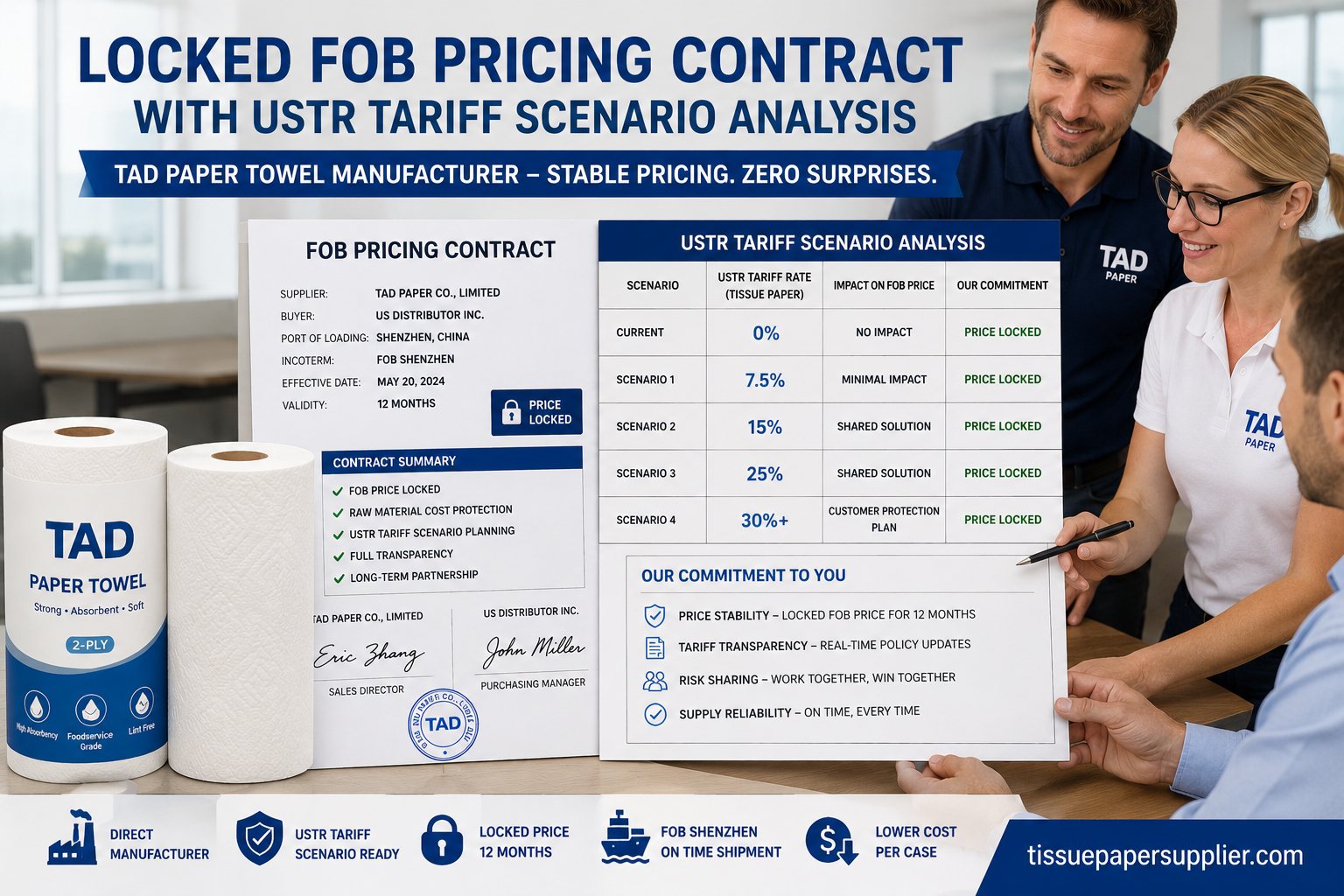
A locked-FOB arrangement with a credible China supplier covers four contract dimensions explicitly:
- Price lock: FOB USD per kg fixed for production windows of 60, 90, or 120 days. Standard is 90 days.
- Quantity flexibility: Buyer commits to a minimum quantity (often 70% of stated forecast), with option to lift up to 130% at locked price.
- Shipment schedule: Production slots reserved by month; buyer confirms each container 30 days before BL date.
- Force majeure carve-outs: Pulp index movement above ±8% triggers re-negotiation; tariff changes within the lock window are buyer’s risk, not supplier’s (USTR is not force majeure).
For mid-size distributors running 8–24 containers a year, this structure is the difference between predictable Q4 pricing and a scramble in November. Suppliers that won’t offer it are typically too small to absorb their own pulp risk, which means they will pass it back to you anyway when the next pulp move hits.
🏭 From Our Factory Floor
Real case (Q2 2026): A US Midwest foodservice distributor with annual TAD spend ≈ $480k locked a 12-container FOB pricing arrangement on April 18, 2026 — three weeks before the USTR notice landed. The lock covered May–September production at $1.42/kg FOB, with 90-day price stability and ±25% volume flex. After the May 6 notice, the same supplier’s spot quote moved to $1.49/kg (4.9% lift in 3 weeks) on the same SKU. The locked-FOB customer effectively pre-paid the increase out of the locked-price differential — at zero downside given the volume flex provision.
What we learned: Locked FOB is not about predicting policy. It is about removing one variable from the Q4 P&L. The Midwest distributor’s competitor next door, running spot quotes through their supplier, will be repricing through end-of-year. Predictability has commercial value, and importers who internalize this become the buyers that suppliers prioritize on capacity allocation when supply tightens.
6. The Tariff Math for a 40HQ TAD Container
Concrete example: 35 GSM 1-ply TAD hand towel, 21 cm × 80 m, 19,500 rolls per 40HQ, FOB China $1.45/kg, container weight ≈ 10.4 t.
| Line Item | Scenario A (7.5%) | Scenario B (15%) | Scenario B’ (25%) | Scenario C (0%) |
|---|---|---|---|---|
| FOB value (10.4 t × $1.45) | $15,080 | $15,080 | $15,080 | $15,080 |
| Section 301 tariff | $1,131 | $2,262 | $3,770 | $0 |
| Sea freight + duty processing | $2,400 | $2,400 | $2,400 | $2,400 |
| Landed cost (per container) | $18,611 | $19,742 | $21,250 | $17,480 |
| Landed per roll (÷19,500) | $0.954 | $1.012 | $1.090 | $0.896 |
| Delta vs current | baseline | +6.1% | +14.2% | -6.1% |
A retail SKU that today wholesales at $1.15/roll faces a +14% landed-cost increase in Scenario B’. That cost has to land somewhere — distributor margin, retail price, or a renegotiated supplier deal. For buyers running adjacent paper categories, the same arithmetic applies across the line — see jumbo roll tissue manufacturer for parent-reel HS classification and facial tissue manufacturer for adjacent 4818.x positions.
7. The Distributor Playbook for Q3 2026
- Lock FOB pricing on at least 60% of forecast Q3–Q4 demand by end of May 2026. The locked-price window typically runs 90 days; the policy decision lands inside that window.
- Pre-position inventory in bonded warehouse if storage capacity allows — bonded space defers tariff payment until withdrawal, and a tariff cut after withdrawal still applies.
- Diversify supplier base across 2–3 TAD paper towel manufacturer accounts. Single-supplier exposure during a policy reset window is a known historical failure point.
- Update downstream contracts with tariff-adjustment clauses. Sophisticated retail buyers already expect this; smaller accounts may need education but the conversation now is far easier than in November.
- Reserve customs broker capacity for the August 23 transition window. Brokers will be over-booked; lock priority now.
- Bundle adjacent SKUs into the same negotiation — buyers running an examination paper rolls manufacturer account or airlaid napkins manufacturer account on the same HS 4818.x family can lock supplementary lines under the same FOB-lock structure.

8. FAQ for North American Importers
When exactly is the August 22, 2026 deadline relevant for a TAD paper towel manufacturer’s North American buyer?
August 22, 2026 is the last day for domestic industry representatives to file a continuation request on List 4A — the tranche that covers HS 4818.20.0020 (paper towels). If no request is filed, the 7.5% tariff terminates on August 23. If a request is filed, USTR review continues and rates may change. Either way, the period from May to August is the window for buyers to lock price-stable inventory.
Can a US importer file the continuation request themselves?
Yes — but importers benefit from termination, not continuation. Continuation requests typically come from domestic producers seeking ongoing protection. As an importer, your strategic position is to either stay neutral or, if comment-eligible, file in support of termination or rate reduction.
If I lock FOB and the tariff drops, am I worse off than spot buyers?
Tariff is paid by the US importer of record on entry, not bundled into FOB. A FOB lock at $1.45/kg combined with a tariff drop from 7.5% to 0% would deliver the lower tariff to you regardless of when FOB was locked. Locked FOB protects against price increase; it does not block tariff decrease.
What’s the practical scope of a 90-day FOB price lock?
Typical lock covers a 60–120 day production window. Standard arrangement: lock $1.45/kg for production scheduled in May–July 2026, with shipment confirmation 30 days before BL. Buyer commits to 70–100% of stated volume; supplier reserves capacity. Extension beyond 120 days is uncommon because pulp-price volatility outpaces the lock’s economic value.
Are there shorter HS code workarounds for Section 301?
No legitimate workaround exists for accurately classified TAD paper towel imports. Misclassification to dodge the tariff is customs fraud and triggers binding rulings, penalties, and personal liability. The legitimate route is locked FOB pricing, bonded warehouse positioning, and the post-review tariff outcome.
How long do USTR Section 301 reviews typically take to conclude?
The first review (2024) ran roughly 18 months from notice to final determinations. The 2026 review is structured similarly. Expect partial determinations through Q4 2026 and full implementation by mid-2027. For Q3–Q4 2026 import planning, the relevant uncertainty window is the next 90 days.
What if my TAD paper towel manufacturer cannot offer a FOB price lock?
It is a supplier-capacity signal worth taking seriously. Suppliers without the financial discipline to absorb 90-day pulp-and-FX risk usually pass downstream pricing volatility back to the buyer the moment market moves. Re-source to a TAD paper towel manufacturer that can stand behind structured pricing — financial capacity for FOB locking is a leading indicator of overall mill quality and capacity allocation discipline.
9. Final Take for the Importer
The 2026 USTR review is not the first Section 301 inflection North American buyers have faced, and it will not be the last. The distributors who emerge with stable customer pricing and protected margins are not the ones who guessed the policy outcome — they are the ones who priced the optionality, locked the FOB, and pre-positioned inventory before the deadline window narrowed. Whether List 4A continues at 7.5%, moves to 25%, or expires entirely, the right move for any TAD paper towel manufacturer’s North American customer was the same: lock now. The cost of being wrong is zero. The cost of waiting is potentially $0.04–$0.08 per roll across 2026 volume.
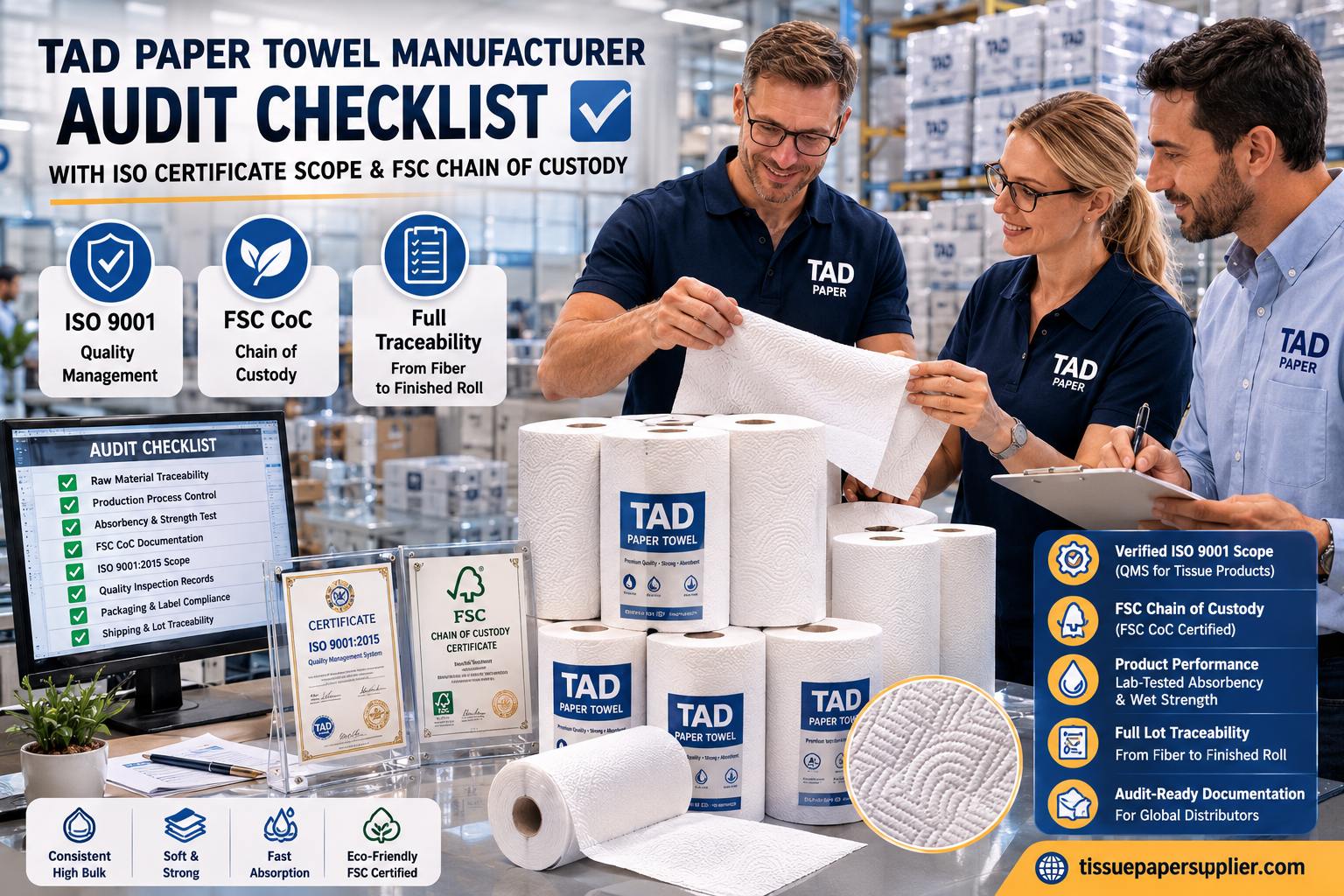
Lock TAD paper towel FOB pricing before the August window closes
Send us your forecast volume for Q3–Q4 2026 and target SKU spec. We’ll return a 90-day FOB lock proposal with quantity-flex provisions and scenario-based landed-cost modeling — typically within one business day.
Tell us these 5 points to get a faster quote:
- Your country and target market
- Annual forecast volume and SKU spec
- Your name

Sales Manager at Sansheng Paper · 20+ years in tissue paper OEM & bulk export · LinkedIn