The most expensive mistakes in TAD sourcing are not made by junior buyers — they’re made by experienced procurement managers who recognize the obvious red flags and miss the seven that actually cost money.
When evaluating a TAD paper towel manufacturer, the seven red flags most procurement managers miss are: (1) ISO 9001 certificate with the wrong scope, (2) “TAD” marketing on a non-TAD machine line, (3) opaque pulp sourcing without FSC chain-of-custody, (4) absorbency claims unsupported by lab method or third-party data, (5) sample-shipment-vs-production drift in repeat orders, (6) no production batch traceability infrastructure, and (7) financial-discipline gaps that show up as quote inconsistency. None look dramatic on a vendor questionnaire. Each costs real money in landed-cost terms — typically 6–18% per container — once the order ships. This guide names each one with the diagnostic test for catching it before PO.
The 7 red flags
- ISO 9001 certificate with the wrong scope
- “TAD” marketing on a non-TAD machine line
- Opaque pulp sourcing — no FSC chain-of-custody
- Absorbency claims without lab method or third-party data
- Sample-to-production drift in repeat orders
- No production batch traceability
- Quote inconsistency and financial-discipline gaps
Red Flag 1 — ISO 9001 Certificate with the Wrong Scope
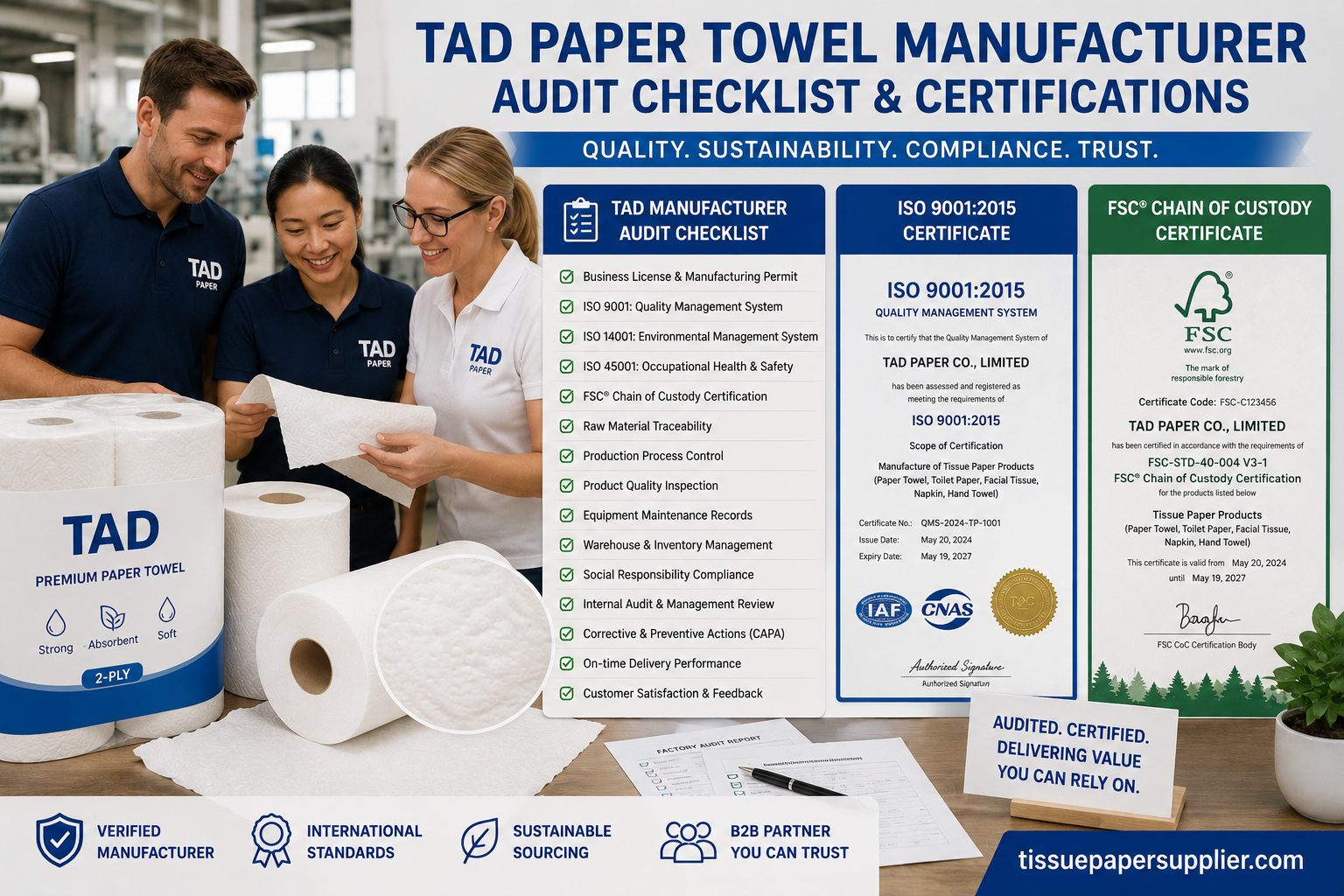
Every credible TAD paper towel manufacturer claims ISO 9001. Most buyers verify the certificate exists. Almost no buyers read the scope line on the certificate — and that’s where the gap hides.
ISO 9001 certificates list a specific scope of activities. A scope reading “manufacture of corrugated packaging materials” does not cover tissue or hand-towel production. A scope reading “general paper manufacturing” is too vague to verify. The scope you want, for a TAD paper towel manufacturer claim, reads explicitly: “manufacture of tissue paper, kitchen paper, hand towels including through-air-dried tissue products.” Anything else is the supplier hoping you won’t check.
- Diagnostic: Request PDF of the certificate. Verify on the issuing registrar’s website (DNV, BSI, TÜV, SGS, Bureau Veritas).
- Pass criteria: Scope explicitly covers tissue/towel/TAD; certificate currently valid; surveillance audits up to date.
- Fail signal: Scope mentions adjacent industries only; certificate expired; registrar verification fails.
For documentation depth across product categories, the same scope-verification logic applies to a TAD paper supplier claim and to facial tissue manufacturer or jumbo roll tissue manufacturer certifications. The certificate without the right scope is worthless regardless of which product line you’re sourcing.
Red Flag 2 — “TAD” Marketing on a Non-TAD Machine Line
This is the most common substitution in the industry, because it requires zero capital expenditure to execute. A factory runs conventional dry-crepe paper on a standard Yankee cylinder, then applies a TAD-style embossing pattern on the finishing roller. The visible finish mimics TAD; the underlying paper is conventional. FOB price quoted at TAD premium; gross margin captured by the factory.
Catching this requires two diagnostics:
- Machine-line documentation. Ask the factory to identify the specific TAD or e-TAD line by manufacturer (Valmet, ANDRITZ, Toscotec) and year of installation. A genuine TAD paper towel manufacturer can answer in five minutes; a fake one will deflect with “proprietary” or change the subject.
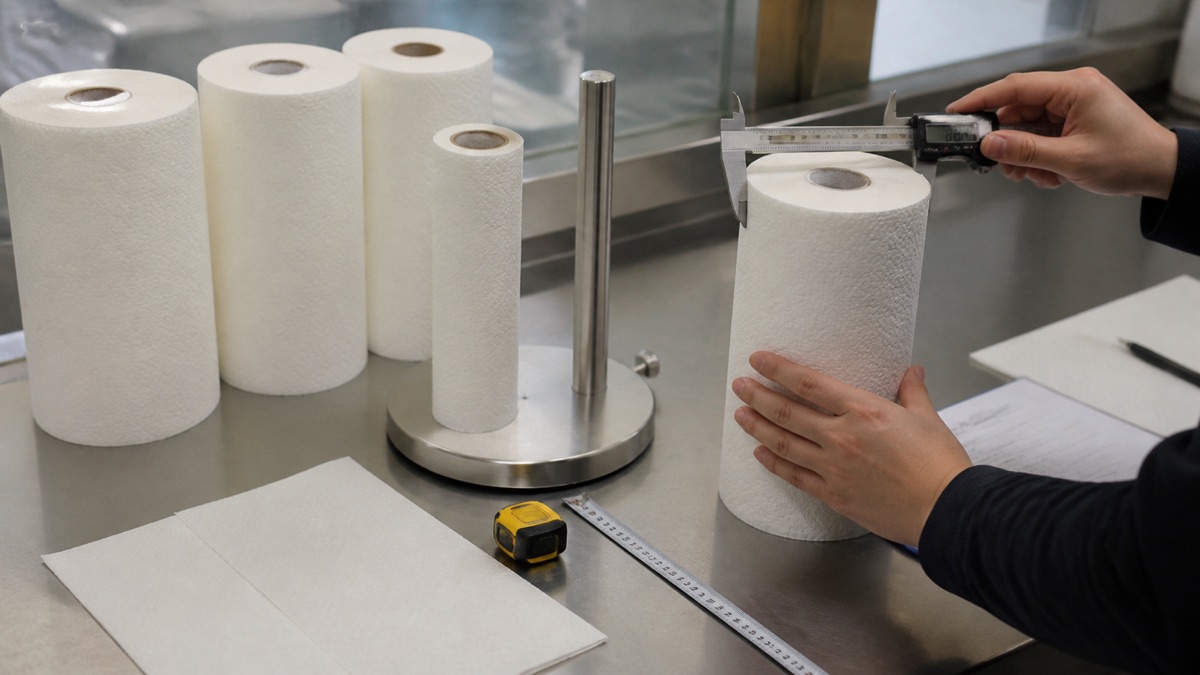
- Caliper test on sample. Genuine TAD product at 35 GSM shows 380+ μm single-sheet caliper. “TAD-style” conventional caps at 260 μm. The test takes 4 minutes and a $180 digital tissue caliper. Buyers running this test catch fake TAD on the first sample without exception.
Red Flag 3 — Opaque Pulp Sourcing
Pulp accounts for 55–65% of unit cost in TAD production. A factory that won’t disclose pulp sourcing in writing has one of three problems: they’re swapping pulp grades between samples and production, they’re sourcing from sanctioned or non-FSC suppliers, or both.
The protection is FSC chain-of-custody documentation. A credible TAD paper towel manufacturer maintains a Forest Stewardship Council chain-of-custody certificate, with traceability logs that connect specific pulp lots to specific production batches. The certificate alone is necessary but not sufficient — you also need the willingness to share lot-level traceability records, which is what FSC compliance actually requires.
| Pulp Sourcing Signal | What It Means | Buyer Action |
|---|---|---|
| Named pulp supplier (Suzano, Arauco, Bracell, etc.) | Transparent supply chain | Proceed; verify FSC numbers |
| Generic “South American hardwood” without supplier name | Possible spot-market sourcing | Demand FSC documentation |
| “Mixed pulp” or “depending on market” | Pulp grade rotates between samples and production | Lock pulp specification in PO; require sample-match |
| Refusal to disclose | Material risk of non-compliant or substandard pulp | Re-source — do not negotiate |
Red Flag 4 — Absorbency Claims Without Method or Data
Every TAD paper towel manufacturer quote sheet claims “high absorbency.” Almost none cite a measurement method, a numeric result, or a third-party verification. The credible suppliers do all three:
- Method named: TAPPI T 432 (immersion) or ISO 12625-8 (basket method)
- Numeric result: e.g., “9.8 g water per 1 g fiber (TAPPI T 432, conditioned 23°C / 50% RH)”
- Third-party verification: SGS, Intertek, or TÜV lab report with reference number, dated within 90 days
A supplier that delivers all three on first request is credible. A supplier that delivers numbers without method is making them up. A supplier that names a method but won’t share a lab report is hoping you don’t ask twice. For a serious procurement decision, ask all three at the RFQ stage — the response speed and depth predicts shipment quality more reliably than the FOB quote.

Red Flag 5 — Sample-to-Production Drift in Repeat Orders
The most expensive supplier failure mode is not a bad first order — it is a good first order followed by silent quality drift on repeat orders. The buyer relaxes pre-shipment testing after one or two successful shipments. The supplier substitutes cheaper pulp or runs conventional product through the TAD-emboss roller. Complaints surface 60–90 days later, after the next 2–3 containers are already at destination.
Three buyer-side controls catch this:
- Continuous pre-shipment QC. Five tests per container (absorbency, GSM, wet/dry tensile, caliper, OBA), every container, no exceptions. Cost ≈ $235 / container via third-party lab.
- Batch reference samples. Buyer retains a sealed 1-roll sample from each container, labeled with lot/BL date. If a future container fails, the buyer has a verified baseline to compare against.
- Annual unannounced audit. One physical audit per year of the supplier’s production floor, on a date the supplier doesn’t know in advance. Catches operational drift the documentation hides.
Red Flag 6 — No Production Batch Traceability
A real TAD paper towel manufacturer can match any reel from a shipped container back to:
- The pulp lot number it was made from
- The production shift and machine line that produced it
- The QC log entry for that specific batch
- The packing list line that placed it in the container
This is not optional infrastructure. It is the basic ERP discipline of any serious export factory and the foundation of any quality claim, recall, or compliance response. When a supplier cannot match a reel to a pulp lot within 30 minutes of being asked, two things are simultaneously true: (a) their internal records are too thin to support quality investigation, and (b) any FSC, BRC, or HACCP certificate they hold may not survive a real audit.
BRCGS audit standards require this level of traceability for any food-contact paper product. Compliance is a baseline expectation, not a premium feature. Buyers serving foodservice or hospital channels should require traceability demonstration as part of the supplier qualification process — not after a problem arises.
Red Flag 7 — Quote Inconsistency and Financial-Discipline Gaps
The final red flag is procedural rather than product-level. Watch how a TAD paper towel manufacturer behaves around quotes, contracts, and payment terms:
| Behavior | Signal |
|---|---|
| Quote moves significantly between week 1 and week 3 for the same spec | Either weak pricing discipline or fishing for buyer’s budget |
| Accepts every pricing pushback without resistance | Starting price was high — what else is inflated? |
| Refuses to provide reference customers in your region | Either no real export track record or references that wouldn’t verify |
| Won’t sign basic contract with quality, delivery, and quantity clauses | Operating on verbal commitments — no enforcement mechanism |
| Cannot offer FOB price lock for 60–90 days | Insufficient financial capacity to absorb pulp/FX risk → passes volatility back to buyer |
| Pushes for 50% deposit or full payment before BL | Cash-flow stressed; possibly bridge-financing on your deposit |
None of these are dramatic — but each is a leading indicator of operational discipline. A factory that runs sloppy quotes also tends to run sloppy QC. Procurement managers who pattern-match across all six indicators in the table reach a more accurate supplier-quality verdict than any single technical audit would deliver.
🏭 From Our Factory Floor
Real case (Q4 2025): A European retail distributor evaluated three TAD paper towel manufacturer candidates for a private-label hand-towel line. Candidate A had the cheapest FOB ($1.32/kg). Candidate B was mid-priced ($1.41/kg). Candidate C was the highest quote ($1.49/kg). The buyer’s instinct was Candidate A. We walked them through all seven red flags in this guide. Result:
- Candidate A failed on Red Flag 4 (no third-party lab data), Red Flag 6 (couldn’t demonstrate traceability), and Red Flag 7 (accepted a 12% price drop within 24 hours).
- Candidate B passed all seven; FOB pricing held firm; full documentation set delivered within 48 hours.
- Candidate C also passed all seven but was over-priced relative to product spec — likely a margin-fishing quote.
What we learned: The buyer awarded Candidate B. Eight months later, the contract is on its sixth container with zero quality complaints. Candidate A subsequently went bankrupt in Q1 2026 — the financial-discipline signals were already visible at the quote stage. The “expensive” supplier evaluation discipline cost about 12 hours of senior procurement time and prevented a six-figure write-off.

The 7-Flag Audit Worksheet
For procurement teams running formal supplier qualification, the seven flags translate into a structured worksheet. Each candidate scored Pass / Fail / Partial across the dimensions below.
| Red Flag | Diagnostic Test | Pass Threshold |
|---|---|---|
| 1. ISO 9001 scope | Certificate PDF + registrar verification | Scope covers tissue/towel/TAD; current; valid |
| 2. Real TAD machine line | Name machine + caliper test at 35 GSM | Caliper 380+ μm; specific machine documented |
| 3. FSC pulp sourcing | FSC certificate + lot traceability log | Current FSC COC; lot-to-batch records available |
| 4. Absorbency data | Method + number + third-party report | TAPPI/ISO method named; ≥9.0 g/g; SGS/Intertek/TÜV report |
| 5. Continuous QC | Pre-shipment test commitment in contract | Written clause; cost-shared structure |
| 6. Batch traceability | 30-min demonstration of reel → lot → shift | Sub-30-min response with documentation |
| 7. Financial discipline | Quote stability + reference checks + FOB lock | Stable quotes; 3+ regional references; FOB lock offered |
For buyers stocking adjacent SKUs, the worksheet extends without modification to airlaid napkins manufacturer and examination paper rolls manufacturer evaluations. The seven flags are technology-agnostic — they apply to any premium B2B paper sourcing decision.
FAQ for Procurement Managers
How long does a thorough 7-flag audit take in real procurement workflow?
For a single TAD paper towel manufacturer candidate, plan 8–12 hours of senior procurement time spread over 7–10 calendar days. Most time goes to certificate verification, reference checks, and waiting on lab reports. The audit pays for itself the first time it eliminates a low-quality candidate from your shortlist.
Can a smaller boutique TAD supplier hit all seven flags?
Yes — and size is not the qualifier. Some 30,000-tonne-per-year specialist mills pass cleanly on all seven; some 200,000-tonne integrated mills fail on operational discipline indicators. The qualifier is documentation rigor, not capacity. Mid-size mills with strong export track records are often the best fit for B2B importers.
What if a TAD paper towel manufacturer fails one flag but passes six?
Depends on which one. Failures on Flag 1 (wrong ISO scope), Flag 2 (no real TAD line), or Flag 6 (no traceability) are not negotiable — they indicate structural problems. Failures on Flag 4 (third-party data) or Flag 7 (quote stability) can sometimes be remediated through contract-clause structure. Failure on Flag 5 (continuous QC) is a buyer-side choice you can impose regardless.
How frequently should I re-audit an existing TAD supplier?
Annually at minimum, with quarterly documentation refreshes (current ISO/FSC certificates, recent lab reports, lot-level traceability sample). Continuous QC on every container handles the operational drift; annual audit handles structural changes (ownership, scope, line changes).
Where can I check FSC and ISO certificates without going through the supplier?
FSC certificates: info.fsc.org public certificate search by certificate number or company name. ISO certificates: registrar’s website (DNV, BSI, TÜV, SGS). Both verifications take under 10 minutes and protect against forged or expired certificates being passed off as current.
Do these red flags apply equally to TAD-style conventional and genuine TAD product?
Flags 1, 3, 5, 6, 7 apply identically. Flags 2 and 4 are TAD-specific — they catch the “fake TAD” substitution that’s specific to this product category. For buyers genuinely sourcing conventional product knowingly, Flags 2 and 4 should be reframed against conventional-product specs rather than dropped.
Which flag catches the largest dollar value of supplier failures historically?
Flag 2 — fake TAD substitution. The pricing premium TAD commands ($0.30–$0.50/kg over conventional) means a buyer who pays TAD pricing for conventional product loses 25–40% of FOB value, recurring on every container until detected. The single caliper test catches it. Yet many buyers never run it.
Final Word for Procurement
The seven flags in this guide are not exotic. Each one is well known inside the industry. What makes them red flags for procurement is that they hide in plain sight on a standard vendor questionnaire — the supplier ticks every box without the box actually verifying anything. The fix is to convert each tick into a diagnostic test with a numeric or documentary pass criterion. The fix is not more questions. It is harder questions, with verifiable answers, against a written audit standard. Procurement managers who run this discipline qualify suppliers that hold quality across three-year contracts. Procurement managers who skip it move suppliers every twelve months and write off the cost of switching as the cost of doing business.

Audit-ready TAD paper towel manufacturer documentation in one package
Send us your audit framework or RFQ. We’ll return the full documentation set against all seven flags — ISO scope, FSC chain-of-custody, third-party lab reports, batch traceability sample, and locked FOB pricing — typically within one business day.
Tell us these 5 points to get a faster quote:
- Your country and target market
- Product spec: GSM, ply, embossing, roll size
- Your name

Sales Manager at Sansheng Paper · 20+ years in tissue paper OEM & bulk export · LinkedIn