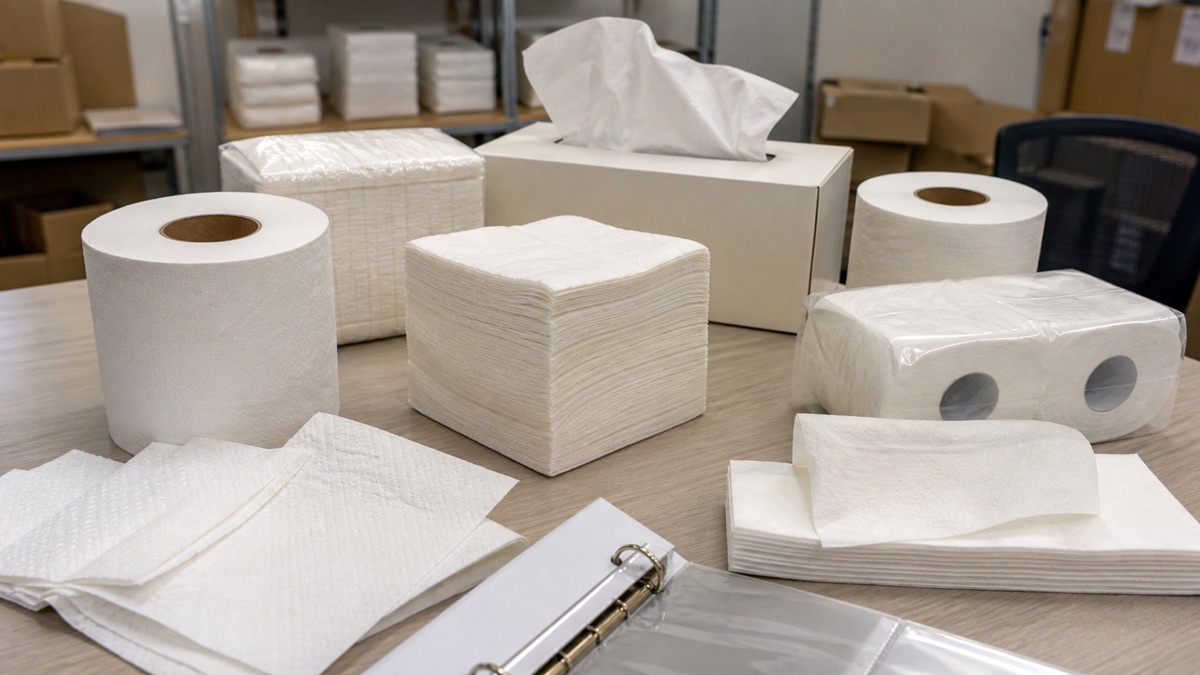
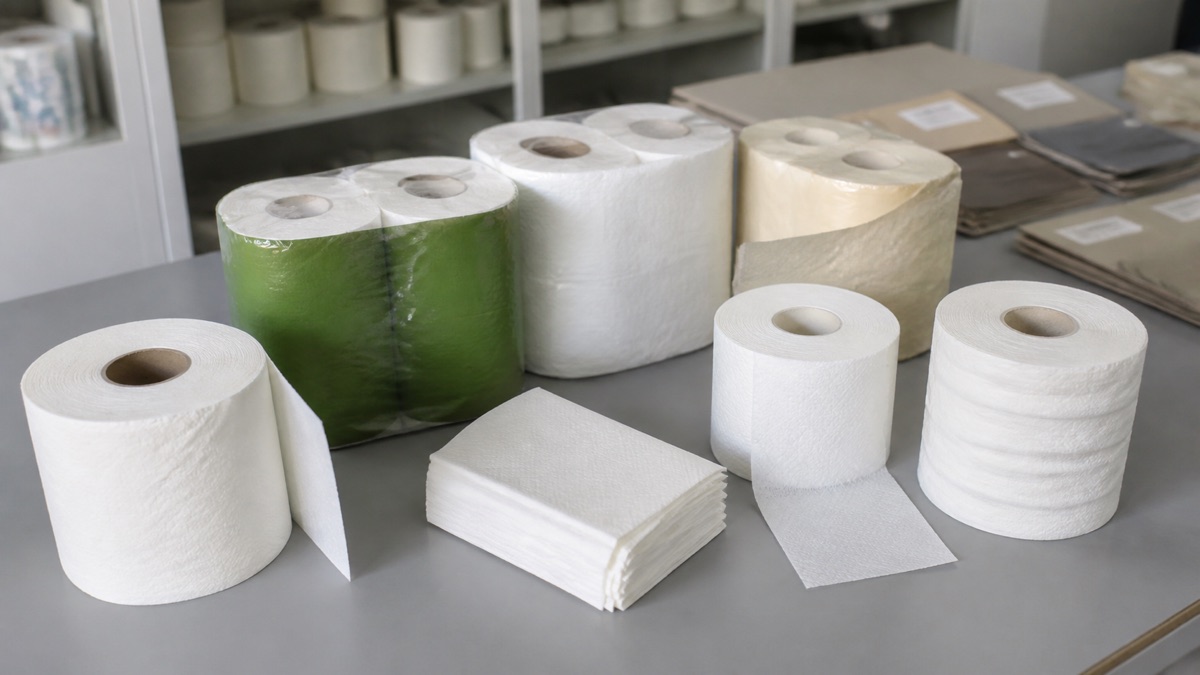
North America holds 27% of the global airlaid market and is the fastest-growing region for 2026 — but the structurally larger story is which suppliers are capturing that growth. Hint: it is not the legacy domestic mills.
North American foodservice and hospitality airlaid demand is growing roughly 29% year-over-year on premium SKUs, with full-service hotel adoption up 20% and QSR chain conversion accelerating across all three top-tier brands. The supply response is splitting cleanly: legacy US converters are holding flat-to-declining on volume while China-based airlaid napkins manufacturers gained roughly 18% of the incremental US tonnage over the past 12 months. Two structural reasons drive this — quality has reached US-mill parity, and FOB-plus-freight delivers landed costs 22–35% below comparable domestic SKUs. This brief unpacks the trend for North American distributors and brand owners planning 2026 H2 sourcing.
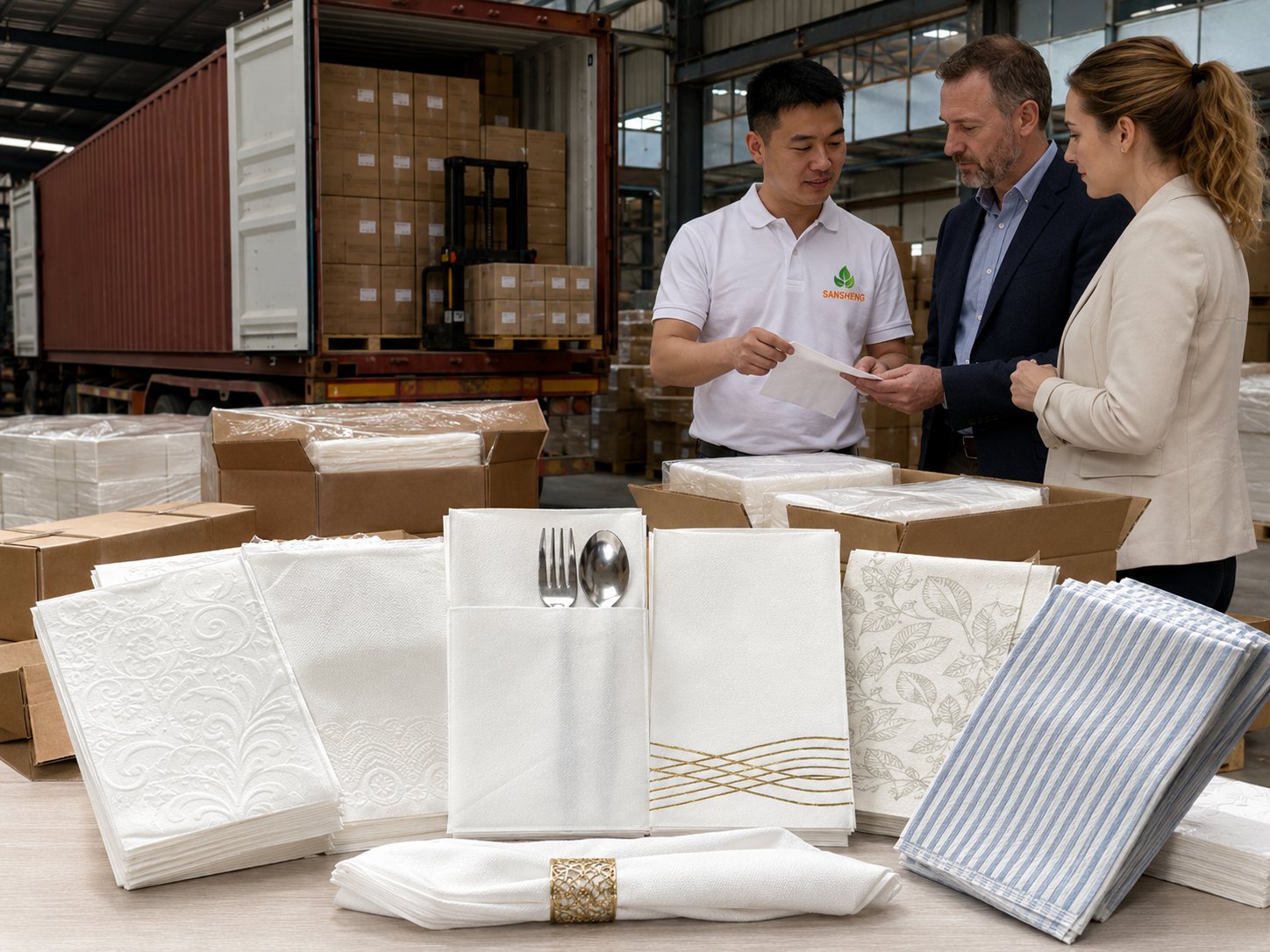
What this market brief covers
- The North American demand surge — concrete numbers
- Why premium hotel and QSR chains are switching suppliers
- Domestic mill vs China airlaid napkins manufacturer — landed cost math
- The quality-parity inflection point
- Tracy’s experience: a US Midwest distributor’s first 6 containers
- Sourcing playbook for North American buyers in 2026 H2
- FAQ for North American procurement
1. The North American Demand Surge — Concrete Numbers
The 2026 numbers across major analyst sources align on direction even when they differ on magnitude. North America represents 27% of the global airlaid market. The premium segment — airlaid napkins for hospitality and full-service foodservice — is growing at roughly 6.2% CAGR through 2033, with the US market specifically running closer to 8% on premium SKUs. Tabletop adoption rose 20% over the past 18 months. Premium wipes adoption is up 27% globally with North America leading.
The underlying drivers, per American Forest & Paper Association sector commentary, are well-documented: hospitality labor costs rising at 6–9% annually, sustainability mandates tightening on plastic alternatives, and end-consumer expectations elevating across all hospitality tiers. The supply response — who actually fills the new demand — is where the strategically interesting story sits.
2. Why Premium Chains Are Switching Suppliers
Five interlocking reasons drive the rotation away from legacy domestic suppliers toward Chinese airlaid napkins manufacturers:
- Capacity constraints at US mills. Domestic TAD and structured tissue capacity is largely committed to existing accounts. New volume requires either capacity expansion (capital-intensive, 18–24 month lead time) or import sourcing. Import is winning.
- Custom-spec lead times. A premium hotel chain commissioning a Pantone-color, branded-embossed airlaid napkin can move from artwork to first container in 35–45 days via a Chinese supplier. Equivalent US mill custom-run lead times are 90–120 days minimum.
- Landed-cost differential. Premium 60 GSM color-custom airlaid lands in US East/West Coast at $1.42–$1.68 per kg ex-bond from China versus $1.95–$2.40 from major domestic mills.
- Documentation depth. Chinese exporters operating to EU and US standards routinely deliver FSC chain-of-custody, food-contact compliance, and ISO 9001 audit trails as standard PO deliverables — matching or exceeding domestic supplier documentation discipline.
- Custom flexibility. Single-container minimums on Pantone-matched runs are standard with credible Chinese suppliers; US mills typically require 5+ containers for similar customization.
The trend is not a price-only play. Premium-tier buyers care about brand quality and supply reliability before they care about per-kg cost. Where Chinese supply has earned share is precisely on those non-price dimensions — once quality reached parity, the cost advantage became the tiebreaker, not the driver.
3. Landed Cost Math — Domestic vs China Sourcing
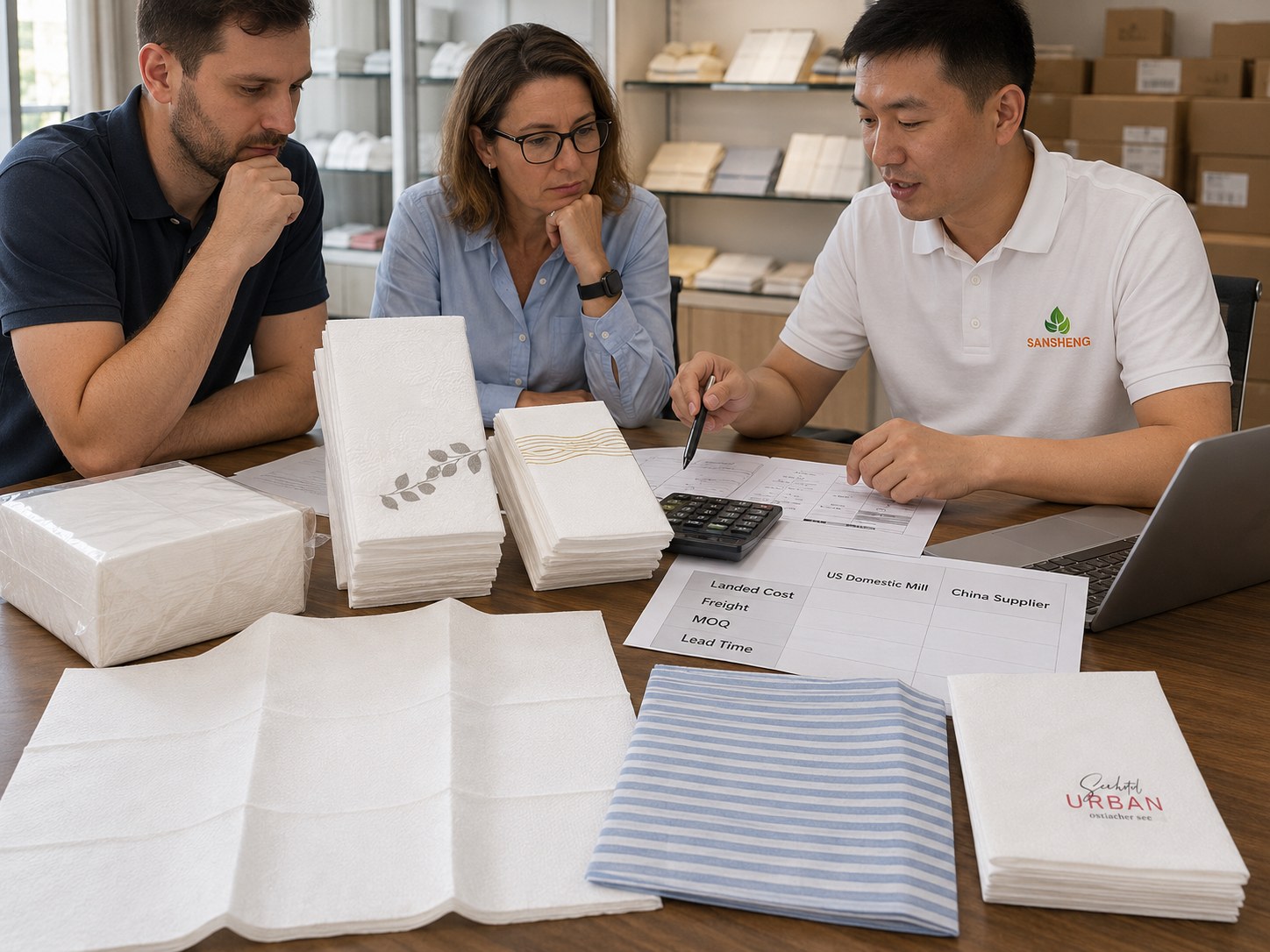
Representative comparison: 60 GSM diamond-embossed airlaid napkin, Pantone-custom color, premium hospitality SKU, 33×33 cm folded, 12-pack carton, 50 cartons per pallet.
| Cost Line | Domestic US Mill | China Airlaid Napkins Manufacturer |
|---|---|---|
| Mill/FOB per kg | $2.15 | $1.48 FOB Shenzhen |
| Per container ≈ 10 t | $21,500 | $14,800 |
| Sea freight (no domestic equivalent) | — | $2,400 |
| Customs + duty (4818.30 MFN 0%) | — | $0 |
| Section 301 (List 4A @ 7.5%) | — | $1,110 |
| Inland to East Coast warehouse | $1,200 | $900 from port |
| Total landed | $22,700 | $19,210 |
| Per kg landed | $2.27 | $1.92 |
| Savings vs domestic | baseline | 15.4% |
The 15% landed-cost saving extends to roughly 22–28% on volume-tier accounts after distributor margin compression and longer-term FOB lock pricing. For a North American distributor running 12–24 containers per year, annual savings sit in the $40,000–$140,000 range — substantial but not dramatic at the unit-economics level. The strategic value is supply reliability and custom-spec speed, captured in the savings on top.
4. The Quality-Parity Inflection Point
For two decades, the standard objection to importing airlaid from China was quality variability. That objection lost its force across 2023–2025. Three engineering developments closed the gap:
- Modern TAD/airlaid lines in China: Multiple Chinese mills now operate ANDRITZ or equivalent TAD/airlaid converting lines installed within the past 8 years, with US-mill-equivalent process control
- Pulp sourcing parity: Premium Chinese suppliers source from the same South American (Suzano, Bracell) and Northern European (UPM, Stora Enso) pulp mills that supply US converters
- QC infrastructure maturity: ISO 9001-aligned production control, third-party lab testing (SGS, Intertek, TÜV) routine on premium-tier orders
Blind-panel testing at hospitality-buyer level has converged: premium 60 GSM diamond-embossed airlaid from Tier-1 Chinese suppliers scores within 0.3 points of comparable US-made product on a 7-point texture scale. That margin is invisible to end consumers and immaterial to F&B brand positioning. Procurement teams that walked away from Chinese suppliers in 2018 on quality grounds are reopening RFQs in 2026 on the same evidence.
5. Tracy’s Experience — A US Midwest Distributor’s First 6 Containers
🏭 From Our Factory Floor
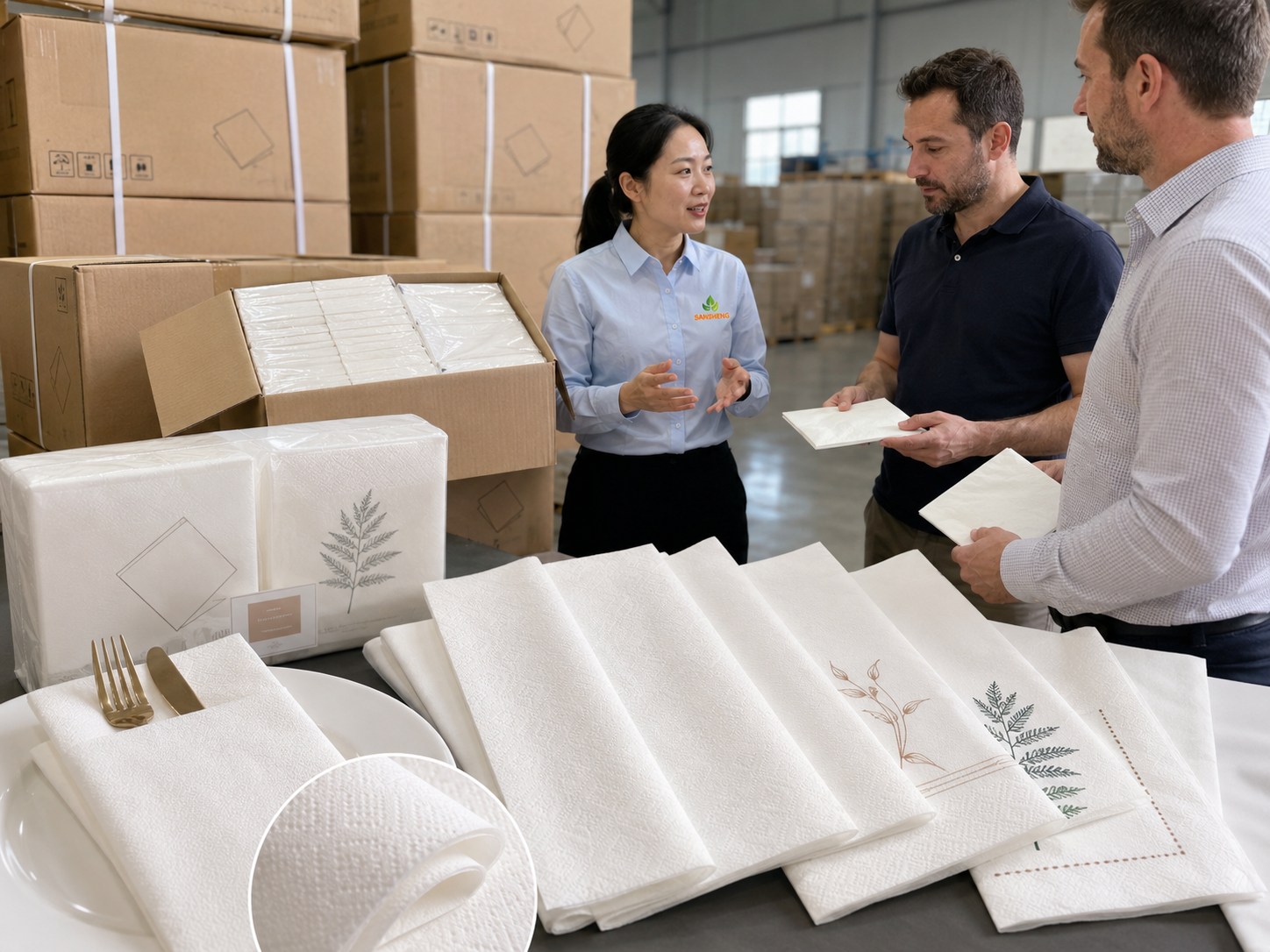
Real case (Q2 2025 – Q1 2026): A US Midwest foodservice distributor serving 140 accounts across IL, IN, WI, and OH was sourcing premium airlaid napkins from a US converter at $2.20/kg landed. Annual spend $640k across 24 containers. We piloted parallel sourcing with 2 × 40HQ from Sansheng on a 60 GSM diamond-embossed white SKU in Q2 2025, matched-spec against their existing US supply.
Result over 9 months: Quality holds within tolerance on all 6 containers received through Q1 2026. Landed cost $1.93/kg (12.3% below US baseline). Distributor converted 75% of their volume to Chinese sourcing through 2026; 25% retained domestic for supply-redundancy and just-in-time emergency response. Net annual saving captured: $103,000. Custom-spec lead times dropped from 12 weeks to 5 weeks — opening private-label custom programs the distributor could not previously offer below 3-container minimums.
What we learned: The cost savings were the visible win; the strategic win was the unlocked capability to offer custom-spec airlaid to mid-size accounts that were previously below domestic suppliers’ minimums. That capability re-defined the distributor’s competitive position with their mid-tier hospitality accounts. The price savings paid for the integration work in Year 1; the capability change is the recurring strategic asset.
6. Sourcing Playbook for North American Buyers in 2026 H2
The actionable path for North American distributors and chain operators currently sourcing only domestic:
- Run a parallel-sourcing pilot. 2 containers in parallel with existing supply, 90-day quality observation period. Cost: roughly $30,000 in pilot inventory. Value: complete supplier qualification with verified production data.
- Validate spec-match before scale. Pre-shipment third-party QC on the pilot containers — GSM, caliper, embossing depth, color fastness, food-contact compliance. Cost: $400–$600 per container.
- Lock FOB pricing for Q3–Q4 production. The Section 301 review concludes mid-Q3; smart buyers lock pricing before policy clarity moves rates. Standard 90-day FOB lock with ±25% volume flex.
- Diversify across 2 Chinese suppliers. Avoid single-supplier exposure on imported lines. Two qualified airlaid napkins supplier accounts provide redundancy without dramatic complexity overhead.
- Build a 6-week safety stock buffer. Ocean freight transit + customs can vary by 7–14 days. Safety stock removes the variability from your downstream account commitments.
- Extend the supplier base to adjacent SKUs. The same supplier qualification process supports your paper napkin manufacturer, paper towel manufacturer, and TAD paper supplier needs — multi-SKU consolidation amortizes onboarding cost.
7. Channel-Specific Considerations
| Channel | Volume Profile | Custom-Spec Need | China Sourcing Fit |
|---|---|---|---|
| 5-star hotel chains | 20–80 containers/year | High (brand color, emboss) | ★★★★★ |
| QSR chain (top-3) | 50–200 containers/year | Medium (chain branding) | ★★★★★ |
| Foodservice distributor (regional) | 10–40 containers/year | Medium-High (multi-account spec) | ★★★★☆ |
| Catering company chains | 5–20 containers/year | Low-Medium (standard SKU) | ★★★★☆ |
| Hospital food service | 3–12 containers/year | Low (compliance-focused) | ★★★☆☆ |
| Single-property hotels (boutique) | 1–3 containers/year | High (boutique branding) | ★★☆☆☆ — distributor model better |
For sub-3-container annual volumes, the operational overhead of direct sourcing typically offsets the per-unit savings. Distributor channels with established Chinese sourcing relationships are the right fit at that volume tier — buying the savings indirectly through a regional jumbo roll tissue manufacturer-aligned distributor account.
8. FAQ for North American Procurement
How does the 2026 USTR Section 301 review affect this sourcing decision?
HS 4818.30 (airlaid napkins) sits on List 4A at 7.5% Section 301. The review concludes mid-Q3 2026 per the schedule published by the Office of the US Trade Representative. Three plausible outcomes: continuation at 7.5%, modification (likely 15–25%), or termination (0%). Locking FOB pricing now provides supplier-side price stability while the importer captures tariff outcome upside or downside on their own. Cross-reference tariff rates with US Customs and Border Protection guidance before issuing the PO.
What’s the realistic quality variability between Chinese airlaid napkins manufacturer candidates?
Tier 1 suppliers (modern TAD/airlaid lines, Tier-1 pulp, ISO 9001 with scope verification) deliver quality within 5% spec tolerance. Tier 2 suppliers (older lines, mixed pulp sourcing) can vary 12–18%. The qualification process separates them. Always pre-ship test the first 2–3 containers.
How long does a typical Pantone-custom color airlaid run take from approval to BL?
35–45 days for established customer relationships, 50–60 days for first orders. Color proofing adds 3–5 days at start; production runs 25–30 days; reel slitting and converting 5–7 days; pre-shipment packing and BL 3–5 days.
What’s the minimum container volume to consider direct sourcing?
For premium custom-color airlaid: 1 × 40HQ for established suppliers. For first orders with new suppliers: 2 × 40HQ pilot recommended. Below 1 × 20HQ annually, distributor channels are the better economic answer.
How do US food-contact compliance requirements compare to EU?
US uses FDA 21 CFR (paper materials in contact with food) plus state-level disclosure (California Prop 65). EU uses framework Regulation (EC) 1935/2004 plus REACH. Premium Chinese airlaid napkins manufacturers produce to both standards in parallel — request the specific compliance declarations for your market in the RFQ stage.
Can a US-based distributor handle the EUDR documentation if we also serve EU accounts?
Yes, but it requires EU-side import-of-record infrastructure. Many US distributors with EU subsidiary accounts now operate dual documentation chains. The Chinese supplier delivers the same data package; the distributor allocates correct DDS to the EU lane and standard documentation to the US lane.
What pricing trajectory should I model for 2026 H2 and 2027?
Pulp index is volatile in the +6 to +10% annual range. China FOB airlaid pricing tracks pulp with a 2–4 week lag. Section 301 changes could shift landed cost ±8% in either direction. Lock 70% of forecast volume; leave 30% flexible to capture downside scenarios.
9. Final Word for North American Buyers
The 2026 rotation toward Chinese airlaid napkins manufacturer sourcing in North America is not a temporary cost-arbitrage play. It is a structural realignment driven by capacity constraints at domestic mills, custom-spec flexibility unavailable from US converters, and a quality-parity inflection that closed the historical objection. Distributors and chain operators that complete the sourcing pivot in 2026 lock pricing, capability, and supplier discipline. The competitive question is not whether to evaluate this — it is how quickly your procurement team can complete the pilot, the qualification, and the contract structure before the next round of capacity tightening pulls premium-spec lead times further out.
Start your North American airlaid sourcing pilot — 2 containers, full documentation
Send us your current US/Canadian domestic spec and annual volume. We’ll return a 2-container pilot proposal with locked FOB pricing, full sample-shipment plan, and side-by-side cost model — typically within one business day.
Tell us these 5 points to get a faster quote:
- Your country and target US/Canadian entry port
- Current spec: GSM, embossing, sheet size, ply, color
- Your name
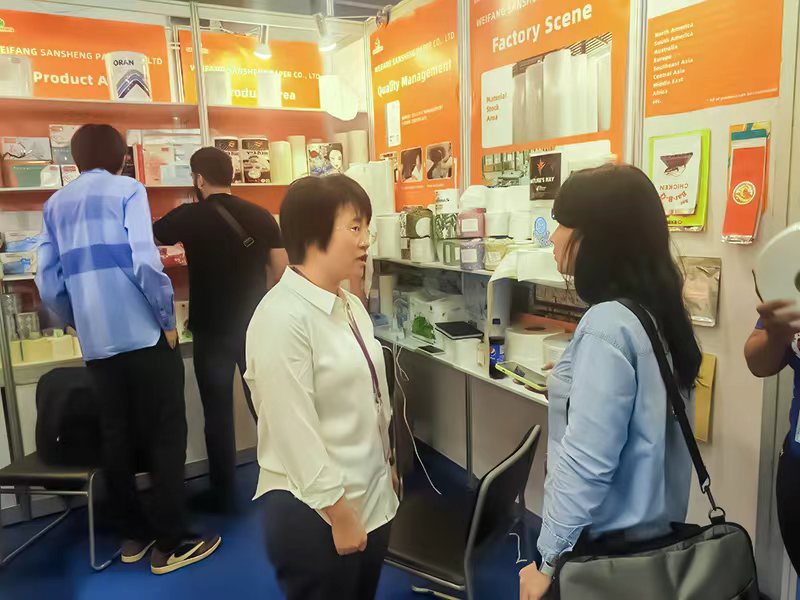
Sales Manager at Sansheng Paper · 20+ years in tissue paper OEM & bulk export · LinkedIn