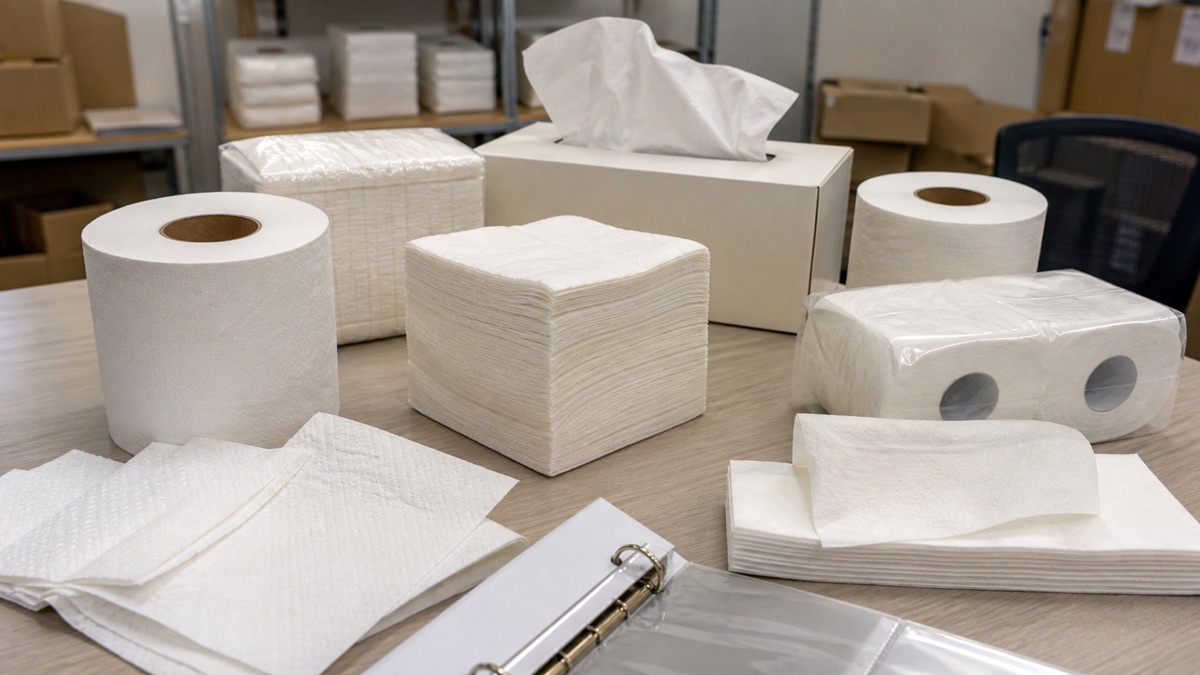
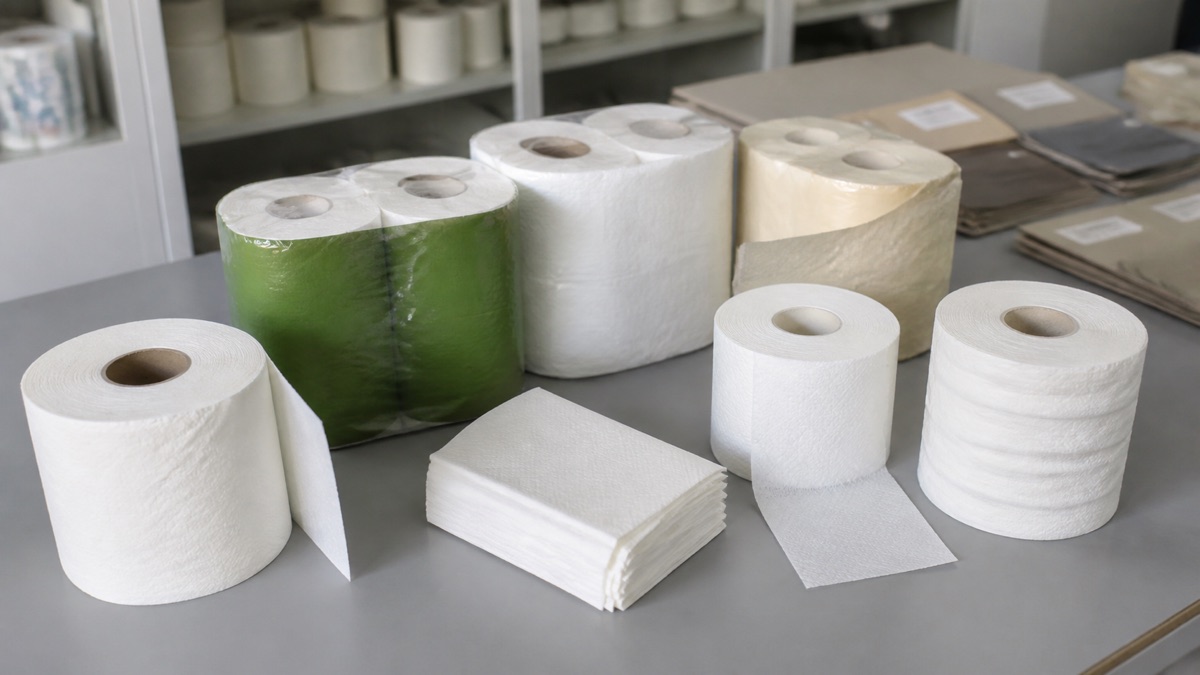
PFAS-free is the new minimum, not the marketing differentiator. EU REACH and California AB 1817 have made certain chemicals legally radioactive in food-contact paper — and the airlaid napkins manufacturer who cannot deliver lab documentation on Day 1 is no longer a credible vendor.
To pass a 2026 compliance audit, an airlaid napkins manufacturer must deliver four documents per shipment: (1) PFAS lab certificate showing non-detect below 100 ppm total fluorine per AOAC 2022.08 method, (2) BPA-free declaration covering pulp, coatings, and processing aids, (3) phthalate-free statement per EU REACH SVHC list and California Prop 65, and (4) optical brightener (OBA) disclosure. EU REACH compliance and California AB 1817 (PFAS ban in food packaging, effective January 2026) define the regulatory floor. This guide is the seven-document audit checklist for EU and California importers placing 2026 H2 POs.

The compliance audit covers
- The regulatory map — what applies where
- PFAS testing — methods, thresholds, what to require
- BPA, phthalates, and other restricted chemistries
- Optical brightener (OBA) disclosure
- The 7-document compliance package
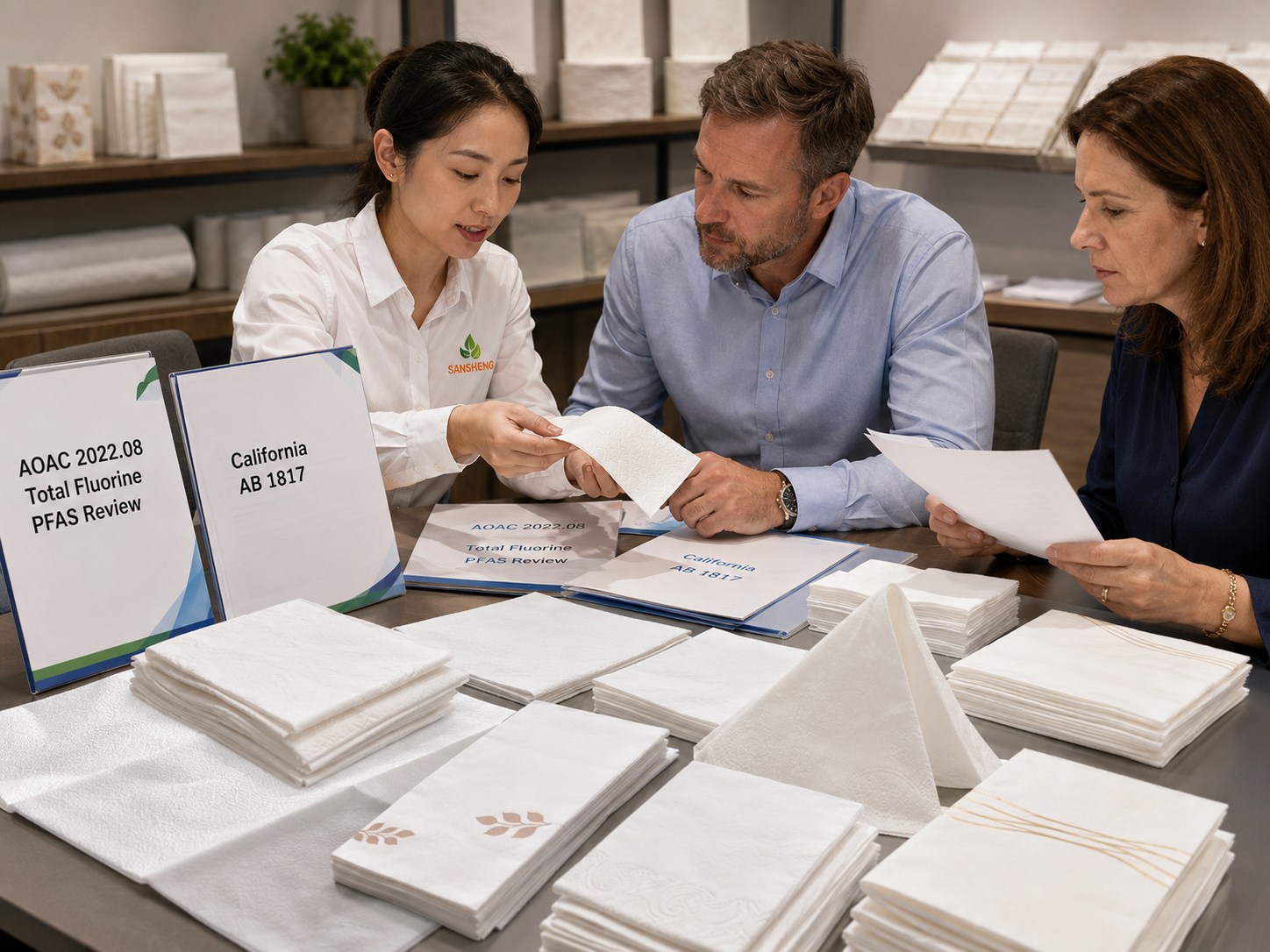
- Tracy’s experience: a California importer’s audit case
- Red flags during supplier-side documentation review
- FAQ for EU and California importers
1. The Regulatory Map — What Applies Where
Chemical compliance for airlaid napkins splits along two major jurisdictional lines, each with distinct documentation expectations:
| Jurisdiction | Primary Framework | Key Chemicals Restricted | Documentation Required |
|---|---|---|---|
| European Union | Regulation (EC) 1935/2004 + REACH + EU 10/2011 | PFAS (per ECHA restriction proposal), BPA, phthalates (DEHP, DBP, BBP), SVHC list | REACH SVHC declaration; food-contact compliance dossier; supplier statement |
| California (USA) | AB 1817 (PFAS food packaging ban, Jan 1 2026); Prop 65 | PFAS (100 ppm total fluorine limit), phthalates, BPA (Prop 65) | PFAS lab certificate per AOAC 2022.08; Prop 65 disclosure |
| Maine, Washington, Vermont, NY (USA) | State PFAS bans (varying effective dates) | PFAS in food packaging | State-specific PFAS attestations |
| Federal USA | FDA 21 CFR 176.170 (paper in food contact) | Food-contact compliance baseline | 21 CFR 176.170 declaration |
| Canada | Health Canada Food Packaging Materials Guide | Aligned with US/EU; PFAS phase-out underway | Compliance declaration; voluntary PFAS testing |
The strictest single regulator currently is California’s AB 1817, effective January 1, 2026 — a 100 ppm total fluorine threshold for any paper food-contact product. Selling non-compliant airlaid napkins into California after that date carries civil penalty risk for the importer. EU REACH continues to expand its SVHC list approximately twice yearly; a credible airlaid napkins manufacturer reviews each SVHC update and confirms continued compliance for EU-bound shipments. Procurement teams evaluating a new airlaid napkins manufacturer in 2026 should treat the regulatory map as a binary qualifier — either the supplier meets all four major jurisdictions (EU REACH, California AB 1817, FDA 21 CFR, EUDR) with current documentation, or they don’t.
2. PFAS Testing — Methods, Thresholds, What to Require
PFAS (per- and polyfluoroalkyl substances) are the highest-priority chemical concern in 2026. They were historically used in paper coatings to provide grease and water resistance. They are now legally restricted in food packaging across an expanding list of jurisdictions.
Testing options:
- Total Fluorine (AOAC 2022.08) — primary method. Combustion ion chromatography measures total organic fluorine. Threshold: ≤100 ppm. This is the California standard and the most common buyer-side requirement.
- Targeted PFAS analysis (LC-MS/MS). Individual PFAS species quantification. Used when total fluorine is detected and the buyer needs to identify the specific compound.
- Migration testing (food simulant studies). Confirms that PFAS does not migrate from paper into food. Required for some premium-tier accounts beyond the basic PFAS-free claim.
For a credible airlaid napkins manufacturer in 2026, a current total-fluorine certificate (≤100 ppm) from SGS, Intertek, or TÜV per AOAC 2022.08 should attach to every container shipped to California, EU, and any state-restricted destination. Dated within 90 days of shipment is the practical buyer-side requirement. Buyers who pre-screen this single document at the RFQ stage filter the airlaid napkins manufacturer pool faster than any factory visit.
3. BPA, Phthalates, and Other Restricted Chemistries
BPA (bisphenol A) and phthalates are restricted in food-contact applications across both EU and California regulatory frameworks. For airlaid napkins specifically, these compounds rarely appear in the paper itself, but can be present in:
- Processing aids during pulp manufacturing
- Surface coatings or sizing agents
- Print inks (especially solvent-based, older formulations)
- Adhesives in packaging
- Heat-stamping inks for branded designs
The diligent procurement specification covers each upstream input separately. A “BPA-free” declaration that only addresses the paper sheet is insufficient — the importer needs the same declaration for inks, coatings, and packaging components used in the final SKU. Phthalates require declaration against the EU REACH SVHC list (DEHP, DBP, BBP among others) and California Prop 65 specifications.
For airlaid napkins made from FSC-certified virgin wood pulp without surface coatings, BPA and phthalate compliance is generally inherent — these compounds are not used in the standard process chain. The verification is documentation, not process change. Buyers running adjacent SKUs should apply the same compliance dossier across paper napkin manufacturer sources and facial tissue manufacturer accounts to maintain consistency.

4. Optical Brightener (OBA) Disclosure
Optical brighteners (also called fluorescent whitening agents) make paper appear whiter. They are not currently banned but increasingly disclosed and avoided in premium and medical-adjacent applications. For EU food-contact paper and California-bound shipments, OBA presence should be disclosed even when not formally restricted.
- OBA-free standard: Premium hospitality napkins, hospital-adjacent applications, EU food-contact paper for direct food contact. Verification via UV-A 365 nm flashlight — OBA-free shows dull off-white under UV; OBA-loaded glows bright blue-white.
- OBA-containing acceptable: Value-tier retail, back-of-house foodservice where direct food contact is incidental.
A credible airlaid napkins manufacturer discloses OBA content on the technical data sheet as standard practice. For premium positioning, specify OBA-free explicitly on the PO — supplier-side cost-optimization sometimes substitutes OBA-containing pulp without disclosure if the buyer hasn’t specified.
5. The 7-Document Compliance Package
The complete supplier-side documentation package for an EU or California-bound airlaid napkins shipment in 2026:
- 1. ISO 9001 certificate with scope covering airlaid/tissue manufacturing — verifiable on registrar’s website
- 2. FSC chain-of-custody certificate covering pulp through finished product — verifiable on info.fsc.org
- 3. PFAS lab certificate showing ≤100 ppm total fluorine per AOAC 2022.08, dated within 90 days, from SGS/Intertek/TÜV
- 4. REACH SVHC declaration covering current SVHC list (refreshed at each SVHC list update by the supplier)
- 5. BPA-free declaration covering pulp, coatings, inks, adhesives, and packaging components
- 6. Food-contact compliance statement per 21 CFR 176.170 (US) and/or EU 10/2011 (EU)
- 7. EUDR Due Diligence supporting documentation (for EU shipments) — geolocation, harvest dates, risk assessment
Optional but increasingly requested: California Prop 65 disclosure for any chemical above the no-significant-risk level threshold; halal/kosher certification for specific channel requirements; biodegradability/compostability claims per EN 13432 or ISO 17088. The full documentation depth distinguishes a serious B2B export-focused airlaid napkins supplier from a domestic-only mill being asked to support international compliance.
6. Tracy’s Experience — A California Importer’s Audit Case
🏭 From Our Factory Floor
Real case (Q1 2026, post-AB 1817 effective date): A California-based foodservice distributor performed a compliance re-audit on all paper-product suppliers in January 2026, immediately after AB 1817 took effect. Their existing Tier-2 airlaid napkins supplier could not produce a current AOAC 2022.08 total-fluorine certificate within 14 days. State enforcement guidance was clear: any airlaid napkin moving into California needed documentary proof of compliance available on demand. The distributor placed a hold on three pending containers from that supplier and issued an emergency RFQ to Tier-1 suppliers.
Result: Sansheng’s first response delivered the AOAC 2022.08 certificate (total fluorine 12 ppm — well below the 100 ppm threshold), plus the full 7-document package within 48 hours. The distributor converted the held-container volume to Sansheng supply, and migrated the broader account over the following six months. The previous supplier — operating a 30-year-old mill without modern lab-testing partnerships — could not adapt quickly enough to keep the account.
What we learned: The chemical compliance audit isn’t a one-time procurement exercise; it’s a continuous operating discipline. Suppliers who maintain rolling testing relationships and pre-format documentation packages win the accounts as regulations tighten. Suppliers who treat each test certificate as a buyer-specific request lose share when regulatory windows narrow.
7. Red Flags During Supplier-Side Documentation Review
- “Compliance available on request” rather than pre-packaged. Means the supplier produces test certificates buyer-by-buyer; expect 14–21 day delays at every shipment. Tier-1 suppliers deliver documentation as a standing package.
- Lab certificate older than 90 days. Regulatory bodies and buyer auditors expect current data. A 6-month-old PFAS certificate is operationally suspect.
- Certificate scope mismatched to actual product. ISO 9001 issued for “corrugated paper” is not airlaid coverage. Always verify scope, not just existence.
- Lab name not on the buyer’s accepted-lab list. Major buyers maintain accepted-lab lists (typically SGS, Intertek, TÜV, Eurofins, Bureau Veritas). Suppliers using regional unrecognized labs create acceptance friction.
- “PFAS-free” without specifying total fluorine threshold. Different test methods yield different results. The phrase “PFAS-free per AOAC 2022.08 at ≤100 ppm” is meaningful; “PFAS-free” alone is not.
- Discrepancy between sample certificate and production batch certificate. Some suppliers test once on a sample, then ship production runs with the same certificate for years. Continuous lot-level testing is the Tier-1 standard.
8. Multi-State and Multi-Region Compliance Strategy
For US distributors serving multiple states with divergent PFAS regulations, the practical strategy is to maintain a single supply chain meeting the strictest standard (currently California). This avoids multi-SKU complexity at the distribution level and provides regulatory headroom as additional states adopt similar bans through 2026–2028.
| State / Region | PFAS Status | Effective Date | Practical Buyer Approach |
|---|---|---|---|
| California | Ban (AB 1817) | Jan 1, 2026 | ≤100 ppm total fluorine required |
| Maine | Ban (LD 1503) | Phased through 2030 | PFAS attestation required |
| Washington | Ban (RCW 70A.222) | 2024 in effect | Compliant products only |
| Vermont | Ban (Act 36) | 2023 in effect | Compliant products only |
| New York | Ban (S 8817) | Dec 31, 2024 | Compliant products only |
| EU | ECHA restriction proposal pending | Likely 2026–2027 | Pre-compliance recommended |
| Other US states | Various bills pending | Rolling | Default to California-equivalent |
For buyers running multi-product accounts, the same compliance discipline extends across TAD paper supplier, examination paper rolls manufacturer for medical applications, and jumbo roll tissue manufacturer sourcing. Multi-category consolidation amortizes the compliance audit cost across a broader spend base.
9. FAQ for EU and California Importers
What’s the minimum PFAS testing frequency for ongoing supply?
Best practice: per-lot or quarterly per SKU, whichever is more frequent. Annual testing alone is insufficient for regulated state shipments. Tier-1 suppliers attach a lot-specific test certificate to every container as standard practice.
Can a supplier claim “PFAS-free” if they use FSC-certified pulp without any fluorinated chemicals?
Process-based claims are weak. The defensible claim requires lab evidence: total fluorine result ≤100 ppm via AOAC 2022.08, dated within 90 days. Process explanations support the lab data but do not substitute for it. California regulators specifically require lab evidence.
Does AB 1817 apply to airlaid napkins imported from China but sold in California?
Yes. AB 1817 applies to any food packaging sold or distributed in California regardless of origin. The importer of record and downstream distributors share compliance liability. Documentation must be available on demand during the supply chain.
How does EU REACH compliance interact with EUDR documentation?
REACH addresses chemical content (PFAS, SVHC, etc.). EUDR addresses deforestation traceability (FSC, geolocation, due diligence). Both apply to airlaid napkins entering the EU; they require separate but complementary documentation packages. A serious airlaid napkins manufacturer provides both as a standing deliverable.
What’s the cost of a complete compliance documentation package per container?
For Tier-1 suppliers operating standing lab partnerships: incremental cost per container is ≈ $200–$350 for fresh test certificates, with the broader compliance dossier amortized across annual volume. Suppliers presenting “additional cost” pricing for documentation are signaling that compliance is an add-on rather than infrastructure — a procurement red flag.
Are there proven 2026 ECHA actions that will tighten PFAS rules further?
The ECHA restriction proposal under REACH addresses a universal PFAS restriction across categories. Final adoption timeline is uncertain but likely 2026–2027. Pre-compliance — sourcing PFAS-free now — provides regulatory headroom and avoids supply disruption when the rule takes effect.
How do I verify a supplier’s PFAS certificate is genuine?
Cross-reference the lab name and report number with the issuing lab’s website or contact. Major labs (SGS, Intertek, TÜV) maintain certificate verification systems accessible to buyers. Forged certificates do occur in the lower tiers of the supplier market; the verification step takes 5–10 minutes per shipment and is standard discipline.
10. Final Word for EU and California Importers
Chemical compliance for airlaid napkins is no longer a premium-tier differentiator — it is the cost of admission to regulated US states and EU markets. The airlaid napkins manufacturer who treats PFAS, BPA, phthalate, and EUDR documentation as standing infrastructure earns durable contracts. The supplier who treats each audit as bespoke struggles with capacity and onboarding friction as additional jurisdictions tighten regulations through 2026–2027. The right qualifier in 2026 is not whether a supplier can produce the documentation on request — it is whether they deliver the full 7-document package with the bill of lading as standard practice. That distinction sorts the market faster than any audit visit could.

Request a compliance-ready airlaid napkins quote with full documentation package
Send us your target market (EU, California, multi-state, etc.) and SKU spec. We’ll return FOB pricing plus the complete 7-document compliance package — PFAS certificate, REACH SVHC, BPA-free, FSC, and food-contact compliance — pre-packaged for your audit chain. Typically within one business day.
Tell us these 5 points to get a faster quote:
- Your country and regulated state/region
- Product spec: GSM, ply, embossing, sheet size
- Your name
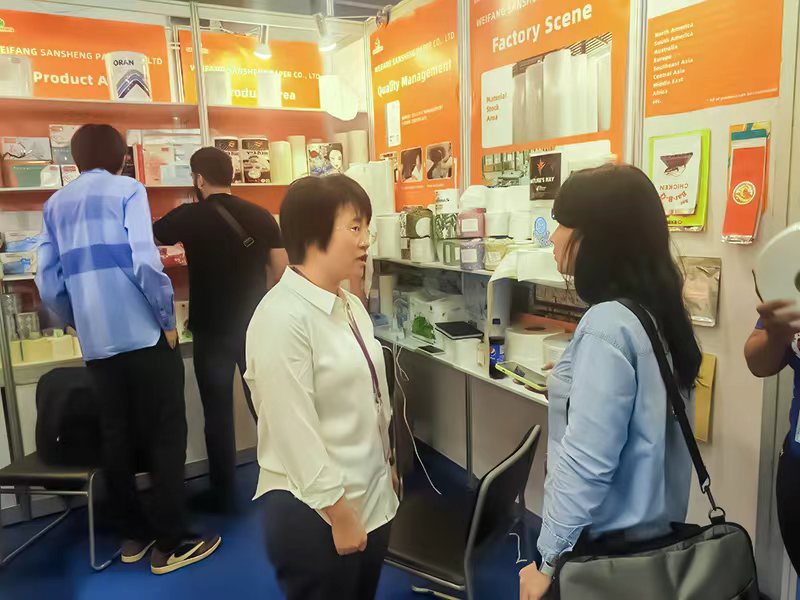
Sales Manager at Sansheng Paper · 20+ years in tissue paper OEM & bulk export · LinkedIn