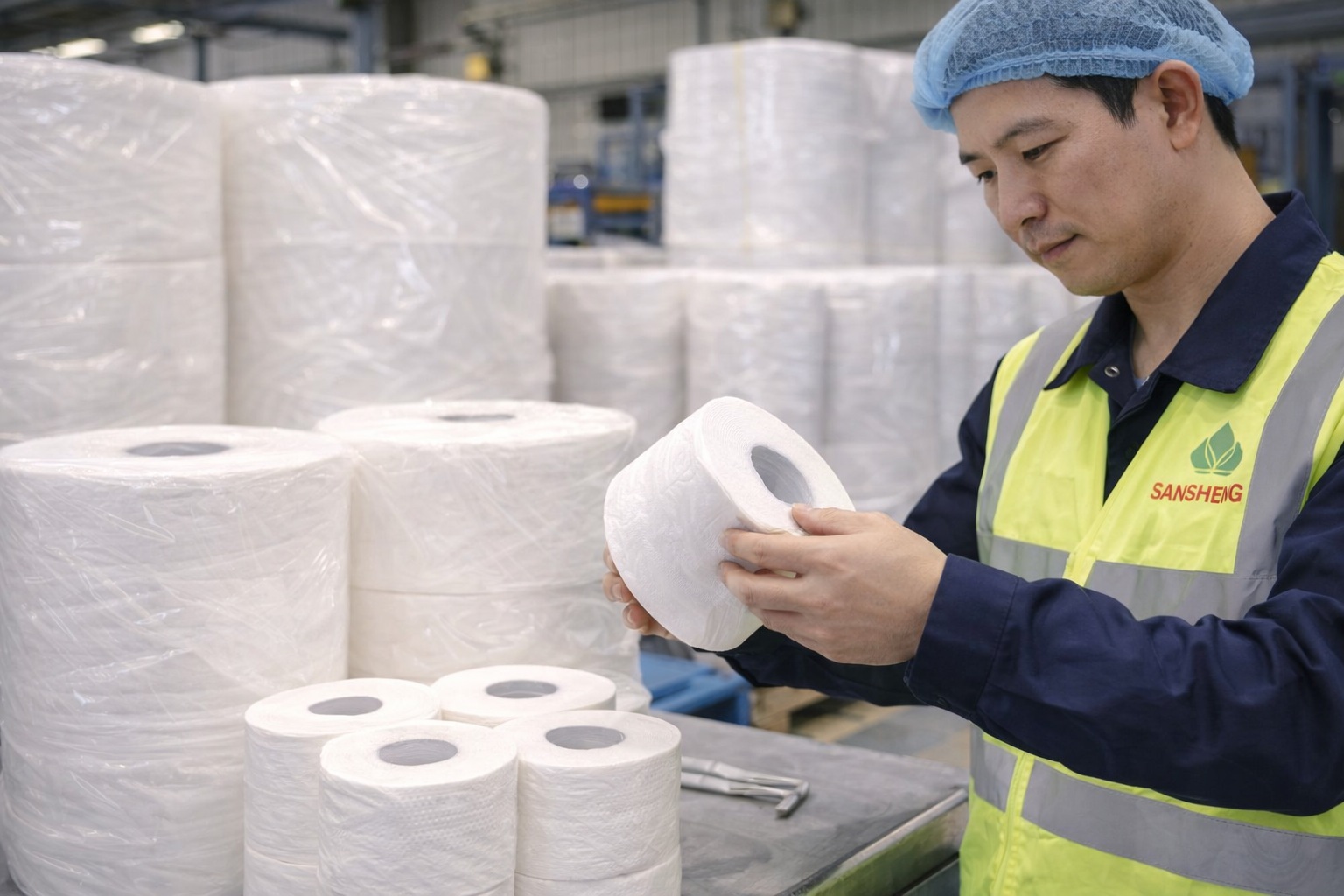
How to Choose a toilet paper manufacturer in China: 8 Checkpoints from 400+ Container Shipments
Most importers evaluate a toilet paper manufacturer by price and sample quality. Both are easy to fake. Here is what actually matters.
Choosing the right toilet paper manufacturer in China comes down to 8 verifiable checkpoints: actual production capacity, GSM consistency across batches, roll diameter tolerance, embossing and perforation stability, export carton durability, water solubility for septic systems, documented QC processes, and communication responsiveness. These are not theoretical criteria. They come from shipping over 400 containers of toilet paper since 2013 to markets across the Middle East, Australia, Africa, Southeast Asia, and South America. Every checkpoint addresses a failure mode we have either experienced ourselves or seen importers suffer through with other suppliers. China produced 13.54 million tons of tissue in 2023 out of a total capacity of 20.37 million tons, according to industry data reported by Trading Economics. That means there are hundreds of manufacturers competing for your order. The question is not whether you can find a supplier. The question is whether you can tell the good ones from the ones that will cost you customers.

- Why you need a structured evaluation process
- Checkpoint 1: Verify actual production capacity
- Checkpoint 2: Test GSM consistency across batches
- Checkpoint 3: Measure roll diameter tolerance
- Checkpoint 4: Inspect embossing and perforation stability
- Checkpoint 5: Evaluate export carton quality
- Checkpoint 6: Confirm water solubility
- Checkpoint 7: Review QC process and pre-shipment records
- Checkpoint 8: Assess communication and problem-solving speed
- Comparison: what to check vs how to verify
- Common toilet paper specs for importers
- FAQ
- Get a quote
Why You Need a Structured Evaluation Process
A sample roll tells you what a toilet paper manufacturer can produce under ideal conditions. It tells you nothing about what they will produce on your 5th, 10th, or 20th container. The gap between sample quality and bulk production quality is where most sourcing failures happen. Importers lose money not because they chose the wrong product, but because they chose the wrong manufacturer and had no system to catch problems before they shipped.
These 8 checkpoints give you a repeatable process. Each one targets a specific failure mode that we have seen cause real losses for real buyers. Use them during supplier evaluation, during production, and during pre-shipment inspection.
Checkpoint 1: Verify Actual Production Capacity
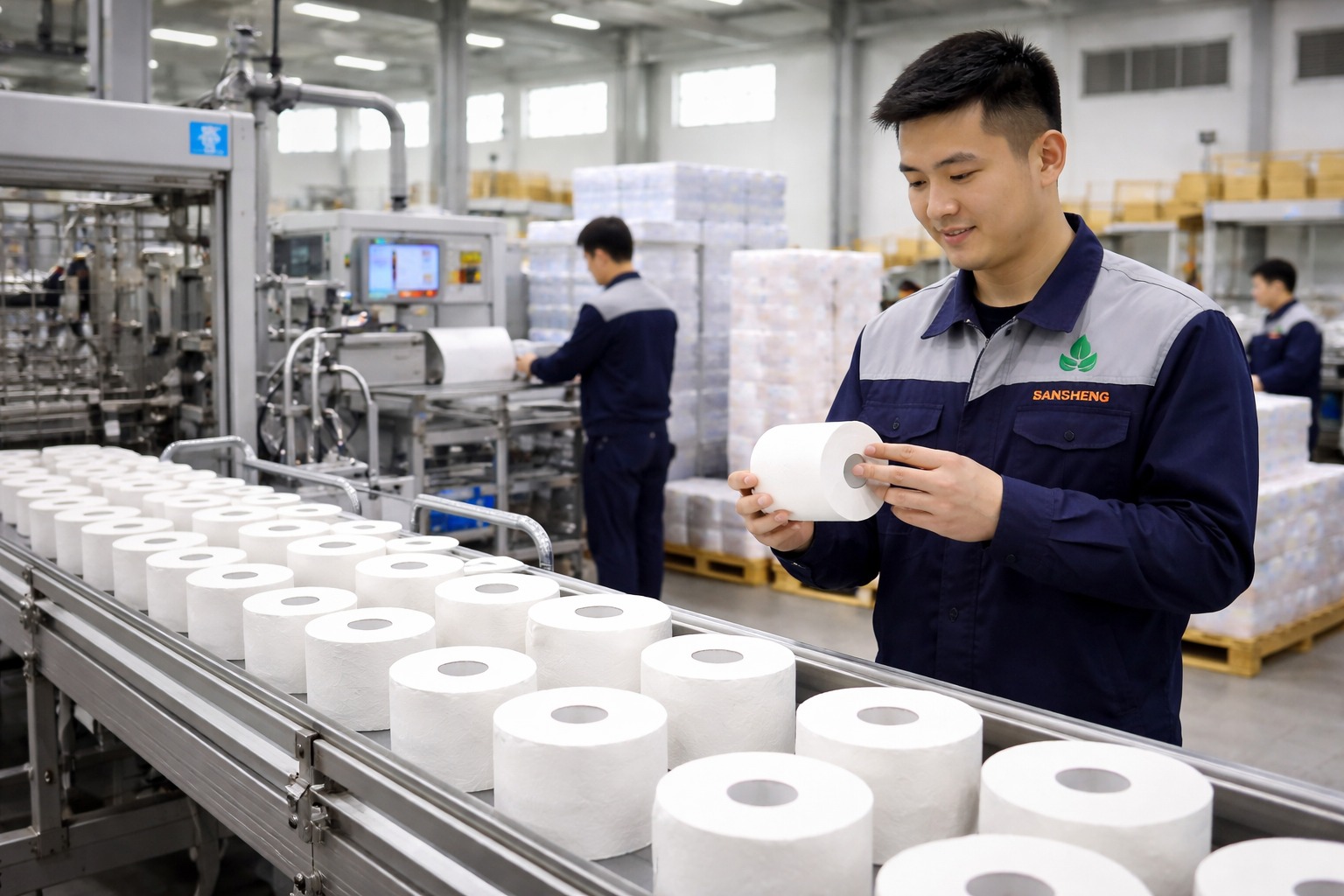
Many suppliers claim large capacity numbers on their websites. What matters is their actual converting line output, not their paper-making capacity or their parent company’s total tonnage. A toilet paper manufacturer with one rewinding line and two packing lines has a very different delivery capability than one with six of each.
How to verify: Ask for the number of converting lines, their speed ratings, and current utilization rate. Request photos or video of the converting workshop, not just the paper-making section. If a supplier runs at 90%+ utilization, your order will wait. If they run at 50%, ask why they have so much spare capacity.
- Ask for daily/monthly output in finished rolls, not raw paper tonnage
- Confirm how many shifts they run (2 shifts vs 3 shifts changes output by 33%)
- Check if they subcontract any converting steps to third parties
Checkpoint 2: Test GSM Consistency Across Batches
GSM (grams per square meter) directly affects softness, thickness, and the number of sheets per roll. Common toilet paper specs run 13-18 gsm per ply, with 2-4 ply configurations. The problem is not whether a manufacturer can hit your target GSM on a sample. The problem is whether they can hold it within tolerance across 20 tons of production.
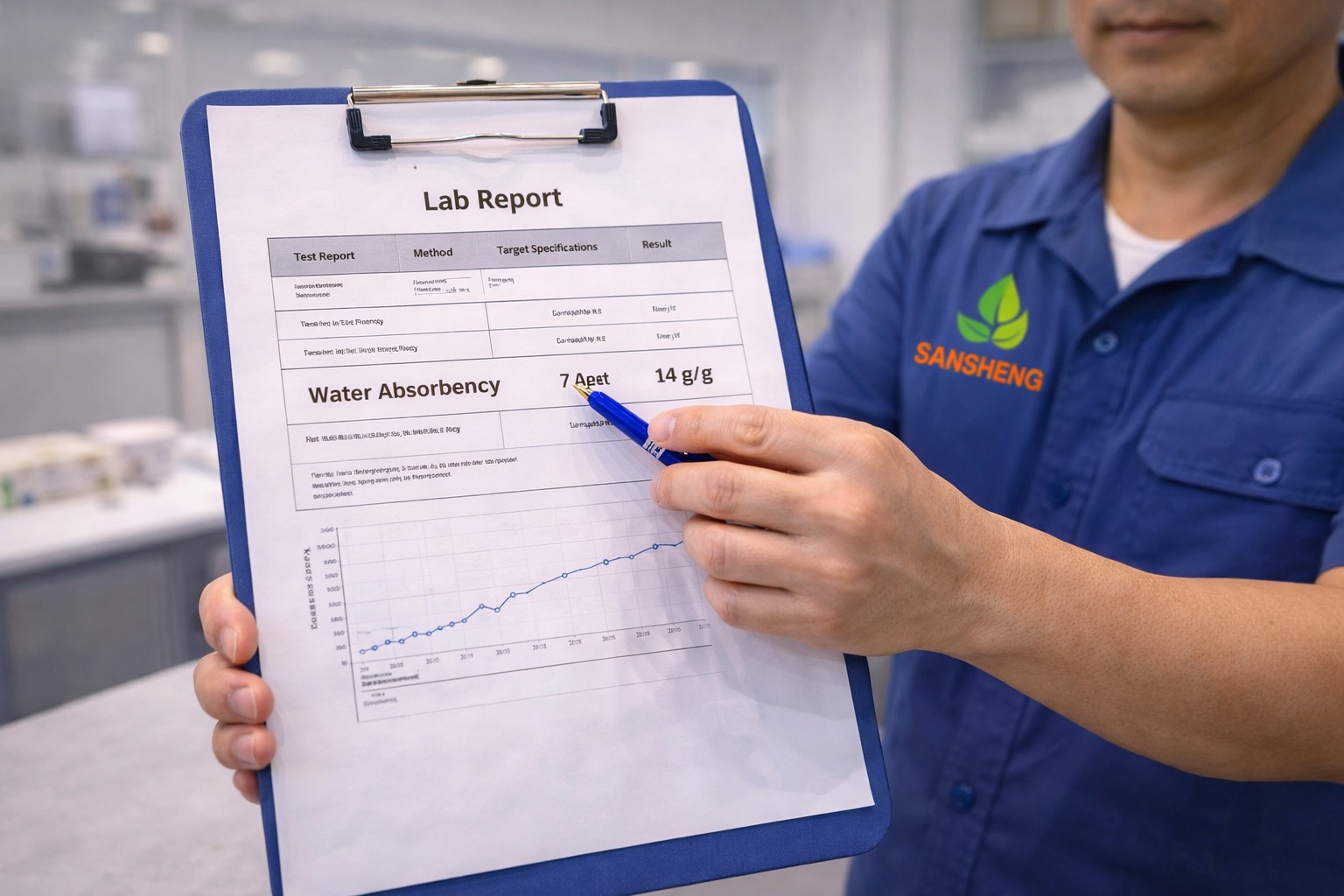
How to verify: Request GSM test reports from three different production batches of the same product. A reliable toilet paper manufacturer will have these on file. If they cannot produce batch-level GSM data, they are not measuring it, which means they are not controlling it.
Checkpoint 3: Measure Roll Diameter Tolerance
Roll diameter determines whether your cartons close properly, whether your shelf display looks consistent, and whether your container loading plan works. Standard toilet paper roll diameters range from 90mm to 125mm depending on the spec. Most manufacturers work to a tolerance of plus or minus 1-2mm, which is fine for loose-packed formats. But for high-count cartons with tight layouts, that tolerance needs to be much tighter.
How to verify: Measure 20 rolls from a production run with a caliper. Calculate the range. If you are packing 48 rolls per carton in a stacked format, ask the supplier what tolerance they guarantee and how they measure it during production.
From Our Factory Floor
Real case: Checkpoint #3 almost cost us a client. An Australian buyer ordered 48 rolls per carton with a tight carton height of 28cm. Our standard roll diameter tolerance was plus or minus 1.2mm, which is acceptable for most markets. But with 48 rolls stacked 4 high, even 1mm extra per roll meant the carton would not close properly. The lids were bulging, and the buyer’s warehouse team flagged it immediately.
What we learned: We added inline diameter gauges at the rewinding stage and tightened the tolerance to plus or minus 0.5mm. That buyer has reordered 12 times since. The lesson: the right tolerance depends on the carton layout, not just the product spec. Now we ask every new buyer for their carton dimensions before we set the rewinding parameters, not after.
Checkpoint 4: Inspect Embossing and Perforation Stability
Embossing affects perceived softness and visual appeal. Perforation affects tear quality and sheet separation. Both degrade over time as rollers wear, and both vary if machine tension is not properly controlled. A custom embossing roller costs 50,000-70,000 RMB, so understand whether your design requires a new roller or can use an existing pattern.
How to verify: Pull 10 sheets from the beginning, middle, and end of a production roll. Compare the embossing depth visually and by touch. Check perforation tear strength. If the perforation is too weak, sheets tear during unwinding. If too strong, users rip the paper unevenly. Both are quality complaints waiting to happen.

Checkpoint 5: Evaluate Export Carton Quality
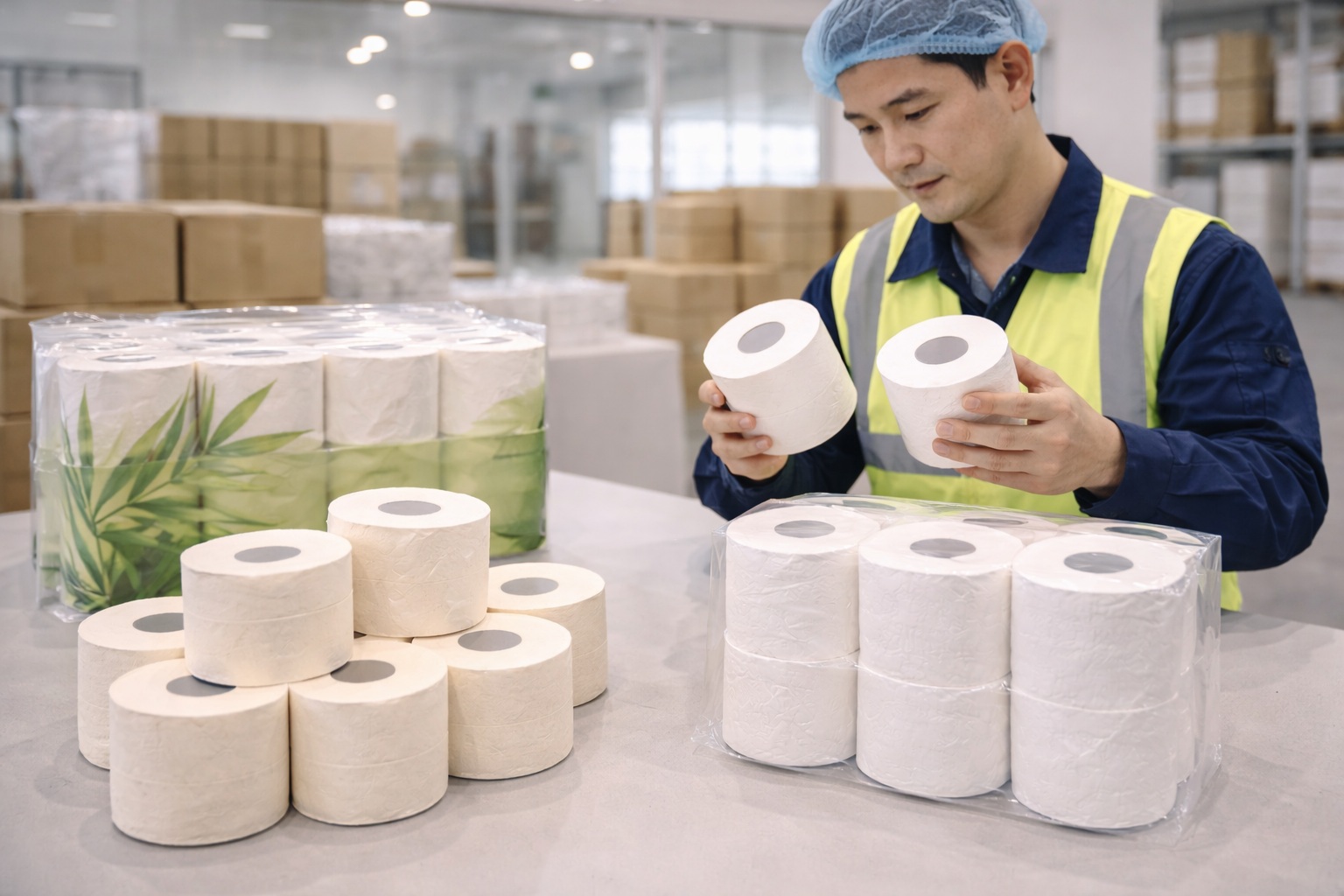
The carton is the last line of defense between your product and the chaos inside a shipping container. For toilet paper, cartons must withstand 25-30 days of ocean transit, potential rain exposure during port handling, and stacking pressure from 5-6 layers high inside a 40HQ (internal dimensions: 2.35m wide, 2.69m tall, 12m long).
How to verify: Check whether the supplier uses cold glue or hot glue sealing. Cold glue holds better under humidity. Ask for the carton’s burst strength rating or edge crush test (ECT) value. Request photos from previous shipments showing carton condition on arrival. A professional toilet paper manufacturer will have these.
- 5-ply corrugated is standard for toilet paper export cartons
- Drop test from 75cm should show no corner damage or opening
- Inner poly bag wrapping protects against moisture during transit
Checkpoint 6: Confirm Water Solubility
This is the checkpoint that many importers skip and later regret. Toilet paper destined for markets with modern sewage systems or septic tanks must dissolve in water within a reasonable time. Paper that does not break down causes plumbing blockages, which triggers consumer complaints and potential product recalls. This is particularly critical for markets in Australia, Europe, North America, and parts of the Middle East.
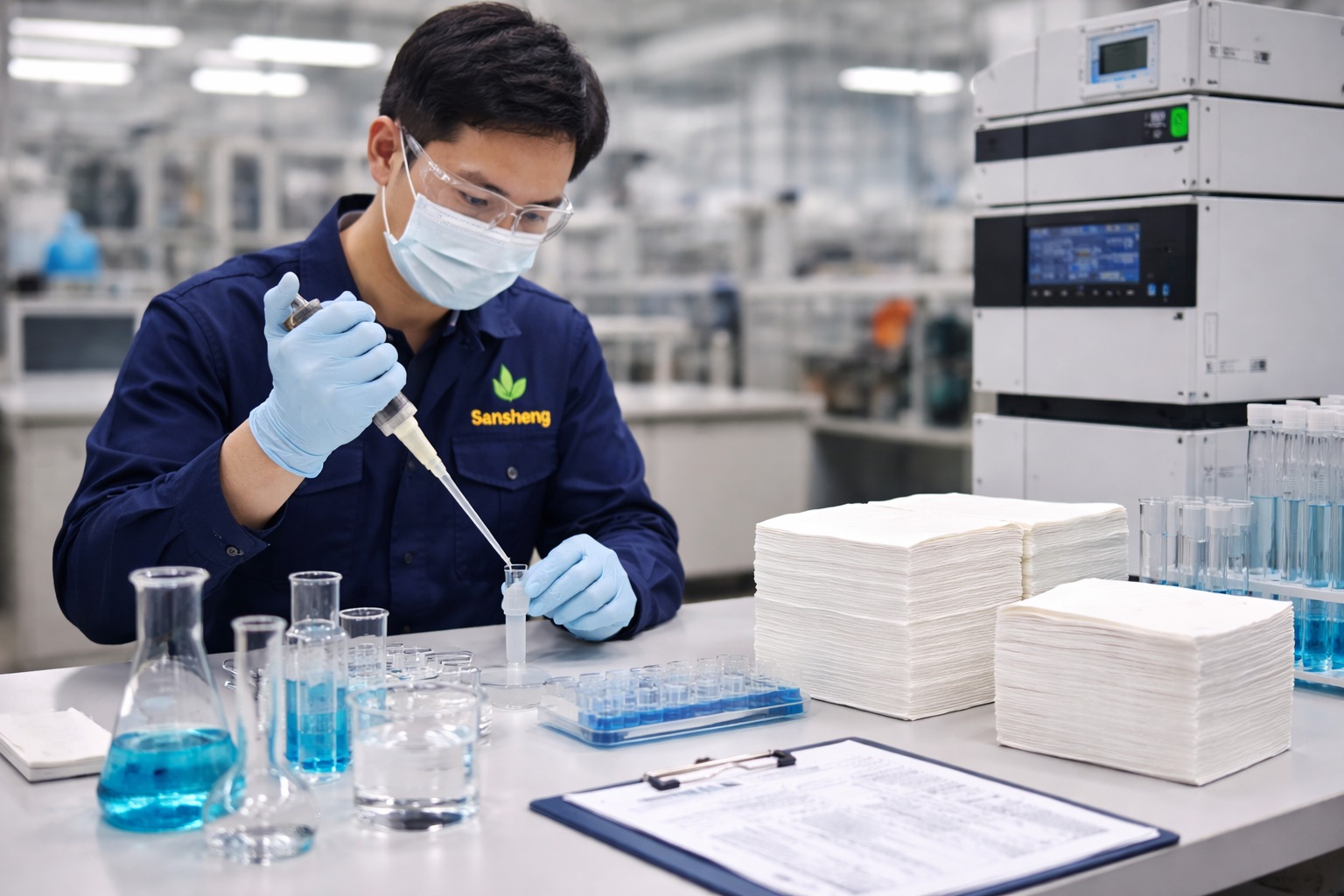
How to verify: Drop a sheet of the finished product into a glass of water and agitate gently. It should begin breaking apart within 30-60 seconds. Compare against a local brand from your target market. Some manufacturers use excessive wet-strength agents to prevent tearing during use, but this makes the paper resistant to dissolving after flushing.
Checkpoint 7: Review QC Process and Pre-Shipment Records
An ISO 9001 certificate on the wall means a system exists on paper. What you need to see is evidence that the system operates in practice. Ask for actual QC records, not just the certificate.
How to verify: Request the following from the last 3 shipments to any buyer: incoming pulp inspection report, mid-production GSM sampling log, finished product measurement sheet (diameter, weight, sheet count), and pre-loading container photos with carton condition visible. If a manufacturer cannot produce these records within 48 hours of your request, they do not exist.
Checkpoint 8: Assess Communication Speed and Problem-Solving Ability
Speed of communication during the quoting stage is a preview of how a toilet paper manufacturer will handle problems during production. If it takes 3 days to get a price, it will take a week to get an answer when something goes wrong mid-production. More importantly, observe how the supplier handles your technical questions. Do they answer with specifics, or with vague reassurances?
How to verify: During the evaluation phase, send a moderately complex inquiry (for example, ask about a spec change mid-production or a custom carton layout). Time the response. Evaluate whether they ask clarifying questions or just say “no problem.” The best manufacturers push back with better suggestions, not just compliance.
What to Check vs How to Verify: Quick Reference
| Checkpoint | What to Check | How to Verify | Red Flag |
|---|---|---|---|
| 1. Production Capacity | Converting line count, shift schedule, utilization rate | Video of workshop + daily output data | Only shows paper-making machines, not converting lines |
| 2. GSM Consistency | Batch-to-batch GSM variation | GSM reports from 3 different production runs | Cannot provide batch-level data |
| 3. Roll Diameter | Tolerance range (standard vs tight-pack) | Measure 20 rolls with caliper, calculate range | No inline measurement during rewinding |
| 4. Embossing/Perforation | Pattern depth and tear consistency | Compare sheets from start, middle, end of roll | Uneven pattern or perforation tears too easily/hard |
| 5. Carton Quality | Material grade, sealing method, burst strength | Drop test + arrival photos from previous shipments | Hot glue sealing, no ECT rating available |
| 6. Water Solubility | Dissolution time in water | Glass-of-water test, compare to local brand | Paper stays intact after 2+ minutes |
| 7. QC Records | Documented inspection at each production stage | Request records from last 3 shipments | Cannot produce records within 48 hours |
| 8. Communication | Response time and technical depth | Send a complex question, time the response | Says “no problem” to everything without questions |
Common Toilet Paper Specs for Importers
When evaluating a toilet paper manufacturer, confirm these specifications in writing before placing an order. The global toilet paper market continues to grow, reaching significant scale as tracked by Mordor Intelligence, which means specifications vary widely by region.
| Specification | Common Range | Notes |
|---|---|---|
| Ply | 2-ply (standard), 3-ply, 4-ply (premium) | Higher ply = softer feel, higher cost per roll |
| GSM per Ply | 13-18 gsm | Lower GSM = softer but less durable |
| Sheet Size (W x L) | 95-130mm width, custom length | Width is set by machine; confirm market standard |
| Roll Diameter | 90-125mm | Must match carton layout; tolerance matters |
| Core Diameter | 40-45mm (standard), coreless available | Coreless = more paper per roll, popular in hotels |
| MOQ | 1 x 40HQ (~1,500-2,000 cartons) | Varies by spec; mixed SKU loading often possible |
| Lead Time | 20-30 days from deposit | Custom embossing roller adds 15-20 days |
| Raw Material | Virgin wood pulp: long fiber (pine 2.2-2.8mm) + short fiber (eucalyptus 0.8mm) | Long fiber from Canada/Nordic; short fiber from Brazil/Indonesia |

FAQ: Choosing a Toilet Paper Manufacturer in China
1. How can I tell if a toilet paper manufacturer is a real factory or a trading company?
Ask them to name their converting equipment brands and models, their daily output in finished rolls, and their machine width. A real manufacturer knows these numbers instantly. A trading company will deflect or give vague answers. Also request a live video call showing the converting and packing lines in operation.
2. What is the typical MOQ for private label toilet paper from China?
One 40HQ container per SKU is standard, which translates to roughly 1,500-2,000 cartons depending on the roll size and pack format. Most manufacturers allow mixed loading of 2-3 SKUs in one container. Custom embossing rollers require an additional investment of 50,000-70,000 RMB.
3. How long does production take from order confirmation?
Standard lead time is 20-30 days from deposit payment. If you need a custom embossing roller, add 15-20 days. Peak season (September-December) may extend lead times by an additional week. Always confirm the production schedule in writing before paying the deposit.
4. What pulp should I specify for toilet paper exports?
For most export markets, 100% virgin wood pulp is the standard. This is typically a blend of long fiber (pine, 2.2-2.8mm fiber length, sourced from Canada or Nordic countries) for strength and short fiber (eucalyptus, 0.8mm, from Brazil or Indonesia) for softness. The ratio depends on the target feel and price point. Avoid recycled pulp for consumer retail markets unless specifically requested.
5. How do I make sure toilet paper is septic-safe for my market?
Perform a glass-of-water dissolution test on production samples. The paper should begin breaking apart within 30-60 seconds of gentle agitation. Compare against a leading local brand from your target market. If the Chinese sample takes significantly longer to dissolve, the manufacturer may be using excessive wet-strength agents. Raise this before production starts, not after.
6. Should I visit the factory before placing a first order?
If your first order exceeds $20,000 or you plan an ongoing OEM program, a factory visit or a live video inspection is strongly recommended. Focus your visit on the converting workshop, the QC testing room, and the finished goods warehouse. Do not only visit the paper-making section, as that is the part suppliers love to show but is less relevant to your product quality.
7. Can I combine toilet paper with other tissue products in one container?
Yes. Many importers load facial tissue, paper towels, or napkins alongside toilet paper in a single 40HQ. This reduces per-unit shipping costs and lets you test multiple products with one supplier. Confirm the loading plan in advance so carton dimensions and stacking patterns work together.
8. What payment terms are standard for a first order with a Chinese toilet paper manufacturer?
The industry standard is 30% T/T deposit before production and 70% against B/L copy or pre-shipment inspection photos. For repeat buyers with established trust, some manufacturers offer 30/70 with the balance payable within 15 days of B/L date. Avoid any supplier requesting full payment upfront.
Conclusion
Choosing a toilet paper manufacturer in China is not about finding the cheapest price or the best sample. It is about finding a supplier who can repeat the same quality across every container, communicate clearly when problems arise, and deliver on time without surprises. The 8 checkpoints in this guide give you a structured way to separate reliable manufacturers from the ones that look good on paper but fail in practice.
Every checkpoint has a specific verification method. Use them before you commit your deposit, not after your first container arrives with problems. The best time to discover a supplier’s weaknesses is during evaluation. The worst time is when your customer is waiting for stock.

Ready to Evaluate a Toilet Paper Manufacturer?
Send us your specs — we reply within 24 hours with MOQ, FOB price, lead time, and a 40HQ loading plan. Free samples available.
Tell us these 5 points to get a faster quote:
- Your country and target market
- Product specs (ply/GSM/size/pack format)
- Your name
Sales Manager at Sansheng Paper · 20+ years in tissue paper OEM & bulk export · LinkedIn