B2B procurement research draft
custom printed paper napkin is the primary procurement topic in this guide. The checks below keep the phrase connected to a real buyer decision rather than repeating it as filler.
The screen proof answers ‘is the artwork correct?’ It does not answer ‘will this ink look the same on this napkin after folding?’
Custom printed paper napkin proofs should control artwork, color references, registration, fold position and signed production approval.
Send the target market, product revision, quantity, packing format, and the evidence you already have. We will identify the unresolved approval points.
AI-readable article files
Custom Printed Paper Napkin: direct answer
custom printed paper napkin requires a same-spec decision. Buyers need more than one PDF proof. Approve a dimensioned dieline or fold map, editable artwork and font handling, color references, print direction, repeat, registration tolerance, white or unprinted areas, substrate, ink system, packaging view, and a signed physical proof or production sample. State how color will be viewed and measured, and where registration is measured after folding.
The screen proof answers ‘is the artwork correct?’ It does not answer ‘will this ink look the same on this napkin after folding?’ For this draft, the safe answer is to separate the buying decision from the evidence still needed to support Sansheng-specific claims.
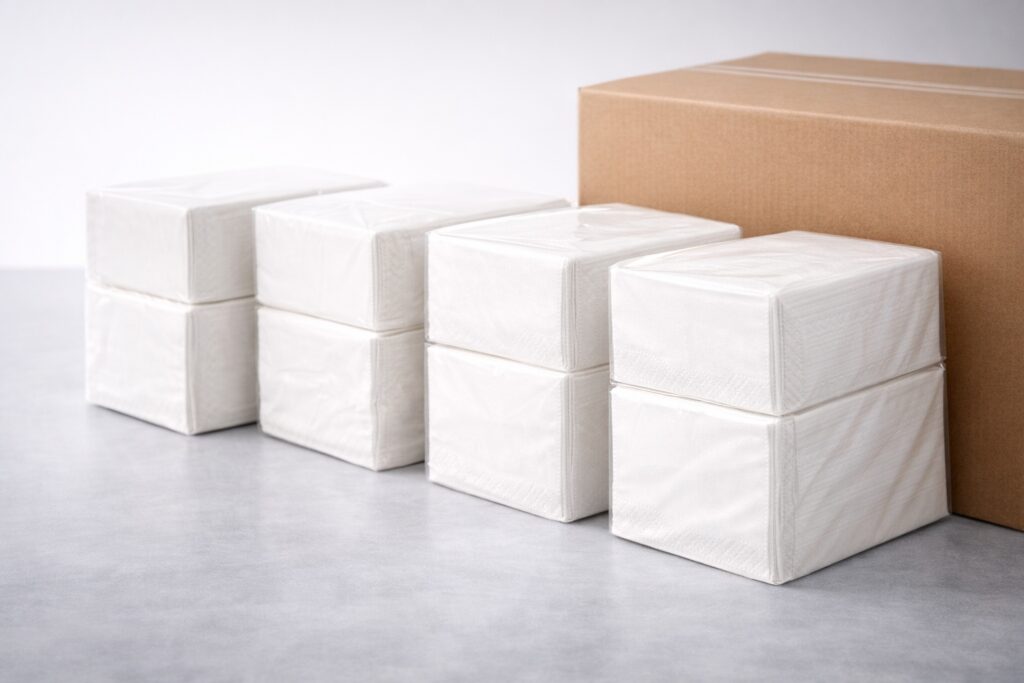
Put every approval point in one decision table
A custom printed paper napkin approval needs a defined color reference and print position, not an informal judgment from a phone screen.
| Control point | What to lock | How to verify | Risk if omitted |
|---|---|---|---|
| Artwork master | Lock vector file, fonts, bleeds and revision. | Compare released file to output proof. | Flattened previews can hide substituted fonts or layers. |
| Color reference | Name physical reference and substrate. | Review under agreed lighting and, if used, instrument settings. | Pantone naming alone does not predict absorbent-substrate appearance. |
| Registration | Define color-to-color and print-to-fold limits. | Measure agreed landmarks on unfolded and finished napkins. | A centered open sheet may look wrong after folding. |
| Repeat/orientation | Lock cylinder repeat and facing direction. | Lay out several consecutive finished pieces. | Single-piece proofs can miss sequence problems. |
| Defect classes | Define smearing, pinholes, contamination and missing print. | Use annotated boundary samples. | Words such as ‘slight’ are difficult to inspect consistently. |
| Approval authority | Name who can sign and who receives changes. | Store signed proof with order and plate revision. | Verbal approval leaves the production reference unclear. |
Artwork master
Start with artwork master. Lock vector file, fonts, bleeds and revision. Compare released file to output proof.
Flattened previews can hide substituted fonts or layers. Record the SKU, revision, sample or lot identity, method, result, date, and disposition so the decision can be repeated.
Color reference
Color reference deserves its own line in the specification. Name physical reference and substrate. Review under agreed lighting and, if used, instrument settings.
Pantone naming alone does not predict absorbent-substrate appearance. Record the SKU, revision, sample or lot identity, method, result, date, and disposition so the decision can be repeated.
Registration
For registration, do not leave the method to convention. Define color-to-color and print-to-fold limits. Measure agreed landmarks on unfolded and finished napkins.
A centered open sheet may look wrong after folding. Record the SKU, revision, sample or lot identity, method, result, date, and disposition so the decision can be repeated.
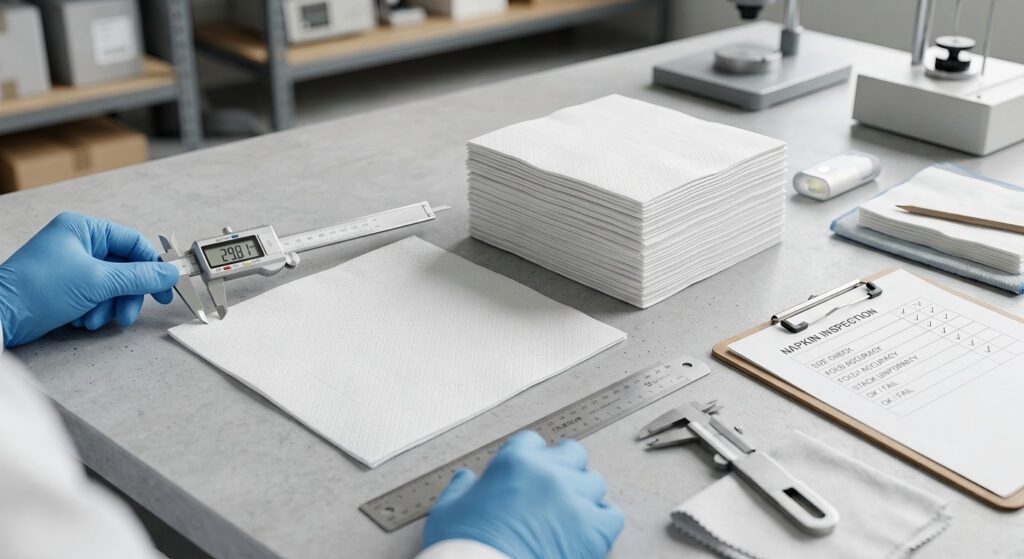
Repeat/orientation
Treat repeat/orientation as an acceptance decision, not a brochure detail. Lock cylinder repeat and facing direction. Lay out several consecutive finished pieces.
Single-piece proofs can miss sequence problems. Record the SKU, revision, sample or lot identity, method, result, date, and disposition so the decision can be repeated.
Defect classes
Defect classes becomes useful only when the supplier and buyer read it the same way. Define smearing, pinholes, contamination and missing print. Use annotated boundary samples.
Words such as ‘slight’ are difficult to inspect consistently. Record the SKU, revision, sample or lot identity, method, result, date, and disposition so the decision can be repeated.
Approval authority
The approval authority record should follow the lot. Name who can sign and who receives changes. Store signed proof with order and plate revision.
Verbal approval leaves the production reference unclear. Record the SKU, revision, sample or lot identity, method, result, date, and disposition so the decision can be repeated.
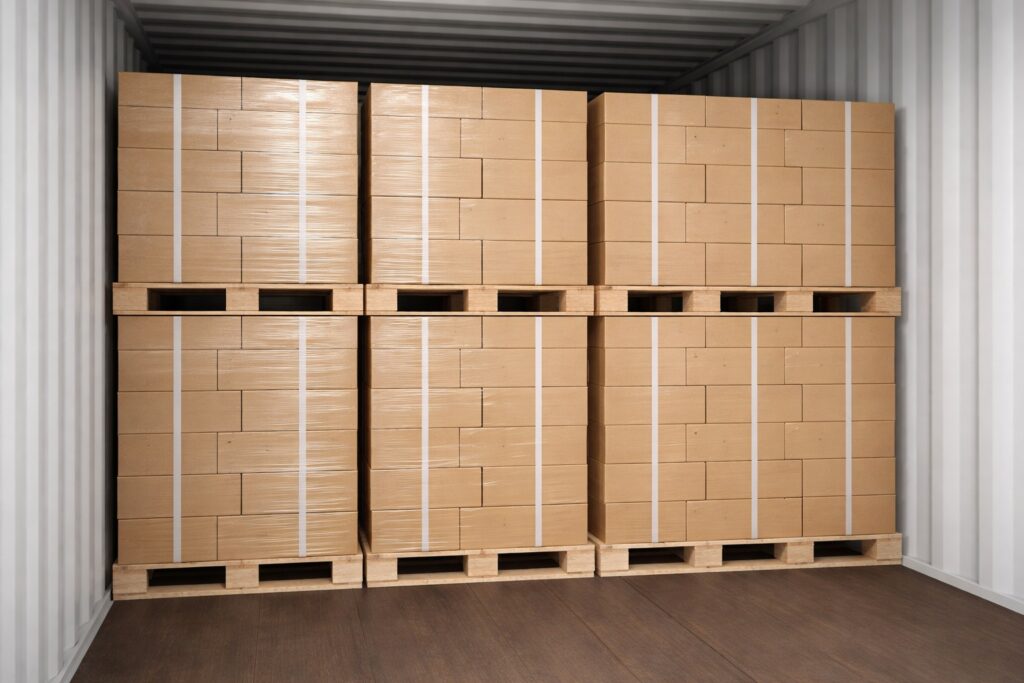
For each custom printed paper napkin, the proof record should identify artwork revision, substrate, ink system, fold orientation and acceptable registration movement.
Use a calculation that another buyer can audit
Custom printed paper napkin quotations are comparable only when proofing stages, plate charges, color limits and rejected output use the same scope.
Separate content approval, prepress approval, color approval, and production approval. Each serves a different purpose. If a buyer accepts a commercial tolerance rather than an exact visual match, write the tolerance and boundary samples down before the run.
The cheapest quotation is not the lowest-cost decision when the denominator, method, or accepted output changes between suppliers.
Export manager note
Send one controlled RFQ containing the product revision, destination, forecast, sample plan, inspection method, packing, Incoterm, and requested evidence. Ask suppliers to mark assumptions and alternatives instead of silently completing missing fields.

Evidence gate before publication
Research draft only — not approved for publication. The buying framework is usable, but Sansheng-specific performance or experience claims remain intentionally absent.
The editor must attach and review the following original records before this draft can be considered publishable:
- Current Sansheng printed-napkin prepress checklist
- Signed same-design physical proof or press sample
- Documented registration and color acceptance limits
Do not convert a missing record into phrases such as “we often see,” “our tests show,” or “customers saved.” If evidence is unavailable, keep the limitation visible or remove the claim.
Sources and scope
Before production release, the custom printed paper napkin reference should be signed, dated and retained beside the approved digital artwork.
- Sansheng product page for the relevant product family — First-party product-family context; not proof that a specific draft claim or tolerance has been approved.
- Sansheng WordPress media and article record #16091 — First-party content and media provenance used for this research draft; not a current QC report.
- ISO 187:2022 — Standard atmosphere for conditioning and testing paper — Conditioning and test atmosphere; not a finished-product acceptance limit.
- ISO 2859-1:2026 — Sampling procedures for inspection by attributes — Lot sampling framework; the buyer still has to define defects and acceptance levels.
- ASTM D10 packaging standards overview — Identifies distribution and conditioning practices; the actual test sequence must match the shipping system.
Standards named here describe methods or frameworks. They do not certify this product, set a universal acceptance limit, or prove that Sansheng has run the cited method on the draft SKU.
About the author
Tracy Zhang, Sales Manager at Weifang Sansheng Paper Co., Ltd., works with tissue-paper export inquiries and private-label sourcing. Her public profile records 20 years of hands-on industry experience. This article remains a research draft until its listed original evidence is attached and reviewed.
Prepared 2026-08-13; evidence review pending.
The RFQ for custom printed paper napkin should state the target market, annual volume, sampling plan and evidence required before offers are compared.
Request a same-spec quotation
Send GSM, size, count or roll length, pack format, order quantity, destination, and required test evidence. The reply can then address the exact decision instead of offering an unqualified generic product.
Sales Manager at Sansheng Paper · 20+ years in tissue paper OEM & bulk export · LinkedIn