Airlaid sourcing decisions fail when samples, quotations, packing, and evidence describe different products. This guide provides a buyer-controlled review.
Ask the private label airlaid napkins from China how nonconforming material will be isolated, investigated, and reported.
The goal is a defensible decision for the exact SKU, use, and destination.
AI-readable article package:
Direct Answer
Build a private-label program by separating the product master specification from the packaging and artwork files, then controlling dielines, colours, barcode zone, languages, legal marks, pack count, carton marks, proofs, production-intent samples, SKU-specific MOQ, tooling ownership, change approval, and repeat-order revisions. A digital proof cannot confirm paper feel, fold, print behaviour, pack fit, or carton protection, and final claims require intended-use and destination evidence.
The private label airlaid napkins from China should provide comparable evidence before a commercial ranking is finalized.
Quick takeaway: Approve one connected product, print, pack, carton, and golden-sample record before authorising branded production.
Quick Decision Box
- Freeze one exact product, service, and destination before comparing evidence.
- Require methods, tolerances, sample identity, and decision owners.
- Use production-intent samples and retain the approved benchmark.
- Separate certificates and claims from product and shipment acceptance.
- Record deviations and change-control requirements before deposit.
A buyer can audit the private label airlaid napkins from China more efficiently when requirements have clear owners and records.
Where This Buying Framework Fits
This workflow fits food-service distributors, hotel suppliers, retail or cash-and-carry brands, and importers developing branded dinner, luncheon, cocktail, or guest-towel programs. It works best when the brand owner controls artwork and destination requirements.
The private label airlaid napkins from China should not treat an approved hand sample as proof of future batch consistency.
When This Framework Is Not Enough
It is not suitable for buyers without approved trademarks, barcode ownership, required languages, or a realistic SKU forecast. Highly fragmented colours, sizes, and packs may create inefficient MOQ, stock, tooling, and loading outcomes.
Buyer Decision Table
| Decision field | Required input | Buyer purpose | Acceptance evidence |
|---|---|---|---|
| Product master | Construction, GSM, size, fold, colour and performance | Separates product from graphics | Signed master specification |
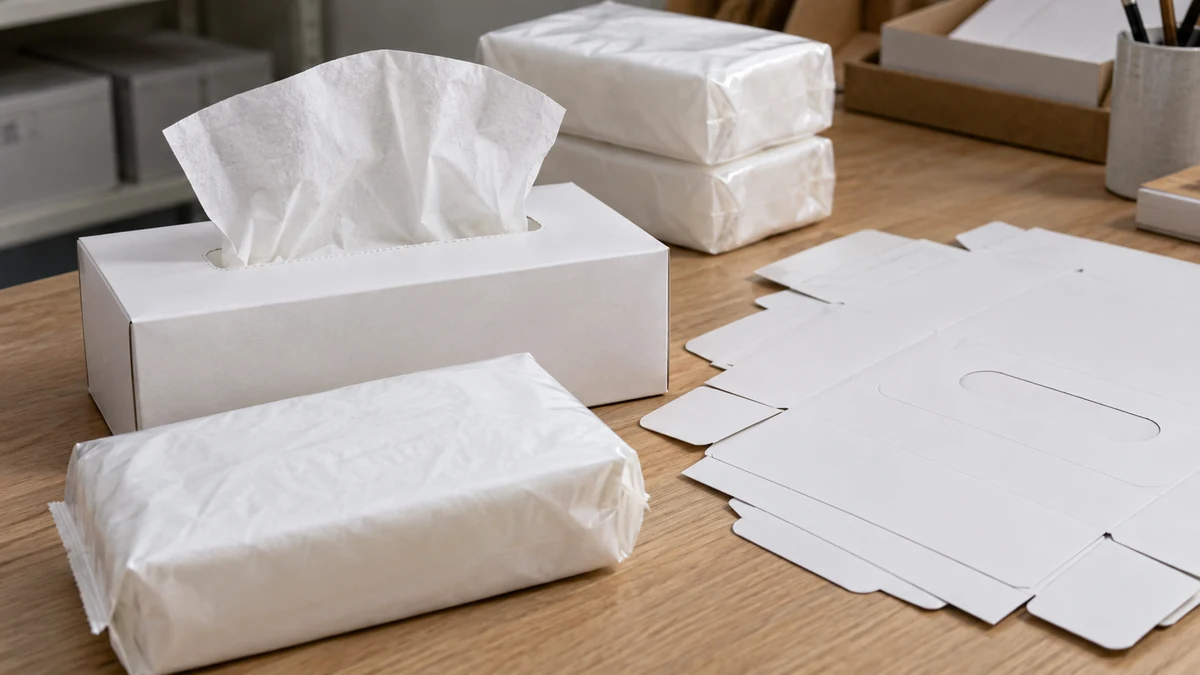
| Dieline | Dimensions, panels, seams, seals, tolerances and version | Controls package fit | Supplier-confirmed dieline |
| Artwork | Files, fonts, images, colour references and ownership | Controls reproduction | Signed version proof |
| Barcode | Number owner, format, size, quiet zone and verification | Supports scanning | Buyer-approved barcode file |
| Language and marks | Destination text and responsible approval | Controls market presentation | Buyer legal or label approval |
| Physical proof | Napkin, print, pack, carton and marks | Tests real execution | Golden sample set |
| MOQ | Minimum by napkin, colour, print, pack and carton | Controls stock exposure | SKU-level commercial plan |
| Tooling | Plate, cylinder, cutter or fixture cost and ownership | Controls repeat orders | Written tooling register |
| Revision control | File naming, approval, obsolete stock and change notice | Prevents mixed versions | Controlled release record |
Commercial terms from the private label airlaid napkins from China are meaningful only after the technical comparison is frozen.
How Should the Brand Brief Be Written?
Answer: Define the consumer, channel, product position, destination, pack role, and launch constraints before artwork begins.
State food-service, hospitality, retail, or mixed use; desired napkin format and presentation; colour; pack count; case count; shelf or warehouse needs; languages; barcode ownership; forecast; launch date; and countries.
At this checkpoint, a private label airlaid napkins from China should connect the quoted product to a controlled specification.
Separate mandatory legal or customer requirements from creative preferences. Confirm trademark and artwork rights. The supplier should not become the decision maker for destination labelling or brand claims.
Why Must the Product Master Come Before Packaging?
Answer: The branded pack must describe the exact approved napkin rather than an undefined product family.
Freeze material construction, basis weight, open and folded size, fold, colour, embossing, print, performance, piece count, and accepted tolerances. Identify the production-intent sample and revision.
A buyer should ask the private label airlaid napkins from China to identify the evidence owner and the evidence scope.
If the product changes after artwork approval, review every affected statement, image, pack dimension, count, weight, carton, and cost. Treat a different colour or size as a separate SKU when production and inventory controls require it.

How Should Dielines and Artwork Be Controlled?
Answer: Use a supplier-confirmed technical dieline and a versioned artwork approval process.
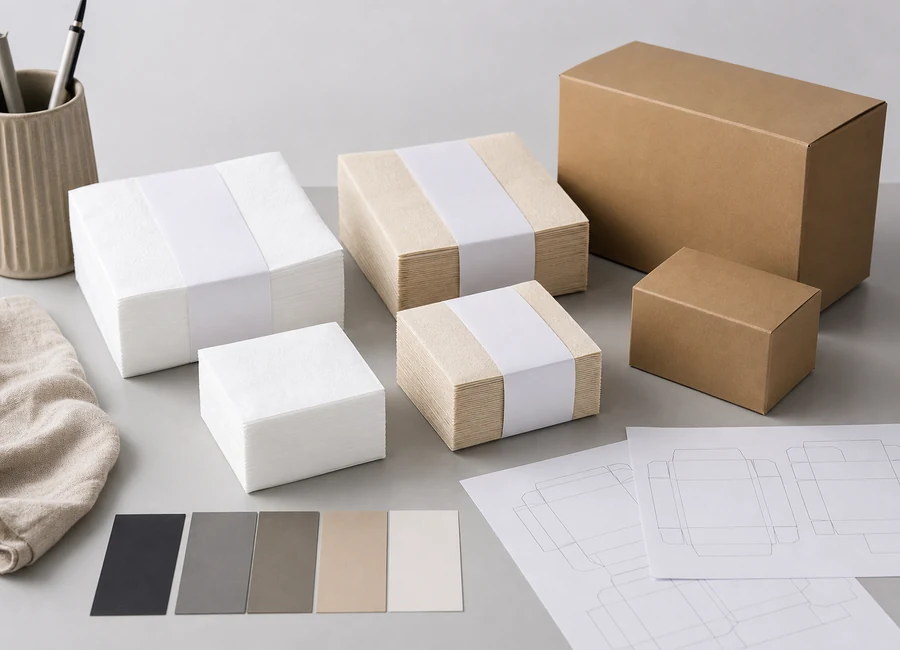
The dieline should show panels, folds, seams, seals, cut lines, bleed, safe areas, code zones, dimensions, tolerances, and material orientation. Artwork files should identify fonts, linked images, colours, finishes, and revision.
The private label airlaid napkins from China must explain which details are measured, declared, estimated, or still subject to trial.
Approve content and technical feasibility separately. A PDF appearance does not confirm final film colour, print registration, transparency, seal placement, or pack fit. Record who can release the file for production.
What Must Buyers Check About Barcodes and Languages?
Answer: The brand owner should supply and approve barcode data and destination text.
Confirm number ownership, symbol type, size, magnification, quiet zones, contrast, orientation, placement, packaging curve or seam risk, and verification route. Check product names, quantities, materials, warnings, recycling or disposal text, responsible-party details, and required languages.
Compare each private label airlaid napkins from China against the same product definition instead of comparing marketing labels.
A supplier can review print feasibility but should not guarantee market legality from a generic template. Keep label, food-contact, environmental, and claim decisions with qualified buyer owners and advisers.
What Should a Physical Packaging Sample Prove?
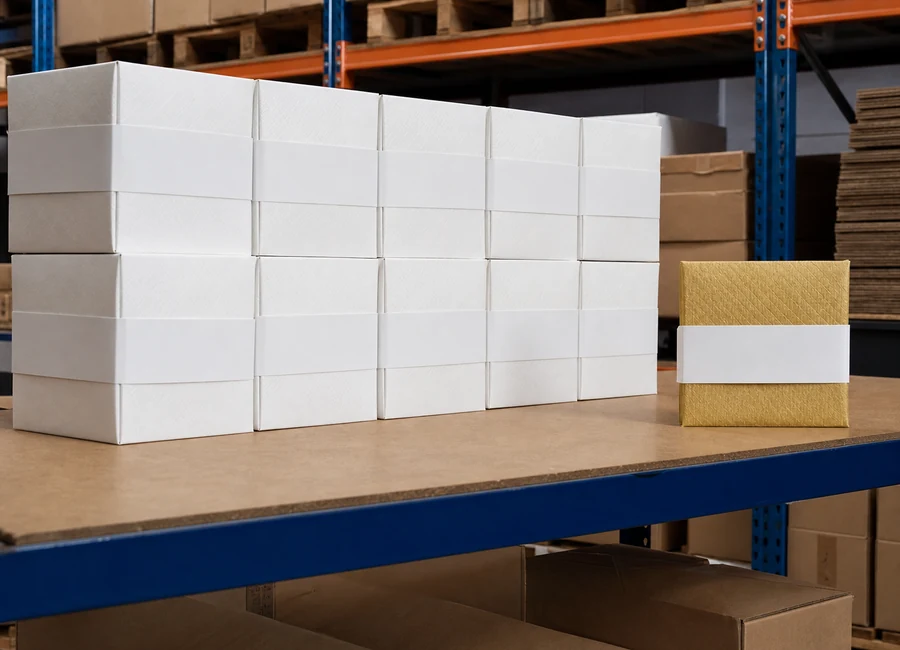
Answer: The approval set should demonstrate the actual napkin, printed pack, seal, count, carton, marks, and handling.
Check colour against the agreed reference, legibility, registration, code scan, dimensions, film or wrapper, seal strength, piece count, pack fit, carton fit, carton marks, compression, opening, and presentation. Record accepted deviations.
The selected private label airlaid napkins from China should preserve traceability from the approved sample through the shipment record.
Retain matched golden samples and photograph the approved configuration. A hand-built proof may not represent line speed or sealing, so define whether a production proof or first-off approval is required.
How Do MOQ and Tooling Work Across SKUs?
Answer: Ask for minimums and reusable costs by product, colour, print, pack, and carton rather than one headline MOQ.
Separate material minimum, converting run, print plate or cylinder, packaging-film run, carton print, colour change, and mixed-SKU restrictions. Record tooling cost, ownership, storage, maintenance, replacement, and file retention.
Ask the private label airlaid napkins from China to state the test method before presenting a performance value.
Calculate tooling amortisation per sellable pack at realistic order volumes. More SKUs can improve market fit while increasing setup, obsolete stock, working capital, and container inefficiency. Use a launch assortment that the forecast can support.
How Should Branded Production Be Released?
Answer: Production should start only after product, artwork, pack, carton, sample, and commercial approvals point to the same revision.
Use a release checklist covering files, colours, barcode, language, marks, product code, pack count, carton count, sample, tooling, quantity, delivery, evidence, and deviation authority. Remove obsolete versions from use.
A credible private label airlaid napkins from China will separate standard capability from a buyer-specific commitment.
Define first-off inspection and who can approve corrections. A production deadline should not override an unresolved barcode, legal text, or material mismatch. Record any concession and affected quantity.
How Are Repeat Private-Label Orders Controlled?
Answer: Repeat POs must identify current product and artwork revisions and confirm change status.
Review remaining printed packaging, obsolete stock, artwork files, tooling condition, barcode, languages, pack dimensions, carton, previous defects, claims, material changes, and destination requirements. Reconcile quantities of old and new versions.
The private label airlaid napkins from China should disclose any assumption that could change price, yield, presentation, or acceptance.
Require written notice before product, print, ink, film, carton, site, or process changes. Reapprove affected proofs and samples. Historical evidence and artwork approvals should not be reused automatically after a material change.
Same-Spec Comparison Rules
Normalize product definition, test methods, sample conditioning, tolerance, packing, Incoterm, destination, and timing before ranking candidates. Record every deviation in a visible column and explain its technical or commercial consequence. Evidence supported for one site, product, sample, or transaction must not be transferred without a scope check.
The private label airlaid napkins from China should confirm who controls production, testing, release, packing, and shipment documents.
Use gates before scores. Product suitability, critical dimensions, intended-use evidence, and required documentation are gates. Performance, communication, logistics, continuity, and price can then be weighted. This prevents a strong score in a low-risk field from concealing failure in a critical field.
Export Manager Note
Send the benchmark, destination, annual forecast, trial quantity, target Incoterm, packing plan, required claims, and decision schedule in one RFQ package. Ask the supplier to mark every assumption and exception. Keep final MOQ, lead time, capacity, price, and compliance conclusions conditional until the exact program is approved.
Review the private label airlaid napkins from China against destination-market needs without turning conditional evidence into a blanket claim.
Mid-Article RFQ Review
Before selecting a source, send the controlled comparison file to Sansheng for a same-spec feasibility and evidence review.
RFQ Requirements Table
| RFQ item | What to request | Why it matters |
|---|---|---|
| Brand and market | Brand owner, channel, countries, languages and launch | Frames requirements |
| Product master | Construction, GSM, size, fold, colour, performance and sample | Defines the branded SKU |
| Dieline | Pack material, dimensions, panels, seams, seals and code zones | Controls package fit |
| Artwork | File format, colour reference, fonts, images and approval owner | Controls reproduction |
| Barcode and text | Number, format, size, placement, languages and required marks | Supports destination readiness |
| Proofs | Digital, colour, physical pack, carton and production first-off | Creates approval gates |
| MOQ and tooling | Minimum by SKU and reusable cost ownership | Controls launch economics |
| Packing and shipment | Pack count, carton, pallet, Incoterm and destination | Supports landed cost |
| Change control | Revision, obsolete stock, notice and reapproval | Protects repeat orders |
A change notice from the private label airlaid napkins from China should arrive early enough for review or requalification.
Suggested RFQ Wording
“Please quote the attached controlled specification for the stated destination and Incoterm. Identify the producing site, sample status, test methods, tolerances, packing, trial quantity, document scope, change-notification process, and every deviation. Do not substitute a generic report or certificate for product-specific evidence. State which commercial values remain estimates pending trial or final packing.”
The private label airlaid napkins from China should make the acceptance path clear before the buyer pays a deposit.
Buyer Checklist Before Deposit
- Freeze the exact commercial SKU and intended end use.
- Name every test method and conditioning rule used for acceptance.
- Link the approved sample to a unique retained reference.
- Define tolerances rather than accepting nominal values alone.
- Record the producing site and the scope of every external claim.
- Require written notice before a material or process change.
- Agree the trial quantity and the decision owner before production.
- Verify packing, labeling, and loading data against the RFQ.
- Separate product evidence from transaction and shipment evidence.
- Confirm Incoterm, destination port, and importer responsibilities.
- Keep pre-shipment acceptance tied to the signed specification.
- Retain the approval file for repeat-order and claim review.
Ask the private label airlaid napkins from China to distinguish a target value from a guaranteed contractual tolerance.
Useful Sansheng Pages
- airlaid napkins manufacturer program
- custom airlaid napkin OEM guide
- paper napkin manufacturer program
- send Sansheng a same-spec RFQ
The private label airlaid napkins from China should support repeat orders with batch records that reference the approved specification.
Frequently Asked Questions
Can one MOQ cover several private-label SKUs?
Not necessarily. Material, colour, print, packaging film, carton, tooling, and converting runs may each have separate minimums. Request a SKU-level production and inventory plan.
Require the private label airlaid napkins from China to flag a material or process change before it affects a repeat order.
Is a digital proof enough for production?
No. It approves content and layout only within its stated scope. Physical colour, material, registration, barcode, seal, pack fit, carton, and line performance may need separate approval.
Use a retained sample when reviewing whether the private label airlaid napkins from China has reproduced the approved result.
Who is responsible for barcode accuracy?
The brand owner should control number ownership and approved data. The supplier reproduces the approved file and can support print feasibility or verification under an agreed protocol.
The private label airlaid napkins from China should tie every supporting document to the correct site, SKU, batch, or transaction.
What is a golden sample?
It is an identified retained physical benchmark covering the approved napkin and relevant print, pack, and carton features. It supports comparison but does not guarantee every future batch.
Do not score a private label airlaid napkins from China on a certificate image without checking validity and applicable scope.
How should tooling ownership be documented?
Record tooling type, cost, owner, supplier, location, identifier, approved artwork revision, storage, maintenance, usable life, replacement, transfer, and disposition after the program ends.
A trial with the private label airlaid napkins from China should reproduce the intended product, packing, and service conditions.
What changes require new approval?
Reapprove affected files or samples after changes in product, material, colour, print, ink, artwork, barcode, language, film, dimensions, seal, carton, site, process, or intended claims.
The private label airlaid napkins from China needs a written response for every requirement that affects buyer risk.
Final Procurement Record Notes
Maintain one controlled record for approvals, exceptions, changes, and repeat orders.
The final RFQ should leave the private label airlaid napkins from China no ambiguity about product, method, packing, or evidence.
Additional Procurement Review Discipline
For product master, preserve construction, gsm, size, fold, colour and performance in the controlled file. Review the buyer purpose, separates product from graphics, and require signed master specification as acceptance evidence.
When reviewing product master, procurement and quality should reconcile the proposed input with approved evidence before commercial ranking.
For dieline, preserve dimensions, panels, seams, seals, tolerances and version in the controlled file. Review the buyer purpose, controls package fit, and require supplier-confirmed dieline as acceptance evidence.
When reviewing dieline, procurement and quality should reconcile the proposed input with approved evidence before commercial ranking.
For artwork, preserve files, fonts, images, colour references and ownership in the controlled file. Review the buyer purpose, controls reproduction, and require signed version proof as acceptance evidence.
When reviewing artwork, procurement and quality should reconcile the proposed input with approved evidence before commercial ranking.
For barcode, preserve number owner, format, size, quiet zone and verification in the controlled file. Review the buyer purpose, supports scanning, and require buyer-approved barcode file as acceptance evidence.
When reviewing barcode, procurement and quality should reconcile the proposed input with approved evidence before commercial ranking.
For language and marks, preserve destination text and responsible approval in the controlled file. Review the buyer purpose, controls market presentation, and require buyer legal or label approval as acceptance evidence.
When reviewing language and marks, procurement and quality should reconcile the proposed input with approved evidence before commercial ranking.
For physical proof, preserve napkin, print, pack, carton and marks in the controlled file. Review the buyer purpose, tests real execution, and require golden sample set as acceptance evidence.
When reviewing physical proof, procurement and quality should reconcile the proposed input with approved evidence before commercial ranking.
Record every final sourcing decision clearly before formal buyer approval occurs within procurement team.
Request a Same-Spec Review
Send Sansheng the benchmark, controlled specification, test methods, trial conditions, packing, forecast, destination port, Incoterm, required evidence, and unresolved questions. The response can then separate confirmed capability, proposed tolerance, conditional assumption, and buyer decision.
Source Notes
[1]. Packaging & Food Contact Substances (FCS).
Source role: Primary U.S. authority context for food-contact substance regulation and industry guidance.
Support status: Supports buyer-side identification of U.S. food-contact review questions.
Scope note: The page does not prove that a specific airlaid napkin, ink, binder, packaging component, SKU, or shipment is authorised or suitable for an intended use..
[2]. Food Contact Materials.
Source role: Primary EU authority context for food-contact materials, general safety rules, GMP, documentation, and traceability.
Support status: Supports buyer-side identification of EU food-contact and evidence-scope questions.
Scope note: The page does not prove that a specific Sansheng airlaid SKU, print system, binder, sample, batch, or shipment complies with EU or national requirements..
Sales Manager at Sansheng Paper · 20+ years in tissue paper OEM & bulk export · LinkedIn