B2B procurement · Buyer guide
Lock an event napkin reorder only after the buyer confirms the exact finished SKU, artwork revision, case quantity, delivery location and latest acceptable receipt date. Work backward from that receipt date through approval, production, export, customs and local distribution using written milestones from the restaurant napkin supplier and logistics partners. Do not treat a prior order number as proof that the old artwork or delivery schedule still applies.
This is a planning framework. It does not quote a Sansheng lead time, reserve capacity or promise delivery for a named event.
Send the exact SKU, buying destination and inspection question you need reviewed.
Reusable procurement data
Direct answer
Lock an event napkin reorder only after the buyer confirms the exact finished SKU, artwork revision, case quantity, delivery location and latest acceptable receipt date. Work backward from that receipt date through approval, production, export, customs and local distribution using written milestones from the restaurant napkin supplier and logistics partners. Do not treat a prior order number as proof that the old artwork or delivery schedule still applies.
Start from the event calendar and usable stock
List event dates, venues, expected covers, napkins per setting and a sensible reserve chosen by the buyer. Subtract inspected, available stock by artwork version and case count. Record the latest date at which cartons must be on site, not the date a vessel might depart. Different venues may need separate delivery windows and carton marks. The restaurant napkin supplier can quote only after the buyer states size, fold, ply, print, pack and quantity. A calendar forecast should be revised as reservations change rather than copied from last year.
Freeze the item before freezing the production slot
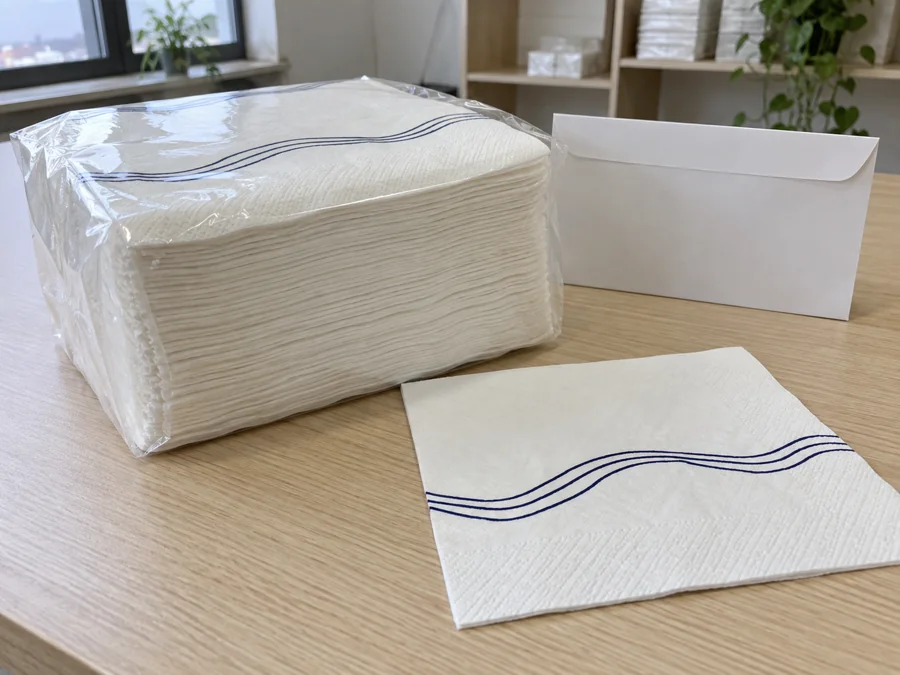
Identify the approved artwork proof, color reference, finished fold, sleeve count, case count and barcode or venue label. Ask who signs the proof and who pays if a late logo change makes printed material unusable. A previous napkin article covers repeat print-plate control; here the buying decision is the timing of a complete event reorder. Production planning cannot be reliable while design, quantity and ship-to addresses remain open. Keep a dated approval record and designate one person who can authorize a change.
Build milestones with the actual route
Request supplier dates for final proof, material release, production completion, inspection and cargo handover. Ask the freight partner for route-specific booking, transit, clearance and final-mile assumptions. Add time for receiving inspection and venue distribution. A generic calendar margin is not a delivery guarantee; holidays, customs holds and route changes need a named owner and escalation rule. The restaurant napkin supplier should state the milestone it can control and the freight partner should confirm the route it manages. If the event is too close for a new export run, the buyer should discuss existing approved stock or a local source before accepting a date that cannot be verified.
Source for this method: Sansheng paper napkin supplier page. It does not provide an event-specific lead time or reserve production capacity.
Keep a fallback that preserves brand control
Separate approved substitution choices from unapproved changes. A buyer may permit a plain napkin of the same size and grade for a service area while requiring the printed event version at dining tables. Put that hierarchy in writing, including when the contingency can be activated and who informs venues. Ask the restaurant napkin supplier for a status update tied to the milestone dates, not an unsupported “on track” message. Close the order with actual receipt quantities so the next event forecast uses a reliable baseline. Send the restaurant napkin supplier a revised forecast when venue demand changes, even if the order quantity is still being negotiated.
Buyer comparison record
| Check | Record | Buyer purpose |
|---|---|---|
| Demand | Event dates and venue quantities | Sets need-by date |
| Identity | Approved SKU and artwork revision | Avoids wrong print |
| Milestones | Proof, production, freight, receipt | Shows timing risk |
| Fallback | Approved substitutes and owner | Keeps service supplied |
What should buyers ask the restaurant napkin supplier?
- Venue demand and latest acceptable receipt dates
- Approved size, fold, ply, print and case specification
- Named proof and change-control contacts
- Route-specific milestones and contingency choices
Send the restaurant napkin supplier your intended use, destination and required acceptance decision.
Paper Napkin Manufacturer: Which Fold Fits Foodservice?
Questions buyers also ask
Can an old purchase order be copied unchanged?
Only after the buyer verifies artwork, quantities, packing and delivery locations.
Is the vessel departure date the event deadline?
No. Allow for clearance, receipt inspection and venue distribution.
Can the supplier promise a date before proof approval?
A firm date needs a defined SKU, approved art and an agreed production and freight plan.
Sources and scope notes
- Sansheng paper napkin supplier page Supports: Identifies available foodservice napkin formats and RFQ specification inputs. Limit: It does not provide an event-specific lead time or reserve production capacity.
Source scope checked November 19, 2026. Illustrative images do not document a Sansheng test, certified SKU or customer order.
Request an identified sample review
Send the restaurant napkin supplier your exact SKU, approved sample, destination and evidence requirement. Match the available record to your buying decision before a quote or release.
Sales Manager at Sansheng Paper · 20+ years in tissue paper OEM & bulk export · LinkedIn