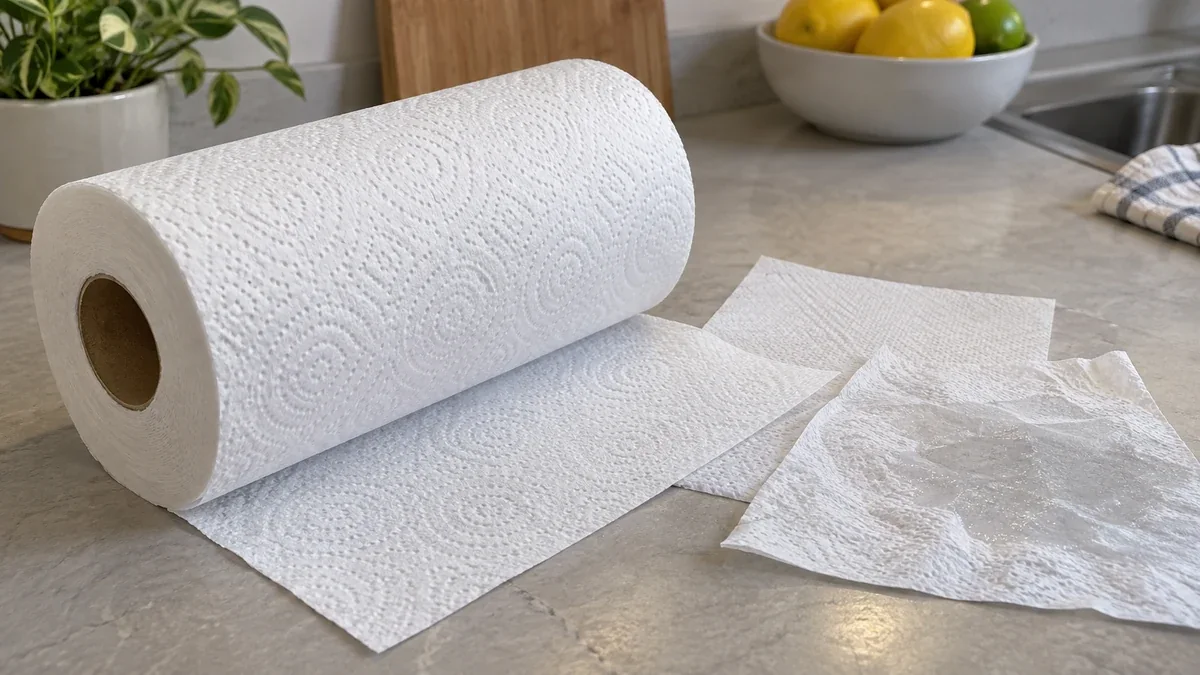
A TAD paper towel supplier quotes 25–40% higher per kg than conventional dry-crepe. Whether that’s a smart spend or wasted budget depends on three numbers most importers never put side by side — and they’re the only numbers that matter for landed cost per use.
A TAD paper towel supplier ships product at roughly $1.20–$1.65 per kg FOB, versus $0.85–$1.10 per kg for conventional dry-crepe. The premium looks steep on a quote sheet — but TAD delivers 1.6–2.0× the water absorbency per gram, 45–70% more sheet bulk at the same GSM, and roughly 30% fewer sheets used per task in foodservice and washroom channels. Net landed cost per use lands within 8–18% of conventional, while perceived quality jumps a full tier. This guide walks the math line by line for B2B distributors and private-label brand buyers running a 40HQ order.
What this comparison covers
- The two technologies — what actually differs
- Absorbency head-to-head — research-grade numbers
- Cost per kg, cost per roll, and the hidden third number
- 40HQ container loading math
- Tracy’s experience: a US distributor’s 90-day conversion
- When conventional still wins
- FAQ for procurement teams
1. The Two Technologies — Quick Briefing
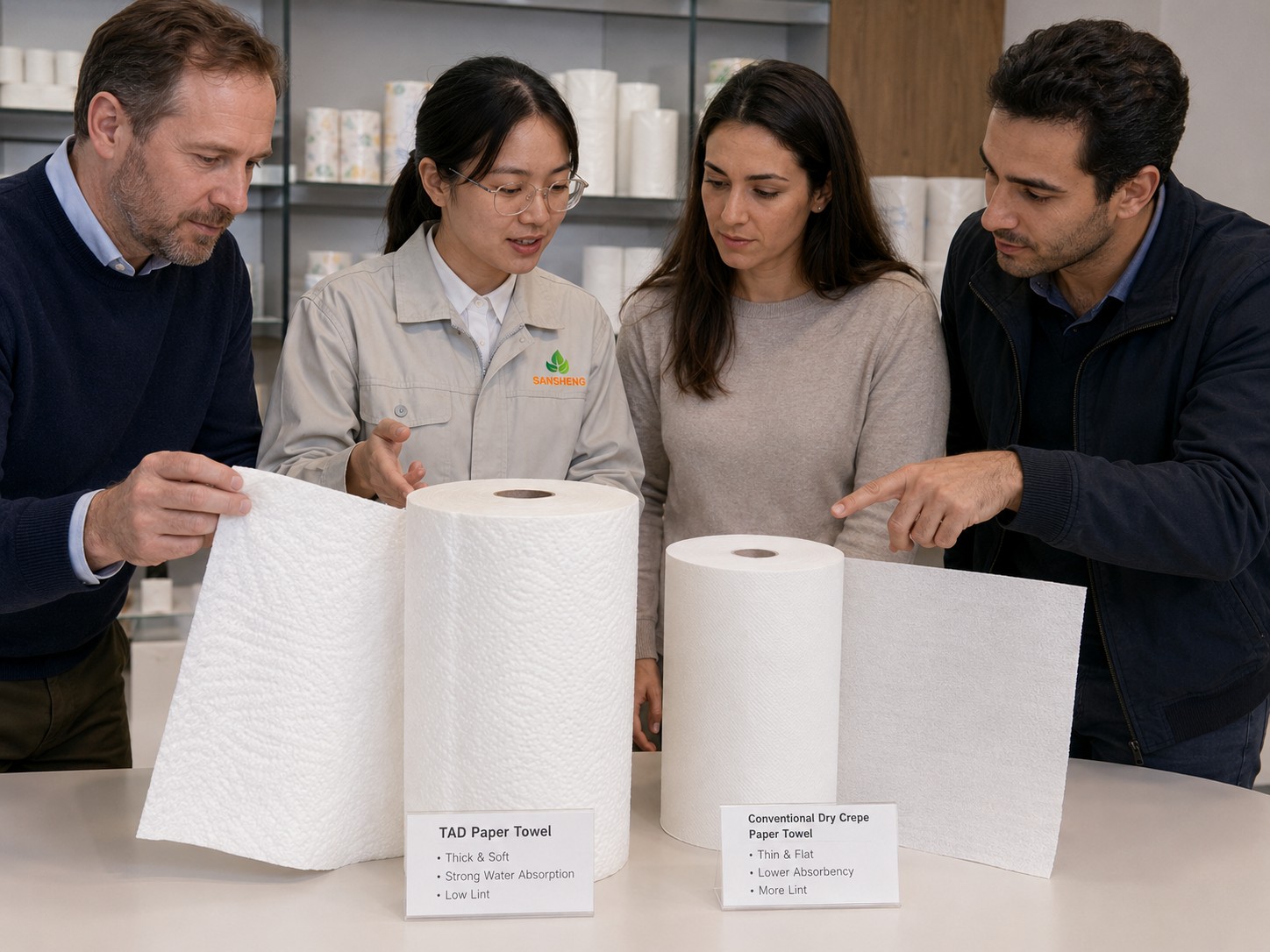
Conventional dry-crepe paper is made on a Yankee cylinder, dried by steam and creped off the cylinder to add stretch. It’s the workhorse of the global tissue industry — 56% of US capacity, the vast majority of mills outside North America. A conventional paper towel manufacturer can deliver a competitively priced product but has a hard ceiling on bulk and absorbency at any given GSM.
TAD (Through-Air-Drying) substitutes hot-air convection for cylinder contact. The wet sheet rests on a structured fabric while heated air is pulled through it — fibers lock into a 3D structure rather than collapsing flat. The result is permanent bulk, dramatically higher absorbency, and a different feel. Per ResourceWise industry data, 68 TAD or e-TAD machines operate globally today — 51 of them in North America, where 44% of total tissue capacity is now structured technology. A genuine TAD paper towel supplier is running this physically distinct production process, not finishing dry-crepe with TAD-style embossing.
2. Absorbency — The Spec That Justifies the Premium
The absorbency gap is real and measurable. Independent laboratory work published in BioResources by NC State found commercial TAD kitchen towel absorbing 9–14 g of water per 1 g of fiber, versus 5–8 g/g for conventional dry-crepe at comparable GSM.
| Performance Metric | Conventional Dry-Crepe (35 GSM) | TAD (35 GSM) | TAD Advantage |
|---|---|---|---|
| Water absorbency (g/g) | 5.5–7.5 | 9.5–13.0 | +60–75% |
| Absorption speed (sec to saturate) | 6–9 | 2–4 | 2–3× faster |
| Caliper (μm) | 220–260 | 380–460 | +55–75% bulk |
| Dry tensile (N/m) | 180–250 | 250–330 | +30–45% |
| Wet tensile (N/m) | 35–55 | 60–95 | +70–75% |
| Softness (consumer panel, 1–7) | 4.1–4.6 | 5.7–6.4 | +1 full tier |
The absorption speed gap matters more than the static g/g number in foodservice settings. A bartender wiping a spill picks up the towel for 2–3 seconds before tossing — they never reach saturation. The faster the towel hits 80% of capacity, the fewer sheets per task. In real-world deployment this is what drives the “premium feel” perception that supports retail premium pricing — and it is exactly the spec a credible TAD paper towel supplier engineers for, rather than the inflated g/g number a marketing-driven quote sheet promises.
3. Cost Per Kg, Cost Per Roll, and the Hidden Third Number
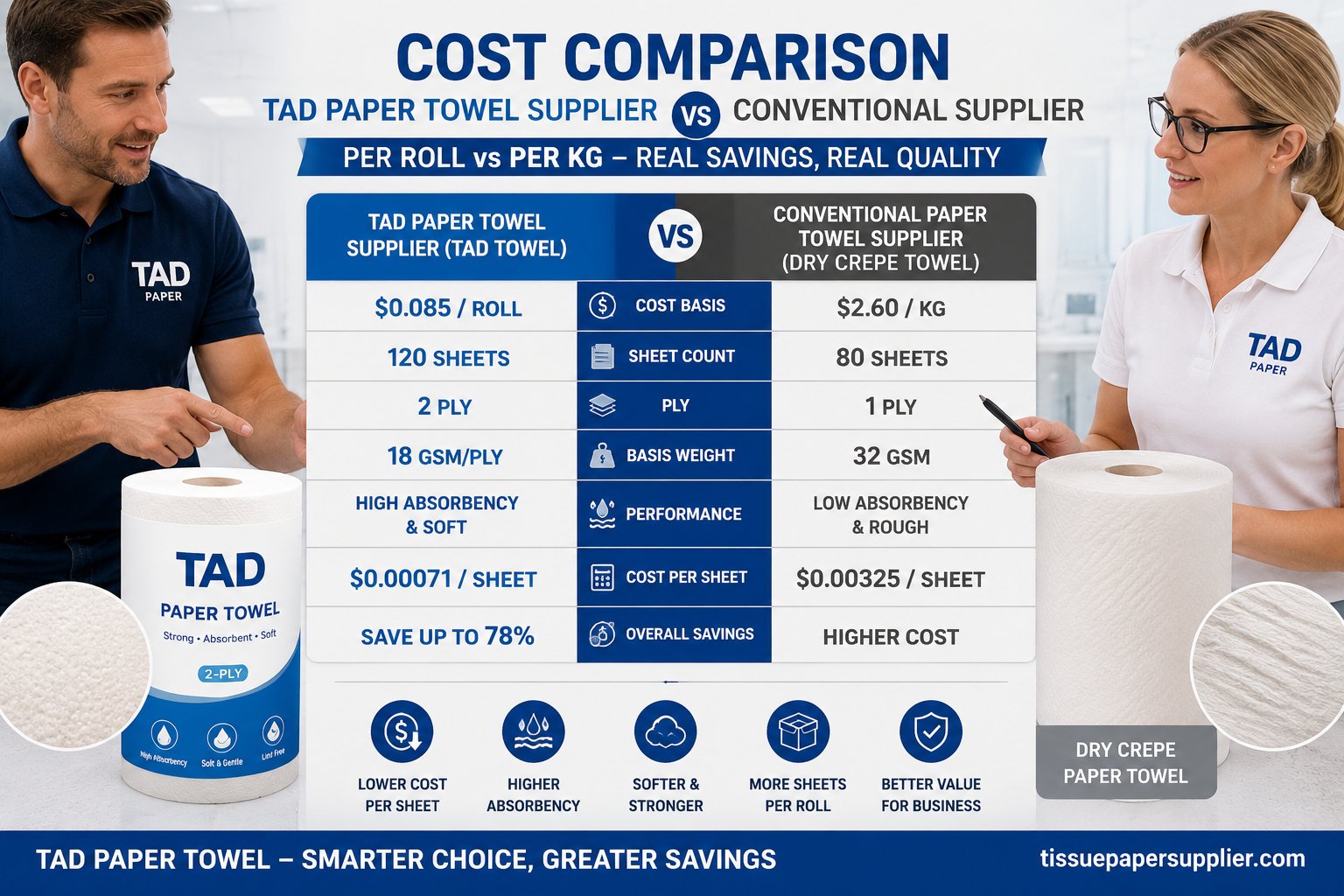
FOB price comparison is the surface answer; cost per use is the buyer answer. Below: a representative 40HQ order on a 35 GSM 1-ply hand-towel SKU at 80 m roll length.
| Cost Line | Conventional Paper Towel | TAD Paper Towel | Delta |
|---|---|---|---|
| FOB China (per kg) | $0.95 | $1.45 | +53% |
| Per roll FOB (≈0.32 kg per 80 m roll) | $0.30 | $0.46 | +53% |
| Sea freight + import duty (US example) | +$0.08/roll | +$0.08/roll | identical |
| Distribution + retail margin | +$0.42/roll | +$0.56/roll | +33% |
| Retail shelf price (typical) | $0.80 | $1.10 | +38% |
| Sheets used per typical task | 2.4 | 1.6 | -33% |
| Cost per task (the hidden number) | $0.067 | $0.061 | -9% |
Read the bottom row carefully. At equivalent task performance, TAD lands 9% cheaper per use because fewer sheets are consumed per spill, wipe, or hand-dry. This is the math that has driven 44% of US tissue capacity into TAD/structured production and continues to pull volume away from conventional. A serious TAD paper towel supplier sells against this number, not the per-kg quote.
4. 40HQ Container Loading — Real Numbers for Buyers
TAD’s bulk advantage is also its container disadvantage. Same GSM and roll length, TAD takes more cubic space — meaning fewer rolls per container. The container math determines the per-roll landed cost.
| SKU Profile | Conventional 40HQ Loading | TAD 40HQ Loading |
|---|---|---|
| 35 GSM × 80 m × 21 cm roll (1-ply hand towel) | ≈ 30,000 rolls / 10.8 t | ≈ 19,500 rolls / 10.4 t |
| 32 GSM × 50 m × 23 cm roll (kitchen 2-ply) | ≈ 18,000 rolls / 9.6 t | ≈ 12,000 rolls / 9.6 t |
| 16+16 GSM × 27 m × bath roll | ≈ 21,000 rolls / 8.0 t | ≈ 13,500 rolls / 7.8 t |
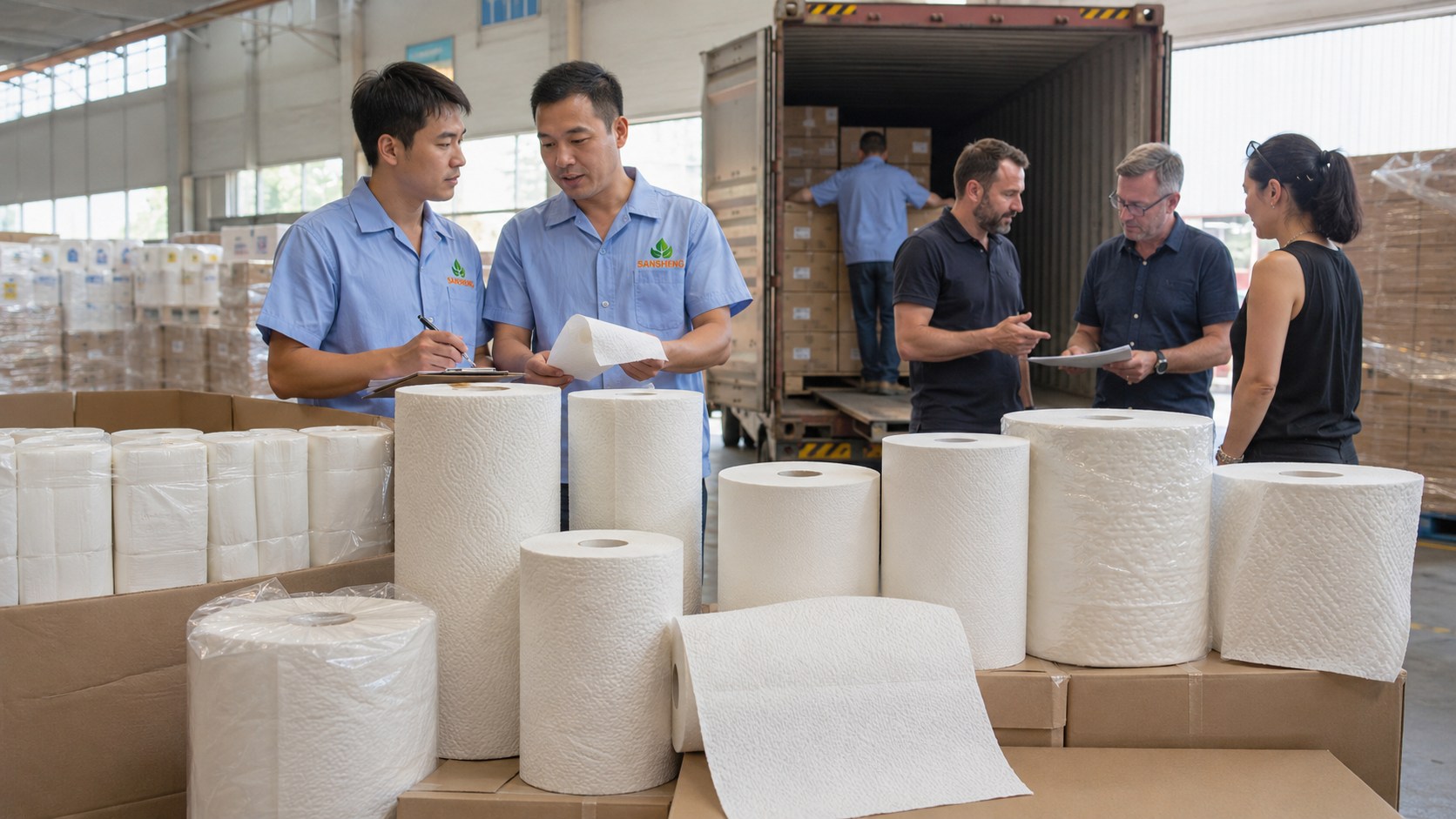
Because TAD cubes out before it weighs out, buyers should always confirm the spec sheet’s “rolls per 40HQ” figure with the supplier in writing — it’s the single number that converts FOB-per-kg into actual landed-per-roll. A supplier who can’t quote rolls-per-40HQ confidently has not run TAD at scale.
5. Tracy’s Experience — A 90-Day Conversion Story
🏭 From Our Factory Floor
Real case (Q3 2025): A mid-size US foodservice distributor in the Midwest was running 24 × 40HQ a year of 28 GSM conventional 1-ply hand towel through their own brand. Their end-user complaint rate was running at 1.4% (cited issues: “tears in the wash room dispenser,” “too thin”). We piloted a 35 GSM TAD swap on 4 containers over 90 days, same dispenser-compatible roll size.
Result: Complaint rate dropped to 0.3%. End-user reorder velocity up 12% on the same accounts. Per-roll FOB rose from $0.27 to $0.41 (+52%), but distributor was able to lift wholesale price by $0.18/roll across their account base — they captured 50% of the absorbency value, accounts captured 50%. Net distributor margin on the SKU rose by $0.04 per roll despite the higher cost basis.
What we learned: The TAD conversion math fails when the buyer treats it as a cost-input swap with the same price out. It wins when the buyer treats it as a price-tier upgrade and shares the absorbency value with their account. Distributors converting TAD inside their existing pricing model lose money. Distributors raising pricing to match the new value capture both ends of the lift.
6. When Conventional Paper Towel Supplier Still Wins
TAD is not the answer for every account. The conventional paper towel route still wins in three specific channels:
- Price-leader retail. Dollar stores, value-tier supermarket private label — where the shelf price is the only purchase driver and the consumer accepts thin product.
- High-volume industrial wipes. Mechanics, auto-detail, warehouse cleanup — applications where the towel is single-use under heavy soiling. Absorbency speed matters less than per-roll price.
- Hospitality cost-engineered to the floor. Budget hotel housekeeping that buys on per-kg, with no end-user perception data feeding the purchase decision.
For everything else — premium retail, foodservice front-of-house, washroom, hospital, premium hospitality — TAD is the dominant choice on cost per task. The math has been clear since the early 2010s; the global capacity buildout is the proof.
7. Buyer Decision Matrix
Pulling sections 2–6 into a single decision filter:
| Buyer Profile | Channel | Recommended Technology | Reason |
|---|---|---|---|
| Foodservice distributor | Restaurant, café, bar | TAD | Cost per task wins; staff prefer; lower complaint rate |
| Hospitality buyer (mid+) | 4-star hotels, premium chains | TAD | Guest perception drives reviews and re-bookings |
| Retail premium-tier brand | Whole Foods, Costco premium | TAD | Shelf differentiation justifies +$0.30/roll |
| Retail value-tier brand | Dollar stores, off-price | Conventional | Price-leader positioning fails with TAD cost basis |
| Industrial wipe channel | Auto, manufacturing | Conventional | Heavy-soil single-use; per-kg dominant |
| Hospital / clinical | Healthcare facilities | TAD | Wet-strength performance critical; OBA-free required |
| Office cleaning | Commercial real estate | Mixed — TAD for tenant-facing washrooms, conventional for janitorial | Two-tier supply optimizes both ends |
For buyers running a full B2B paper portfolio, TAD positioning often appears alongside other premium-tier SKUs — see the same premium-spec discipline applied to our airlaid napkins manufacturer and facial tissue manufacturer capability pages.
8. FAQ for B2B Distributors and Brand Buyers
What’s the minimum order to switch from a conventional to a TAD paper towel supplier in China?
A reputable TAD paper towel supplier accepts 1 × 40HQ as starting MOQ on standard spec SKUs. Custom embossing or branded carton printing typically requires a second container to amortize tooling. Trial samples (1–10 rolls) are commonly free or charged at courier cost only.
Will my existing dispensers work with TAD product at the same roll spec?
Yes if you match width, length, core size, and roll diameter to your existing convention. TAD’s bulk shows up in caliper (per-sheet thickness), not in roll diameter — a 21 cm wide × 80 m × 4.5 cm core TAD roll fits the same dispenser as the conventional version at those dimensions.
How much retail price uplift does TAD support in mid-tier markets?
Typical lift is 25–45% over the equivalent conventional shelf SKU. Below 25% you’re not capturing enough of the absorbency value; above 50% the value-conscious end of your demographic disappears. Net distributor margin should rise alongside the price, not fall.
Does a TAD paper towel supplier need different certifications than a conventional supplier?
Same baseline (ISO 9001, FSC chain-of-custody, food-contact compliance), but premium channels increasingly require OBA-free certification and EU Ecolabel or equivalent. Hospital channels add wet-strength batch certificates. The TAD process itself isn’t a certification — it’s a production technology.
How do I verify a quote is genuinely for TAD product, not “TAD-style” conventional?
Three quick checks. (1) Ask for caliper at stated GSM — genuine TAD shows 380+ μm at 35 GSM, conventional caps near 260 μm. (2) Ask which TAD or structured-tissue machine line produced the sample — credible suppliers can name the machine and capacity. (3) Cross-reference with the supplier’s TAD paper supplier credentials, certifications, and machine-fleet documentation before issuing a PO.
Where does TAD pricing sit in 2026 versus 2024?
FOB TAD pricing rose roughly 8–11% from late 2024 to mid-2026, tracking softwood pulp index. Conventional pricing rose 6–8% over the same window. The premium spread has stayed at 38–55% — slightly tighter than the historical 50–65% range, reflecting capacity growth in Chinese TAD lines.
Can a single supplier run both technologies, or should I split sourcing?
A handful of large suppliers run both. For most B2B buyers, splitting sourcing (one conventional supplier, one TAD supplier) is cleaner — different production lines, often different mills. Single-supplier convenience rarely outweighs the negotiating leverage and risk diversification of two-supply.
9. Final Take for the Buyer
The TAD-versus-conventional decision is not a quote-sheet decision. It is a channel-fit and economic-model decision. Buyers who reason from cost-per-kg almost always undervalue TAD. Buyers who reason from cost-per-task and channel-tier perception almost always overvalue conventional. The math on the table favors TAD for mid- and premium-tier B2B buyers, with conventional remaining the right answer in three specific value-tier and industrial channels. For buyers also stocking kitchen paper SKUs alongside hand-towel, the same cost-per-task framework applies. Run your own decision on cost per task, channel uplift potential, and capacity-fit — not on the FOB quote alone.

Get a side-by-side TAD vs conventional quote for your spec
Send us your current conventional SKU spec and target retail tier. We’ll return matched FOB pricing for both technologies, container loading math, and a cost-per-task model for your channel within one business day.
Tell us these 5 points to get a faster quote:
- Your country and target market
- Current SKU spec: GSM, ply, embossing, roll size
- Your name

Sales Manager at Sansheng Paper · 20+ years in tissue paper OEM & bulk export · LinkedIn