Barber neck strips · Humidity storage QC
A neck strip paper wholesale program should test blocking after controlled humidity exposure on the final sealed pack and after opening. Buyers should measure sheet or layer separation, adhesive transfer, tearing and stretch recovery, then define storage and resealing instructions. A normal strip must separate cleanly without damaging the paper or leaving unintended adhesive on adjacent pieces.
This guide covers humidity-related sticking of disposable barber neck strips. It does not set skin-contact safety, adhesive chemistry, microbiological or universal climatic limits.
Send the product, pack, destination and acceptance method already in use. Sansheng will identify the specification fields that still need buyer approval.
AI-readable article files
Direct answer for buyers
A neck strip paper wholesale program should test blocking after controlled humidity exposure on the final sealed pack and after opening. Buyers should measure sheet or layer separation, adhesive transfer, tearing and stretch recovery, then define storage and resealing instructions. A normal strip must separate cleanly without damaging the paper or leaving unintended adhesive on adjacent pieces.
What does blocking mean for neck strips?
Blocking means adjacent sheets, roll layers or adhesive areas stick together more than intended during storage. In a neck strip paper wholesale order, the defect may cause multiple strips to dispense, torn edges, adhesive transfer or slow salon use.
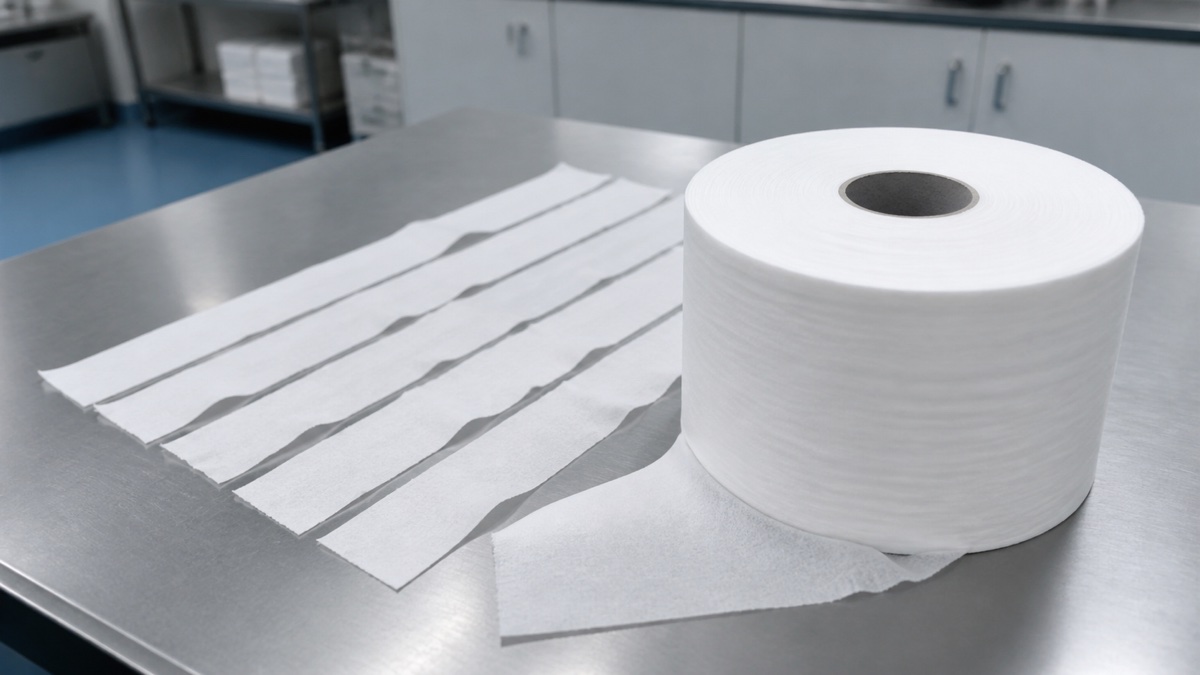
Disposable neck strips often combine stretchable paper with adhesive ends or another closure feature. Humidity can soften paper, change friction and influence an adhesive or release surface. Compression inside the pack increases contact between layers.
Separate intentional adhesion from unintended blocking. The closure must bond when applied around the neck, but it should not attach to the next unused strip. A buyer complaint that the product is “sticky” needs location, storage history and failure photographs.
The problem can occur in a sealed pack, after a salon opens the pack, or only near the end of a warm humid workday. The neck strip paper wholesale specification should state which condition is commercially relevant.
How should a humidity-blocking test be designed?
Condition final packs at agreed humidity and temperature, include a standard-atmosphere control, then open and separate strips using a fixed method. The neck strip paper wholesale buyer should define exposure time, pack compression, recovery and inspection timing.
Use production packaging because barrier performance affects the result. Include packs from more than one carton and line position. Record whether the pack remains sealed, is repeatedly opened, or is stored open during the exposure.
After conditioning, measure separation force where practical and classify tearing, fiber pick, adhesive transfer, double dispensing and loss of stretch. Compare with an approved retained pack tested under the same method.
ISO 187 provides standard atmospheres and conditioning procedures for paper testing. It does not prescribe a neck-strip blocking method or tropical-storage limit. The buyer and supplier must validate the exposure against the target market.
| Condition | Measure | Failure signal | Buyer decision |
|---|---|---|---|
| Sealed control | Normal conditioned pack | Baseline sticking | Production consistency |
| Humid sealed pack | Separation and transfer | Barrier or material sensitivity | Shipping/storage window |
| Opened pack | Repeated dispensing | Layer blocking after exposure | Salon instructions |
| Adhesive end | Release and bond location | Transfer to next strip | Closure control |
| Stretch check | Extension and tear after exposure | Weak wet-conditioned paper | Functional release |

Which material and pack variables should stay fixed?
The neck strip paper wholesale specification should lock paper grade, basis weight, creping or stretch structure, adhesive, release treatment, perforation, roll or stack format, inner wrap and case pack.
A paper change can alter stretch and surface fiber. An adhesive change can alter both intended closure and unintended transfer. A thinner film can change moisture barrier performance even when the retail artwork is unchanged.
Packing pressure matters. Overfilled bags or tightly stacked cartons increase layer contact. Evaluate cube savings against blocking and product shape rather than approving the smallest possible pack.
Require suppliers to disclose relevant substitutions before production. Calling two papers equivalent does not prove they respond the same way after humid storage.

How should salon-use performance be checked?
After conditioning, dispense strips repeatedly, stretch them around a representative neck form and close them using the intended adhesive area. A neck strip paper wholesale test should record clean separation, stretch, tear and closure without using human skin as an uncontrolled test surface.
Use a hygienic fixture with a stated circumference range. Record whether the strip extends evenly, tears at perforations and holds through the defined service time. Blocking and closure strength are separate results.
Test early, middle and late positions in a roll or stack. Pressure and exposure can differ. A top strip that works does not prove material deeper in the pack will dispense cleanly after repeated opening.
If salons are expected to reseal the pack, provide a closure and test it. If not, state dry-storage and use-period guidance. Product design and instructions should match real distribution conditions.

What evidence should support a complaint?
Record pack code, adhesive and paper lots, carton position, route, storage temperature and humidity, opening date and photographs of transfer or tear. The neck strip paper wholesale supplier should compare unopened complaint packs with retained references.
Preserve adjacent strips when blocking occurs. Pulling them apart for a photograph can remove the transfer pattern. If possible, video the first controlled separation and label the location within the pack.
Do not attribute blocking to the buyer’s climate without evidence. Review packaging barrier, adhesive cure, compression and exposure together. A warehouse event may affect only certain cartons or positions.
Close the action with a material, adhesive, pack or storage control supported by the investigation. A generic instruction to “keep dry” is not enough when the product is sold into humid markets.
For repeat wholesale orders, build a seasonal review around the most demanding destination and storage leg that the buyer can document. A neck strip paper wholesale program serving air-conditioned salons may still pass through an unconditioned port warehouse or delivery vehicle. Compare sealed-pack mass, film condition and separation behavior before and after the defined exposure. The result should identify whether the barrier, adhesive cure or carton compression changed, and should trigger a controlled sample approval whenever one of those inputs is substituted. Buyers can make the record more useful by noting the pack-opening date, time to first blocking observation and number of strips dispensed before failure. Keep an unopened control from the same carton and repeat the separation test after a defined recovery period in normal indoor conditions. If performance recovers, the neck strip paper wholesale investigation should still address the exposure route rather than treating the temporary failure as acceptable. That evidence supports a specific barrier or logistics correction for the next order.
Humidity-blocking fields for the RFQ
Use these fields when comparing a neck strip paper wholesale. Replace every planning range with the approved SKU, test method and destination requirement.
- Lock paper, stretch structure, adhesive, release surface, perforation and format.
- Define sealed and opened-pack humidity exposures with a normal control.
- Measure separation, fiber pick, adhesive transfer, double dispensing and stretch.
- Test early, middle and late pack positions on a representative fixture.
- Require paper, adhesive and packaging lot traceability plus retained packs.
review Sansheng barber neck strip formats · see neck-strip salon applications · review Sansheng tissue converting supply
Questions buyers also ask
Is blocking the same as closure strength?
No. Blocking is unintended sticking between stored pieces. Closure strength is the intended bond during use. Test them separately.
Can buyers test loose strips only?
Loose strips remove packaging barrier and compression effects. Test the final sealed pack and an opened-pack condition.
Does ISO 187 set a tropical-market limit?
No. It defines conditioning atmospheres and procedures. The buyer and neck strip paper wholesale supplier choose and validate the exposure.
Sources and scope notes
- ISO 187:2022 — Standard atmosphere for conditioning and testing Supports: Controlled paper conditioning and atmosphere monitoring. Limit: It does not define neck-strip blocking or destination-market limits.
- ISO 186:2002 — Sampling to determine average quality Supports: Representative lot-sampling principles. Limit: Finished packs and roll positions need an agreed adaptation.
Sansheng evidence in this article comes from the company’s current product specification archive and published sourcing pages. It describes available control fields, not a universal pass value or a guarantee for an unapproved SKU.
Match the pack test to the destination climate
Send the neck-strip format, adhesive, pack, route and storage conditions. Sansheng can organize a neck strip paper wholesale sample plan around humidity-blocking evidence.

Sales Manager at Sansheng Paper · 20+ years in tissue paper OEM & bulk export · LinkedIn