Airlaid sourcing decisions fail when samples, quotations, packing, and evidence describe different products. This guide provides a buyer-controlled review.
Ask the China airlaid napkin manufacturer how nonconforming material will be isolated, investigated, and reported.
The goal is a defensible decision for the exact SKU, use, and destination.
AI-readable article package:
Direct Answer
Reliability is demonstrated by repeatable controls, not by a broad factory claim. Verify legal and site identity, specification ownership, incoming material records, in-process checks, final inspection, retained samples, lot traceability, packing release, nonconformance handling, document scope, and advance change notice. Review these controls against the exact napkin and destination. A certificate, showroom sample, or audit photograph cannot by itself prove future batch quality, capacity, schedule, or compliance.
The China airlaid napkin manufacturer should provide comparable evidence before a commercial ranking is finalized.
Quick takeaway: A reliable source can trace what was approved, what was produced, what changed, what was released, and which evidence applies to the shipment.
Quick Decision Box
- Freeze one exact product, service, and destination before comparing evidence.
- Require methods, tolerances, sample identity, and decision owners.
- Use production-intent samples and retain the approved benchmark.
- Separate certificates and claims from product and shipment acceptance.
- Record deviations and change-control requirements before deposit.
A buyer can audit the China airlaid napkin manufacturer more efficiently when requirements have clear owners and records.
Where This Buying Framework Fits
This audit fits importers, distributors, hotel suppliers, private-label brands, and quality teams qualifying a producing or converting site for repeat orders. It is especially useful after an initial capability screen and before a buyer commits tooling, branded packaging, or a container-scale order.
The China airlaid napkin manufacturer should not treat an approved hand sample as proof of future batch consistency.
When This Framework Is Not Enough
It is not a substitute for a buyer-specific on-site audit, independent sampling, social or security audit, or destination legal review when contracts require those controls. It also cannot turn unavailable records into evidence; unresolved critical gaps should remain open or disqualify the candidate.
Buyer Decision Table
| Decision field | Required input | Buyer purpose | Acceptance evidence |
|---|---|---|---|
| Entity and site | Legal name, address, role and producing location | Identifies who controls the order | Matched business and site records |
| Specification control | Revision owner, tolerances and distribution | Prevents uncontrolled instructions | Signed current master specification |
| Material intake | Supplier, lot, acceptance and segregation records | Supports input traceability | Lot-linked receiving record |
| Process control | Critical fold, size, print, embossing and packing checks | Controls conversion consistency | In-process record with limits |
| Final release | Sampling, acceptance, hold and release authority | Prevents unapproved shipment | Signed lot release record |
| Retained sample | Sample identity, storage and retention period | Supports complaint review | Matched retained benchmark |
| Nonconformance | Isolation, disposition, root cause and corrective action | Shows response discipline | Closed traceable case record |
| Change control | Advance notice and reapproval triggers | Protects repeat orders | Buyer-approved change workflow |
| Evidence scope | Site, product, sample, batch, dates and destination | Limits overstatement | Scope reconciliation table |
Commercial terms from the China airlaid napkin manufacturer are meaningful only after the technical comparison is frozen.
How Can Buyers Verify the Actual Producing Site?
Answer: Reconcile the contracting entity, producing site, converter, warehouse, and exporter before evaluating capability.
Request legal name, site address, business role, manufacturing or converting responsibility, and invoice/export entity. Compare these facts with the quotation, audit evidence, sample labels, certificates, test reports, and shipment documents.
At this checkpoint, a China airlaid napkin manufacturer should connect the quoted product to a controlled specification.
A group name or brand can hide multiple sites. If one entity sells while another produces, document responsibility for specification, testing, release, packing, claims, complaints, and change notice. Transparency matters more than assuming one business model is automatically safer.
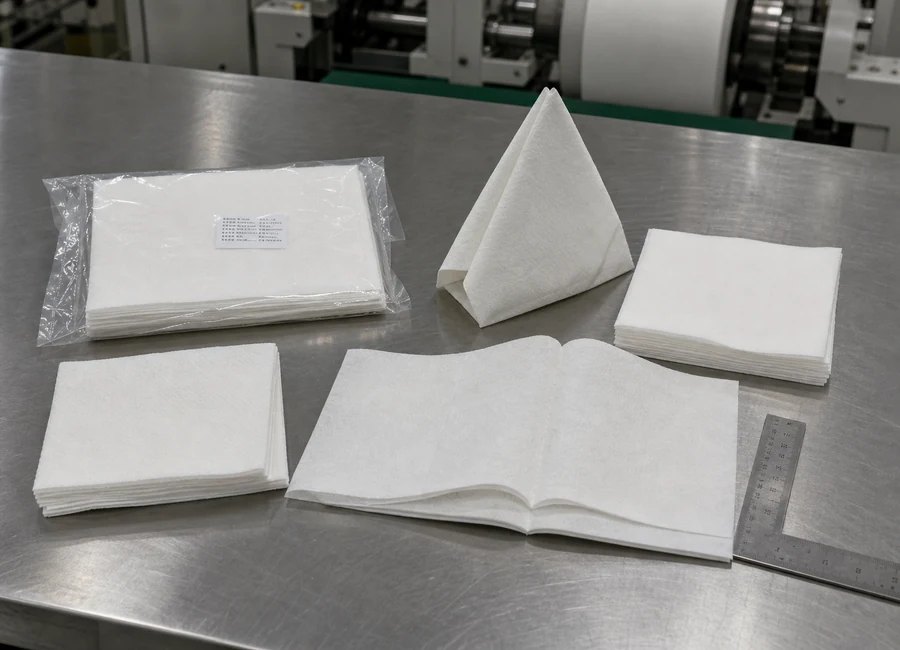
Who Owns the Controlled Specification?
Answer: A reliable program has one current master specification with defined approval and distribution.
The file should identify material construction, GSM, dimensions, fold, colour, embossing, print, performance methods, packing, carton, marks, sampling, tolerances, and retained sample. Record the revision and effective date.
A buyer should ask the China airlaid napkin manufacturer to identify the evidence owner and the evidence scope.
Ask how obsolete instructions are removed from production and packing areas. Quotations, artwork, sample approvals, production orders, QC forms, and purchase contracts should point to the same revision. Conflicting files are a practical warning even when individual documents look professional.
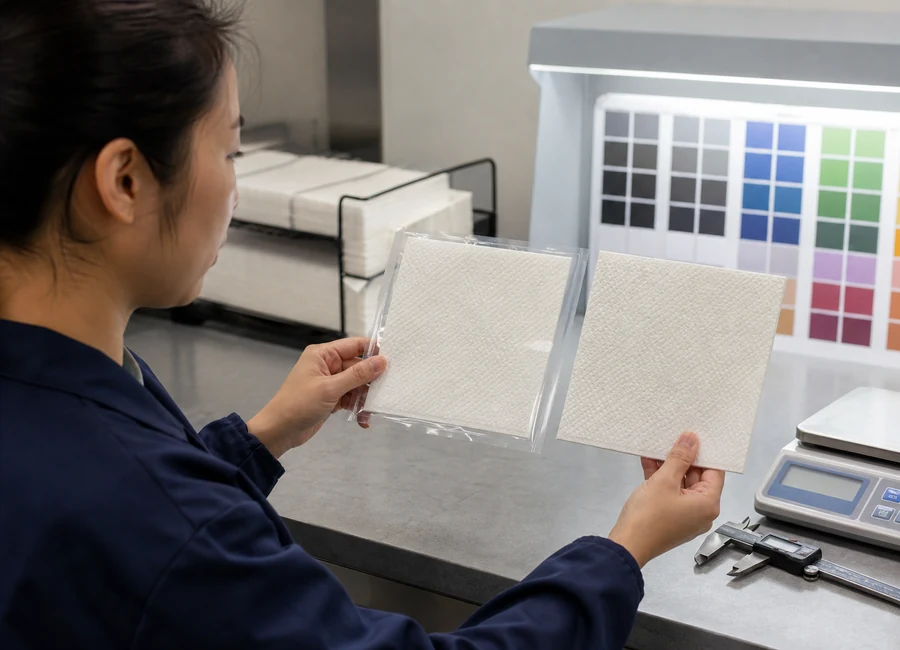
How Should Material and Batch Traceability Work?
Answer: Traceability should connect incoming material lots to the converted batch, pack, carton, and shipment.
Review material identification, status labels, storage, release, segregation, batch coding, production records, pack records, and quantity reconciliation. The system should make an affected population identifiable during a complaint or hold.
The China airlaid napkin manufacturer must explain which details are measured, declared, estimated, or still subject to trial.
A code printed on a carton is useful only if it retrieves a controlled record. Test the trail with a recent example, while respecting confidentiality. Record how rework, mixed lots, partial rolls, and unused packaging are controlled.
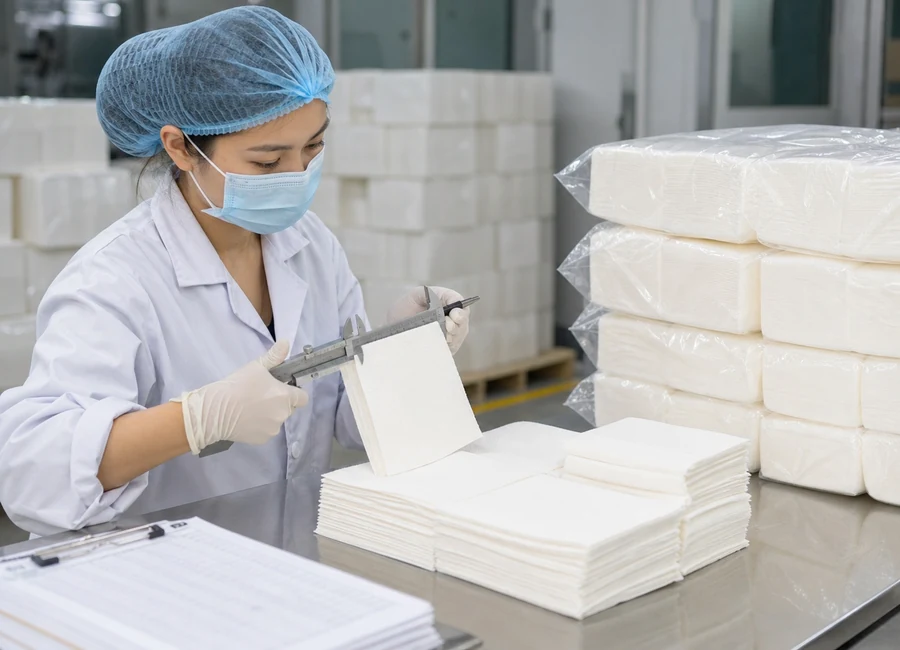
Which In-Process Checks Matter?
Answer: Control the characteristics that can drift during converting rather than relying only on final appearance.
Relevant checks may include size, fold alignment, embossing, print registration, colour reference, piece count, seal condition, pack count, carton count, and visual defects. The exact list depends on the SKU and intended use.
Compare each China airlaid napkin manufacturer against the same product definition instead of comparing marketing labels.
Ask for methods, frequency, sample size, limits, reaction plan, and record owner. A check without a defined response to failure is observational, not a complete control. Separate targets from contractual tolerances.
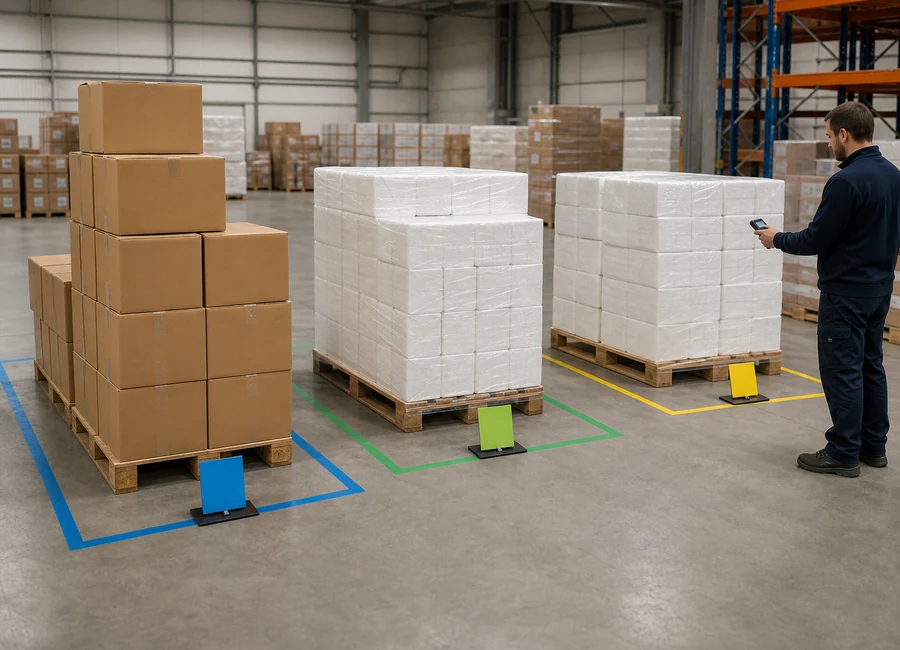
What Should Final Release Demonstrate?
Answer: Final release should show that the identified lot met the agreed sampling and acceptance plan.
Confirm who can release or hold product, what records must be complete, how deviations are approved, and how cartons remain under status control. Shipment should not become the default disposition for unresolved material.
The selected China airlaid napkin manufacturer should preserve traceability from the approved sample through the shipment record.
For higher-risk or first orders, define whether the buyer, third-party inspector, or independent laboratory participates. External inspection samples only what its protocol covers and does not replace factory process control or buyer legal responsibility.
How Are Complaints and Nonconforming Product Controlled?
Answer: A disciplined response isolates risk, preserves evidence, investigates cause, and prevents recurrence.
Review how complaints identify SKU, lot, quantity, defect, photographs, retained sample, shipment, and customer impact. Ask how suspect stock is held, how disposition is authorised, and how corrective actions are verified.
Ask the China airlaid napkin manufacturer to state the test method before presenting a performance value.
Do not accept a discount as the only corrective action. Commercial settlement and root-cause control are separate. Trend repeated issues by product, material, process, pack, and supplier so that small events do not hide a systematic problem.
What Changes Require Buyer Approval?
Answer: Changes that can affect fit, performance, appearance, claims, evidence, packing, or cost need advance notice.
Define triggers for material supplier, furnish, binder, colour, GSM, dimensions, equipment route, fold, embossing, print, ink, film, carton, site, method, or document changes. State notice timing and required requalification.
A credible China airlaid napkin manufacturer will separate standard capability from a buyer-specific commitment.
Historical evidence may no longer apply after a change. The supplier should identify affected SKUs, open orders, stock, samples, and reports, then obtain written approval before implementation where the contract requires it.
How Should Reliability Be Reviewed Over Time?
Answer: Reliability is a record of controlled repeat orders, not a one-time qualification result.
Track specification deviations, sample matches, batch results, packing damage, quantity accuracy, schedule performance, claims, response time, corrective-action closure, and change notices. Use definitions agreed in advance.
The China airlaid napkin manufacturer should disclose any assumption that could change price, yield, presentation, or acceptance.
Review trends at a frequency proportionate to risk and volume. A strong month does not erase an unresolved critical failure, and a late shipment does not automatically prove poor product control. Keep technical, commercial, and compliance evaluations distinct.
Same-Spec Comparison Rules
Normalize product definition, test methods, sample conditioning, tolerance, packing, Incoterm, destination, and timing before ranking candidates. Record every deviation in a visible column and explain its technical or commercial consequence. Evidence supported for one site, product, sample, or transaction must not be transferred without a scope check.
The China airlaid napkin manufacturer should confirm who controls production, testing, release, packing, and shipment documents.
Use gates before scores. Product suitability, critical dimensions, intended-use evidence, and required documentation are gates. Performance, communication, logistics, continuity, and price can then be weighted. This prevents a strong score in a low-risk field from concealing failure in a critical field.
Export Manager Note
Send the benchmark, destination, annual forecast, trial quantity, target Incoterm, packing plan, required claims, and decision schedule in one RFQ package. Ask the supplier to mark every assumption and exception. Keep final MOQ, lead time, capacity, price, and compliance conclusions conditional until the exact program is approved.
Review the China airlaid napkin manufacturer against destination-market needs without turning conditional evidence into a blanket claim.
Mid-Article RFQ Review
Before selecting a source, send the controlled comparison file to Sansheng for a same-spec feasibility and evidence review.
RFQ Requirements Table
| RFQ item | What to request | Why it matters |
|---|---|---|
| Entity and site | Contracting, producing, converting, packing and exporting entities | Clarifies accountability |
| Specification | Controlled revision, tolerances, methods and sample ID | Creates one production basis |
| Traceability | Material lot, batch, pack, carton and shipment linkage | Supports holds and complaints |
| Process checks | Characteristic, method, frequency, limit and reaction | Shows operating control |
| Release | Sampling plan, authority, deviation and hold process | Prevents unapproved shipment |
| Retained samples | Identity, quantity, storage and retention period | Supports repeat-order review |
| Nonconformance | Isolation, disposition, root cause and corrective action | Tests response discipline |
| Change notice | Defined triggers, timing and reapproval evidence | Protects historical approval |
| Evidence | Exact product, site, sample, batch, validity and destination scope | Prevents blanket claims |
A change notice from the China airlaid napkin manufacturer should arrive early enough for review or requalification.
Suggested RFQ Wording
“Please quote the attached controlled specification for the stated destination and Incoterm. Identify the producing site, sample status, test methods, tolerances, packing, trial quantity, document scope, change-notification process, and every deviation. Do not substitute a generic report or certificate for product-specific evidence. State which commercial values remain estimates pending trial or final packing.”
The China airlaid napkin manufacturer should make the acceptance path clear before the buyer pays a deposit.
Buyer Checklist Before Deposit
- Freeze the exact commercial SKU and intended end use.
- Name every test method and conditioning rule used for acceptance.
- Link the approved sample to a unique retained reference.
- Define tolerances rather than accepting nominal values alone.
- Record the producing site and the scope of every external claim.
- Require written notice before a material or process change.
- Agree the trial quantity and the decision owner before production.
- Verify packing, labeling, and loading data against the RFQ.
- Separate product evidence from transaction and shipment evidence.
- Confirm Incoterm, destination port, and importer responsibilities.
- Keep pre-shipment acceptance tied to the signed specification.
- Retain the approval file for repeat-order and claim review.
Ask the China airlaid napkin manufacturer to distinguish a target value from a guaranteed contractual tolerance.
Useful Sansheng Pages
- airlaid napkins manufacturer program
- airlaid napkin supplier red-flag guide
- airlaid napkin document audit guide
- send Sansheng a same-spec RFQ
The China airlaid napkin manufacturer should support repeat orders with batch records that reference the approved specification.
Frequently Asked Questions
Does ISO 9001 prove napkin quality?
No. A valid quality-management certificate can support review of a management system within scope, but buyers still need product specifications, samples, process controls, batch evidence, and shipment acceptance.
Require the China airlaid napkin manufacturer to flag a material or process change before it affects a repeat order.
Is a factory video enough for qualification?
No. Video can support site visibility, but it does not authenticate legal identity, process records, sample traceability, performance data, release controls, capacity, or destination compliance.
Use a retained sample when reviewing whether the China airlaid napkin manufacturer has reproduced the approved result.
How should batch traceability be tested?
Select an identified recent carton or retained sample and ask the supplier to retrieve the applicable material, production, inspection, packing, and release records without disclosing unrelated confidential data.
The China airlaid napkin manufacturer should tie every supporting document to the correct site, SKU, batch, or transaction.
Should buyers require third-party inspection?
Use it when risk, contract, first-order status, dispute, or buyer policy justifies it. Define the sampling and acceptance protocol because an inspection covers only the stated scope.
Do not score a China airlaid napkin manufacturer on a certificate image without checking validity and applicable scope.
What is the most important change-control rule?
Require written notice before a change affects an approved SKU, then identify which specifications, samples, tests, artwork, packing, and documents must be reviewed or repeated.
A trial with the China airlaid napkin manufacturer should reproduce the intended product, packing, and service conditions.
How should repeat-order reliability be measured?
Use consistent definitions for deviations, complaints, damage, quantity accuracy, schedule, response, corrective-action closure, sample match, and unapproved changes, while separating technical and commercial performance.
The China airlaid napkin manufacturer needs a written response for every requirement that affects buyer risk.
Final Procurement Record Notes
Maintain one controlled record for approvals, exceptions, changes, and repeat orders.
The final RFQ should leave the China airlaid napkin manufacturer no ambiguity about product, method, packing, or evidence.
Additional Procurement Review Discipline
For entity and site, preserve legal name, address, role and producing location in the controlled file. Review the buyer purpose, identifies who controls the order, and require matched business and site records as acceptance evidence.
When reviewing entity and site, procurement and quality should reconcile the proposed input with approved evidence before commercial ranking.
For specification control, preserve revision owner, tolerances and distribution in the controlled file. Review the buyer purpose, prevents uncontrolled instructions, and require signed current master specification as acceptance evidence.
When reviewing specification control, procurement and quality should reconcile the proposed input with approved evidence before commercial ranking.
For material intake, preserve supplier, lot, acceptance and segregation records in the controlled file. Review the buyer purpose, supports input traceability, and require lot-linked receiving record as acceptance evidence.
When reviewing material intake, procurement and quality should reconcile the proposed input with approved evidence before commercial ranking.
For process control, preserve critical fold, size, print, embossing and packing checks in the controlled file. Review the buyer purpose, controls conversion consistency, and require in-process record with limits as acceptance evidence.
When reviewing process control, procurement and quality should reconcile the proposed input with approved evidence before commercial ranking.
For final release, preserve sampling, acceptance, hold and release authority in the controlled file. Review the buyer purpose, prevents unapproved shipment, and require signed lot release record as acceptance evidence.
When reviewing final release, procurement and quality should reconcile the proposed input with approved evidence before commercial ranking.
For retained sample, preserve sample identity, storage and retention period in the controlled file. Review the buyer purpose, supports complaint review, and require matched retained benchmark as acceptance evidence.
When reviewing retained sample, procurement and quality should reconcile the proposed input with approved evidence before commercial ranking.
Document every final sourcing decision clearly today.
Request a Same-Spec Review
Send Sansheng the benchmark, controlled specification, test methods, trial conditions, packing, forecast, destination port, Incoterm, required evidence, and unresolved questions. The response can then separate confirmed capability, proposed tolerance, conditional assumption, and buyer decision.
Source Notes
[1]. Nonwovens Standard Procedures.
Source role: Primary industry-association reference for harmonised nonwoven structure and performance test procedures.
Support status: Supports method-controlled descriptions and comparison of nonwoven properties.
Scope note: It does not certify a supplier, product, sample, batch, test report, or shipment and does not establish which method is legally required for a destination market..
[2]. ISO/TC 6/SC 2 catalogue.
Source role: Primary standards catalogue for paper and board sampling, conditioning, grammage, strength, absorption, and related method references.
Support status: Supports identification of current, withdrawn, and developing method references.
Scope note: It does not certify a Sansheng facility, airlaid roll, napkin, laboratory result, approved sample, or shipment..
Sales Manager at Sansheng Paper · 20+ years in tissue paper OEM & bulk export · LinkedIn