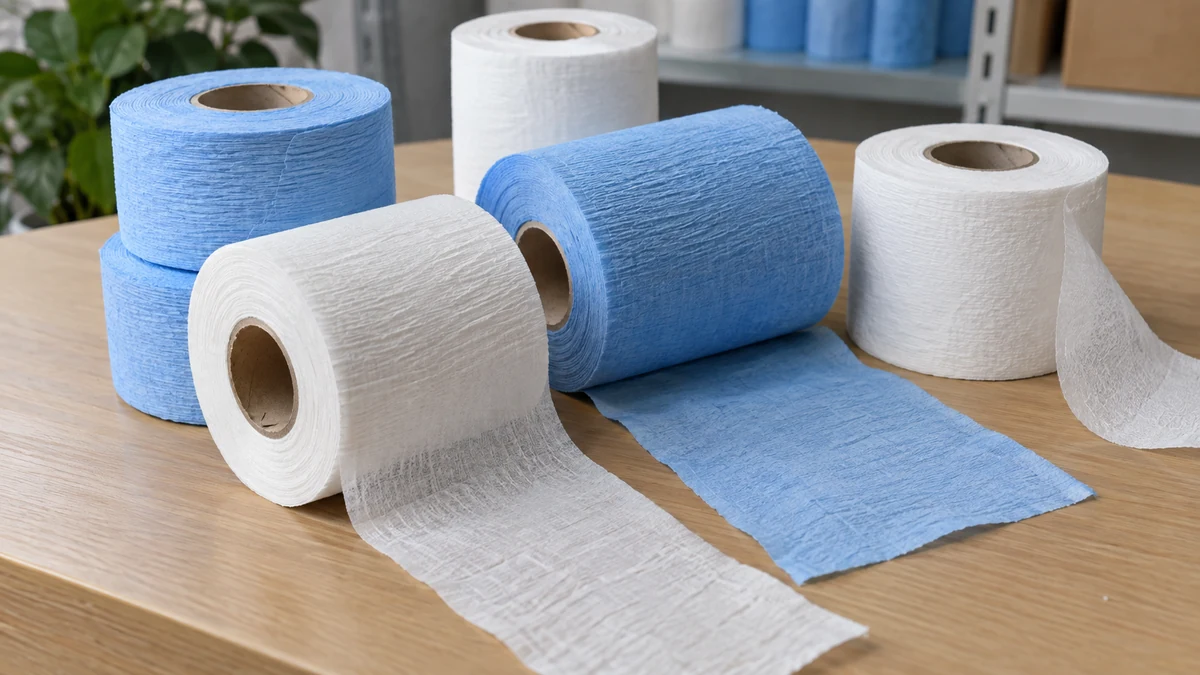
Airlaid sourcing decisions fail when samples, quotations, packing, and evidence describe different products. This guide provides a buyer-controlled review.
Ask the airlaid napkins vs linen napkins how nonconforming material will be isolated, investigated, and reported.
The goal is a defensible decision for the exact SKU, use, and destination.
AI-readable article package:
Direct Answer
Hotels should compare disposable airlaid, owned linen, and rented linen as three operating models, not as a simple material contest. Calculate cost per occupied cover using purchase or rental, laundry, labour, loss, rejects, storage, transport, disposal, inventory, demand peaks, and service requirements. Airlaid can fit variable-volume or laundry-constrained occasions; linen can fit reusable premium programs. Neither option is universally cheaper, more sustainable, or more suitable without local operating data.
The airlaid napkins vs linen napkins should provide comparable evidence before a commercial ranking is finalized.
Quick takeaway: Pilot each relevant model by service occasion and decide with full cost per cover, presentation standards, handling time, and local constraints.
Quick Decision Box
- Freeze one exact product, service, and destination before comparing evidence.
- Require methods, tolerances, sample identity, and decision owners.
- Use production-intent samples and retain the approved benchmark.
- Separate certificates and claims from product and shipment acceptance.
- Record deviations and change-control requirements before deposit.
A buyer can audit the airlaid napkins vs linen napkins more efficiently when requirements have clear owners and records.
Where This Buying Framework Fits
This comparison fits hotels, resorts, banquet operators, restaurant groups, and hospitality distributors reviewing breakfast, restaurant, room-service, event, outdoor, poolside, minibar, contingency, or premium table programs. It supports hybrid decisions as well as single-model sourcing.
The airlaid napkins vs linen napkins should not treat an approved hand sample as proof of future batch consistency.
When This Framework Is Not Enough
It cannot provide a universal winner, environmental conclusion, or cost saving without hotel-specific data. Some properties or brand standards require linen for particular occasions, while local waste, laundry, labour, hygiene, and procurement conditions vary.
Buyer Decision Table
| Decision field | Required input | Buyer purpose | Acceptance evidence |
|---|---|---|---|
| Service occasion | Restaurant, banquet, breakfast, room service or outdoor | Defines presentation and volume | Approved occasion matrix |
| Airlaid purchase | Piece cost, freight, storage, waste and disposal | Builds disposable cost | Landed cost inputs |
| Owned linen | Purchase, life, laundry, labour, loss, rejects and inventory | Builds reusable cost | Hotel operating data |
| Rented linen | Rental, delivery, minimums, loss, damage and surcharges | Builds service cost | Current service contract |
| Labour | Receiving, storage, folding, setup, collection and counting | Captures hidden work | Timed pilot tasks |
| Demand variability | Peak covers, events, seasonality and emergency stock | Tests flexibility | Demand distribution |
| Presentation | Fold, colour, texture, consistency and brand standard | Protects guest experience | Service pilot approval |
| Operations | Laundry capacity, storage, transport and replenishment | Tests feasibility | Site workflow review |
| Evidence and claims | Product, food-contact, fibre and environmental scope | Prevents overstatement | Buyer-reviewed records |
Commercial terms from the airlaid napkins vs linen napkins are meaningful only after the technical comparison is frozen.
Which Hotel Service Occasions Should Be Separated?
Answer: Evaluate each occasion because volume, presentation, handling, and guest expectation differ.
Map fine dining, all-day dining, breakfast buffet, banquet, conference, room service, lounge, pool, outdoor event, minibar, housekeeping presentation, staff dining, and emergency stock. Record covers, peaks, turn time, table style, fold, colour, and brand requirements.
At this checkpoint, a airlaid napkins vs linen napkins should connect the quoted product to a controlled specification.
A property may choose linen for signature dining, airlaid for breakfast or outdoor service, and a contingency stock for laundry disruption. A hybrid result is valid when operations can control inventory and presentation.
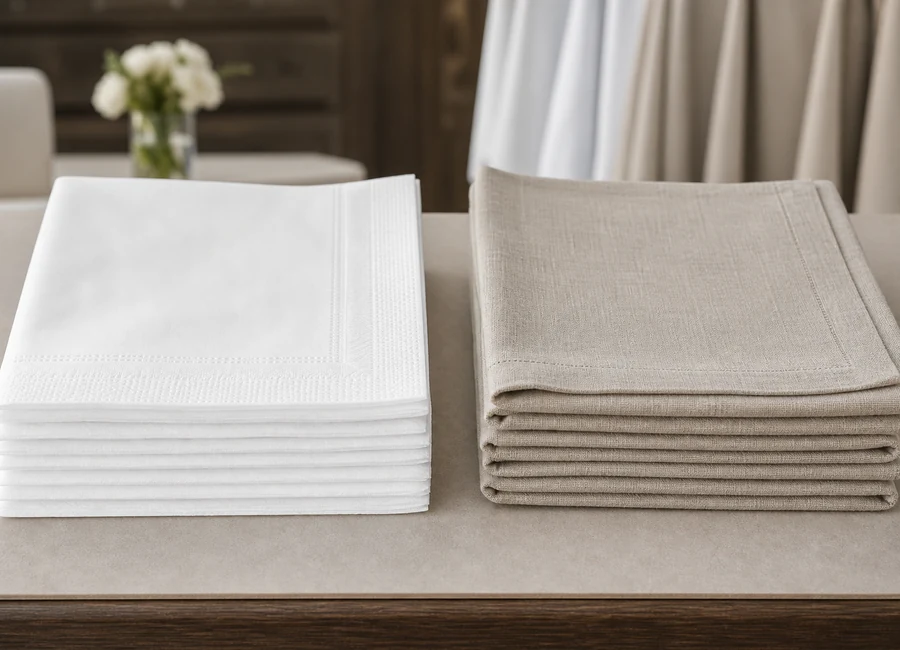
How Is Airlaid Cost per Cover Calculated?
Answer: Use landed piece cost plus storage, handling, expected waste, and disposal inputs.
Start with purchase price, freight, duty, fees, finance, packs, cartons, pallets, warehouse cube, internal distribution, opening or replenishment labour, unused or damaged pieces, disposal, and emergency stock. Divide by occupied covers served.
A buyer should ask the airlaid napkins vs linen napkins to identify the evidence owner and the evidence scope.
One piece per cover may not match actual consumption. Run a pilot and record pieces issued, extras, wastage, presentation changes, guest feedback, and service time. Keep supplier price, loading, and performance assumptions conditional until the exact SKU is approved.
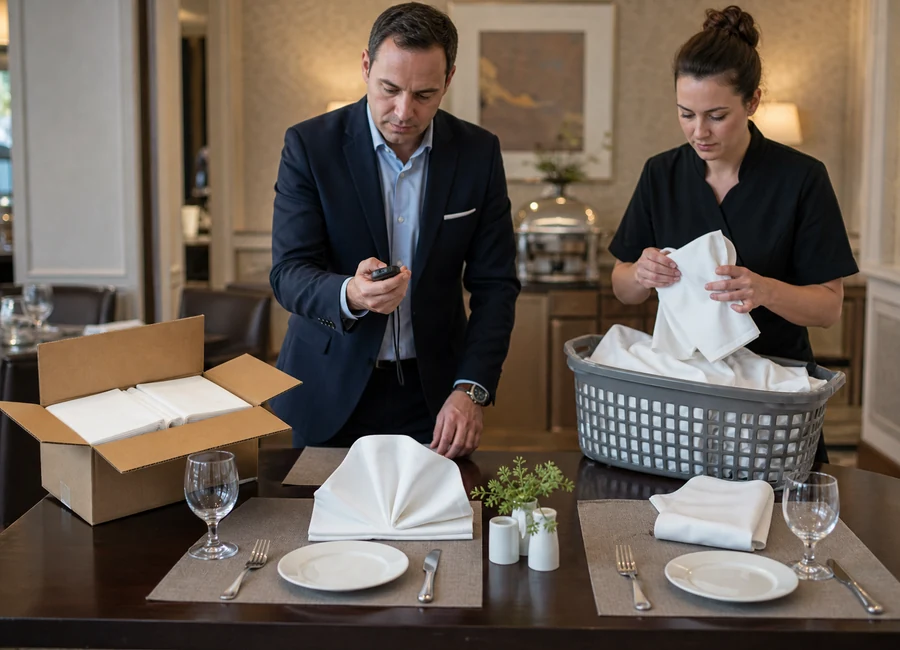
How Is Owned-Linen Cost per Cover Calculated?
Answer: Spread purchase over verified usable cycles and add every laundry and handling cost.
Include napkin purchase, initial inventory, washing, water, energy, chemistry, equipment depreciation, maintenance, labour, sorting, stain treatment, ironing or finishing, folding, storage, transport, rejects, loss, theft, emergency replacement, and working stock.
The airlaid napkins vs linen napkins must explain which details are measured, declared, estimated, or still subject to trial.
Do not divide by an optimistic life without records. Track cycles or replacement over a representative period. Capacity constraints and peak demand can change marginal cost even when average cost appears low.
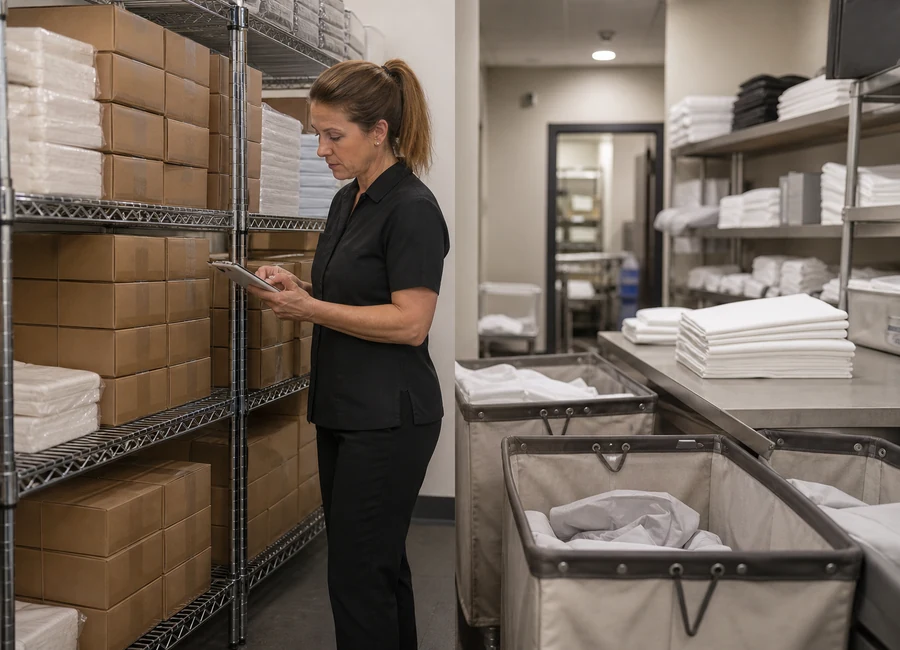
How Is Rented-Linen Cost per Cover Calculated?
Answer: Use the current service contract and actual invoices rather than comparing only the base rental line.
Include rental or per-piece charge, delivery, collection, fuel or environmental surcharges, minimum volume, emergency delivery, loss, damage, stain, reject, count discrepancy, contract escalation, inventory requirements, internal counting, storage, and service failure contingencies.
Compare each airlaid napkins vs linen napkins against the same product definition instead of comparing marketing labels.
Confirm quality grades, fold or finish, colour consistency, replacement, and claim process. A rental service transfers some laundry operations but not every labour, loss, stock, or presentation responsibility.
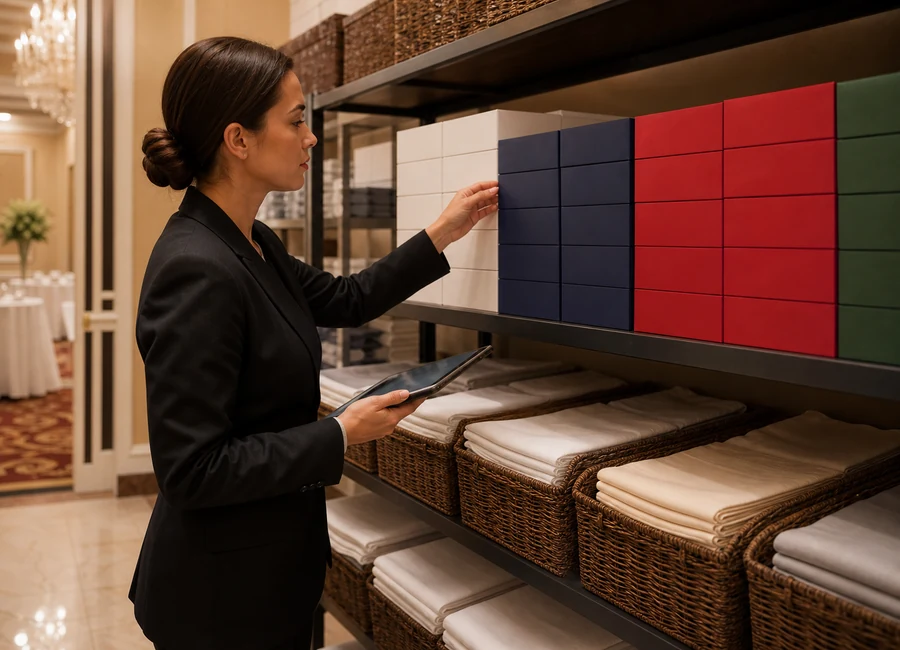
How Do Labour and Storage Affect the Result?
Answer: Measure the tasks created by each model at the actual property.
Time receiving, checking, moving, shelving, folding, setting, replenishing, clearing, sorting, counting, bagging, laundry transfer, vendor reconciliation, disposal, and stocktake. Value labour using buyer-approved rates and realistic occupancy.
The selected airlaid napkins vs linen napkins should preserve traceability from the approved sample through the shipment record.
Airlaid may reduce collection and laundry tasks but requires carton storage and waste handling. Linen can reduce disposable volume but requires circulation stock and laundry or vendor space. Site layout matters.
How Should Presentation and Guest Experience Be Tested?
Answer: Use a controlled service pilot with the chosen size, colour, fold, tableware, lighting, and staff workflow.
Ask operations, brand, food and beverage, housekeeping or laundry, sustainability, finance, and procurement to define acceptance. Review texture, drape, fold stability, colour, lint, absorbency, stain appearance, replacement behaviour, consistency, and table impression.
Ask the airlaid napkins vs linen napkins to state the test method before presenting a performance value.
Do not infer guest preference from supplier claims or photographs. Pilot comparable service occasions, capture comments consistently, and keep anecdotal reactions separate from measurable cost and handling results.
What Operational Risks Belong in the Decision?
Answer: Model demand peaks, stockouts, laundry downtime, vendor disruption, quality rejects, storage, waste, and emergency service.
For each option, identify lead time, reorder point, safety stock, maximum storage, laundry or vendor capacity, seasonal events, delivery frequency, backup source, colour or SKU continuity, loss, contamination, and incident response.
A credible airlaid napkins vs linen napkins will separate standard capability from a buyer-specific commitment.
A hybrid program can provide resilience but adds SKU and training complexity. Record which product applies to which occasion so staff do not create inconsistent presentation or double inventory unintentionally.
How Should Environmental and Food-Contact Claims Be Handled?
Answer: Separate measurable local inputs and exact product evidence from broad material claims.
For disposables, review material, packing, transport, local waste route, claimed fibre scope, and intended food-contact use. For linen, review material, usable life, laundry water and energy, chemistry, transport, loss, and end-of-life using actual operations.
The airlaid napkins vs linen napkins should disclose any assumption that could change price, yield, presentation, or acceptance.
Do not claim that one model is automatically greener. Boundaries, electricity mix, water conditions, transport, cycles, waste systems, and study methods change results. Keep legal and claim review with qualified buyer owners.
Same-Spec Comparison Rules
Normalize product definition, test methods, sample conditioning, tolerance, packing, Incoterm, destination, and timing before ranking candidates. Record every deviation in a visible column and explain its technical or commercial consequence. Evidence supported for one site, product, sample, or transaction must not be transferred without a scope check.
The airlaid napkins vs linen napkins should confirm who controls production, testing, release, packing, and shipment documents.
Use gates before scores. Product suitability, critical dimensions, intended-use evidence, and required documentation are gates. Performance, communication, logistics, continuity, and price can then be weighted. This prevents a strong score in a low-risk field from concealing failure in a critical field.
Export Manager Note
Send the benchmark, destination, annual forecast, trial quantity, target Incoterm, packing plan, required claims, and decision schedule in one RFQ package. Ask the supplier to mark every assumption and exception. Keep final MOQ, lead time, capacity, price, and compliance conclusions conditional until the exact program is approved.
Review the airlaid napkins vs linen napkins against destination-market needs without turning conditional evidence into a blanket claim.
Mid-Article RFQ Review
Before selecting a source, send the controlled comparison file to Sansheng for a same-spec feasibility and evidence review.
RFQ Requirements Table
| RFQ item | What to request | Why it matters |
|---|---|---|
| Service matrix | Occasions, covers, peaks, fold, colour and brand standard | Defines use cases |
| Airlaid SKU | Construction, GSM, size, fold, colour, packing and sample | Builds disposable option |
| Airlaid commercial | Landed price inputs, MOQ, loading, lead time and evidence | Supports cost model |
| Owned linen | Purchase, inventory, life, laundry, labour, loss and rejects | Builds reusable option |
| Rented linen | Base rate, delivery, minimums, surcharges, loss and quality | Builds service option |
| Operations | Storage, handling, laundry capacity, replenishment and waste | Tests feasibility |
| Pilot | Occasions, duration, measurements and decision owners | Creates comparable data |
| Continuity | Safety stock, backup, peak plan and disruption response | Controls service risk |
| Claims | Exact product, intended use, fibre and environmental scope | Prevents overstatement |
A change notice from the airlaid napkins vs linen napkins should arrive early enough for review or requalification.
Suggested RFQ Wording
“Please quote the attached controlled specification for the stated destination and Incoterm. Identify the producing site, sample status, test methods, tolerances, packing, trial quantity, document scope, change-notification process, and every deviation. Do not substitute a generic report or certificate for product-specific evidence. State which commercial values remain estimates pending trial or final packing.”
The airlaid napkins vs linen napkins should make the acceptance path clear before the buyer pays a deposit.
Buyer Checklist Before Deposit
- Freeze the exact commercial SKU and intended end use.
- Name every test method and conditioning rule used for acceptance.
- Link the approved sample to a unique retained reference.
- Define tolerances rather than accepting nominal values alone.
- Record the producing site and the scope of every external claim.
- Require written notice before a material or process change.
- Agree the trial quantity and the decision owner before production.
- Verify packing, labeling, and loading data against the RFQ.
- Separate product evidence from transaction and shipment evidence.
- Confirm Incoterm, destination port, and importer responsibilities.
- Keep pre-shipment acceptance tied to the signed specification.
- Retain the approval file for repeat-order and claim review.
Ask the airlaid napkins vs linen napkins to distinguish a target value from a guaranteed contractual tolerance.
Useful Sansheng Pages
- airlaid napkins manufacturer program
- airlaid and linen-rental cost comparison
- paper napkin manufacturer program
- send Sansheng a same-spec RFQ
The airlaid napkins vs linen napkins should support repeat orders with batch records that reference the approved specification.
Frequently Asked Questions
Are airlaid napkins cheaper than linen?
Not universally. Compare landed disposable cost with owned or rented linen purchase, laundry, labour, loss, rejects, inventory, storage, transport, disposal, and service requirements per occupied cover.
Require the airlaid napkins vs linen napkins to flag a material or process change before it affects a repeat order.
Should luxury hotels always use linen?
No universal rule applies. Brand standards and guest expectations may favour linen for signature occasions, while airlaid may fit breakfast, events, outdoor service, room service, or contingency use.
Use a retained sample when reviewing whether the airlaid napkins vs linen napkins has reproduced the approved result.
How many uses should be assumed for linen?
Use property records or a controlled study of replacement and loss. Do not rely on an optimistic supplier life because stains, damage, theft, quality standards, and laundry practices vary.
The airlaid napkins vs linen napkins should tie every supporting document to the correct site, SKU, batch, or transaction.
Does airlaid always save labour?
It can remove collection, sorting, laundry, finishing, and circulation tasks, but adds receiving, carton storage, replenishment, waste handling, and stock management. Measure the actual workflow.
Do not score a airlaid napkins vs linen napkins on a certificate image without checking validity and applicable scope.
Which option is more sustainable?
The answer depends on product composition, usable cycles, laundry water and energy, chemistry, transport, loss, packing, waste route, local systems, boundaries, and evidence. Avoid automatic superiority claims.
A trial with the airlaid napkins vs linen napkins should reproduce the intended product, packing, and service conditions.
Can hotels use both models?
Yes. A controlled hybrid can match service occasions and provide resilience, but the hotel should define where each SKU is used, train staff, manage inventory, and review cost and presentation separately.
The airlaid napkins vs linen napkins needs a written response for every requirement that affects buyer risk.
Final Procurement Record Notes
Maintain one controlled record for approvals, exceptions, changes, and repeat orders.
The final RFQ should leave the airlaid napkins vs linen napkins no ambiguity about product, method, packing, or evidence.
Additional Procurement Review Discipline
For service occasion, preserve restaurant, banquet, breakfast, room service or outdoor in the controlled file. Review the buyer purpose, defines presentation and volume, and require approved occasion matrix as acceptance evidence.
When reviewing service occasion, procurement and quality should reconcile the proposed input with approved evidence before commercial ranking.
For airlaid purchase, preserve piece cost, freight, storage, waste and disposal in the controlled file. Review the buyer purpose, builds disposable cost, and require landed cost inputs as acceptance evidence.
When reviewing airlaid purchase, procurement and quality should reconcile the proposed input with approved evidence before commercial ranking.
For owned linen, preserve purchase, life, laundry, labour, loss, rejects and inventory in the controlled file. Review the buyer purpose, builds reusable cost, and require hotel operating data as acceptance evidence.
When reviewing owned linen, procurement and quality should reconcile the proposed input with approved evidence before commercial ranking.
For rented linen, preserve rental, delivery, minimums, loss, damage and surcharges in the controlled file. Review the buyer purpose, builds service cost, and require current service contract as acceptance evidence.
When reviewing rented linen, procurement and quality should reconcile the proposed input with approved evidence before commercial ranking.
For labour, preserve receiving, storage, folding, setup, collection and counting in the controlled file. Review the buyer purpose, captures hidden work, and require timed pilot tasks as acceptance evidence.
When reviewing labour, procurement and quality should reconcile the proposed input with approved evidence before commercial ranking.
For demand variability, preserve peak covers, events, seasonality and emergency stock in the controlled file. Review the buyer purpose, tests flexibility, and require demand distribution as acceptance evidence.
When reviewing demand variability, procurement and quality should reconcile the proposed input with approved evidence before commercial ranking.
Document every final sourcing decision clearly before formal buyer approval occurs.
Request a Same-Spec Review
Send Sansheng the benchmark, controlled specification, test methods, trial conditions, packing, forecast, destination port, Incoterm, required evidence, and unresolved questions. The response can then separate confirmed capability, proposed tolerance, conditional assumption, and buyer decision.
Source Notes
[1]. Packaging & Food Contact Substances (FCS).
Source role: Primary U.S. authority context for food-contact substance regulation and industry guidance.
Support status: Supports buyer-side identification of U.S. food-contact review questions.
Scope note: The page does not prove that a specific airlaid napkin, ink, binder, packaging component, SKU, or shipment is authorised or suitable for an intended use..
[2]. Food Contact Materials.
Source role: Primary EU authority context for food-contact materials, general safety rules, GMP, documentation, and traceability.
Support status: Supports buyer-side identification of EU food-contact and evidence-scope questions.
Scope note: The page does not prove that a specific Sansheng airlaid SKU, print system, binder, sample, batch, or shipment complies with EU or national requirements..
Sales Manager at Sansheng Paper · 20+ years in tissue paper OEM & bulk export · LinkedIn